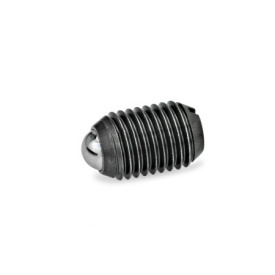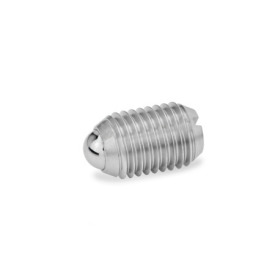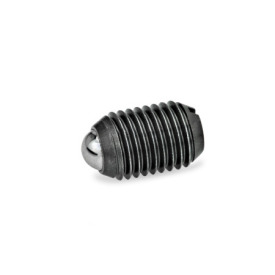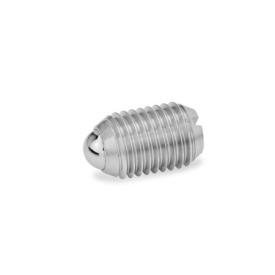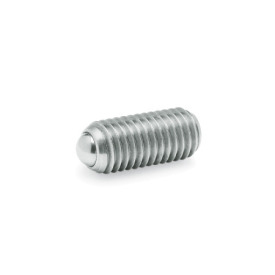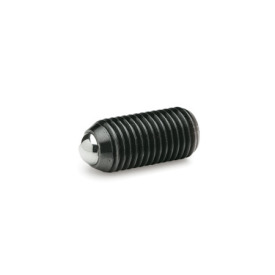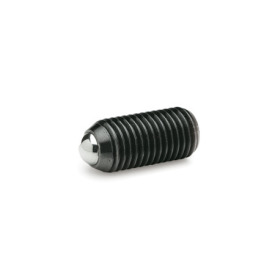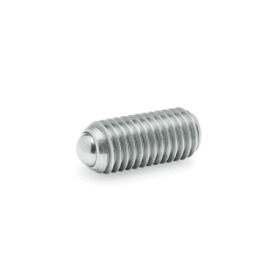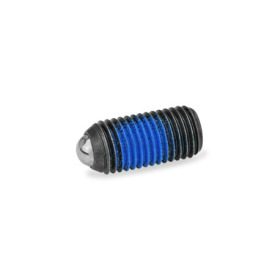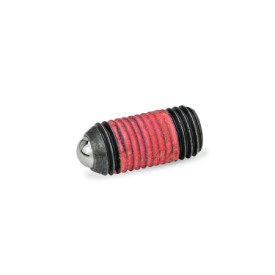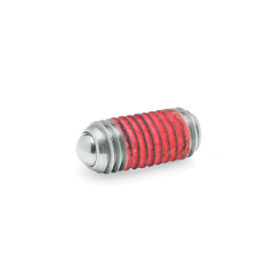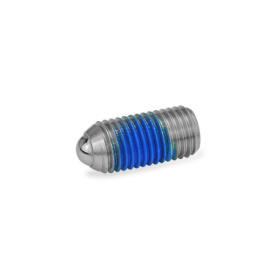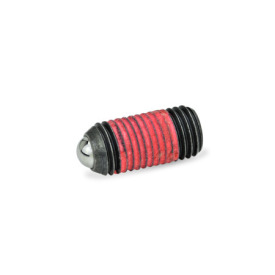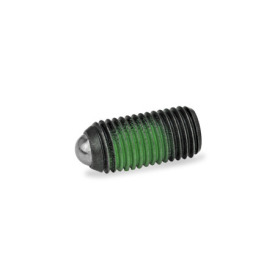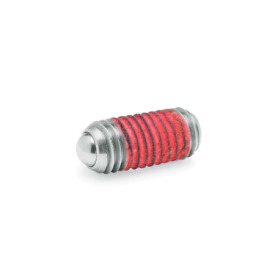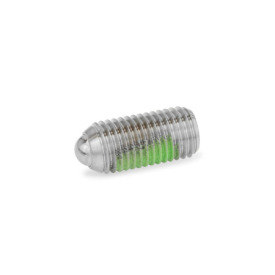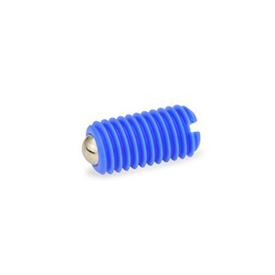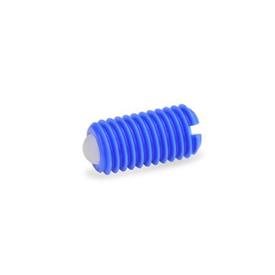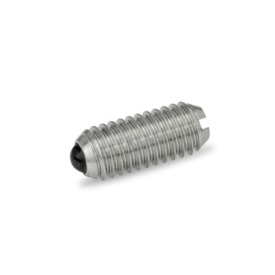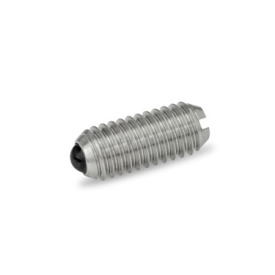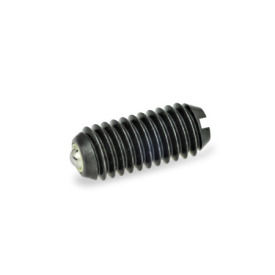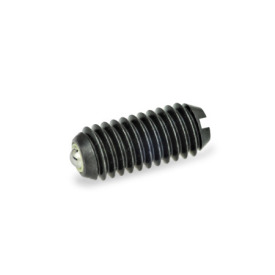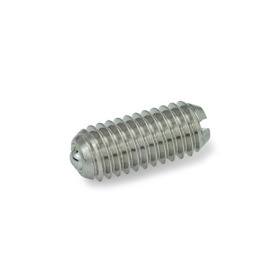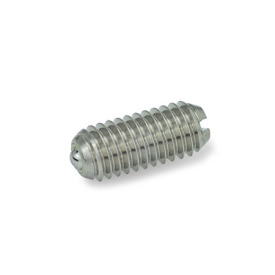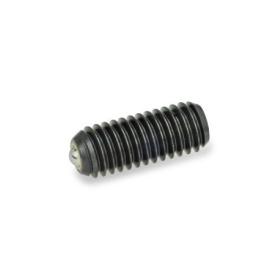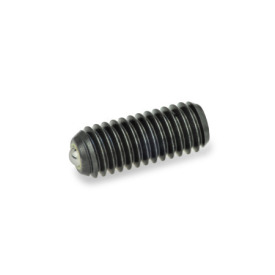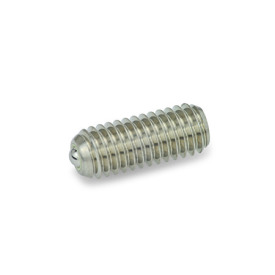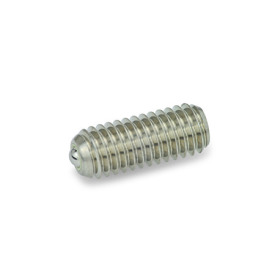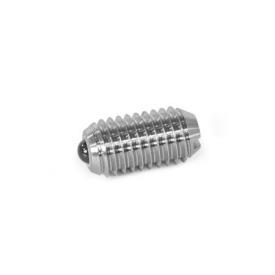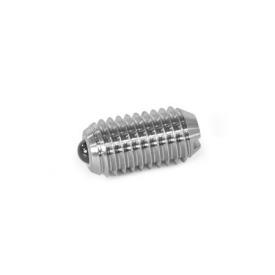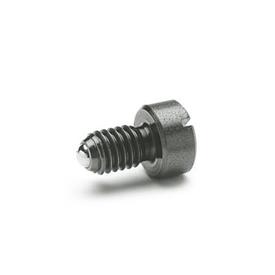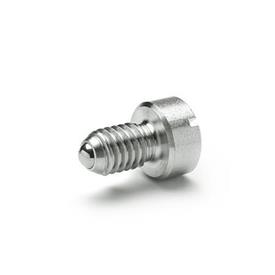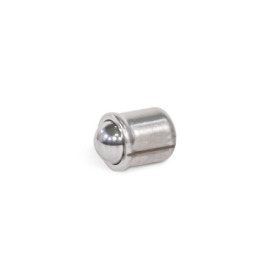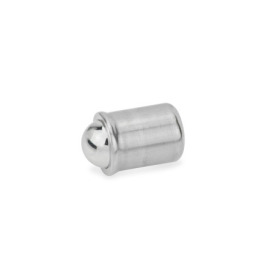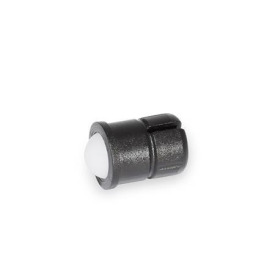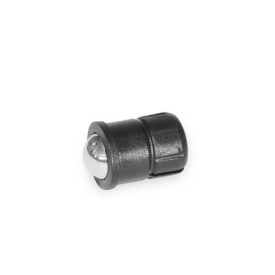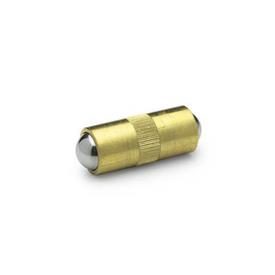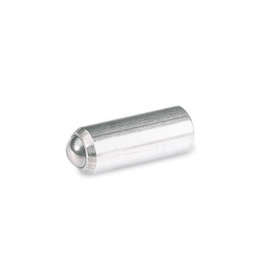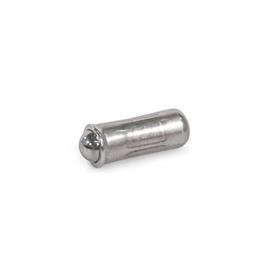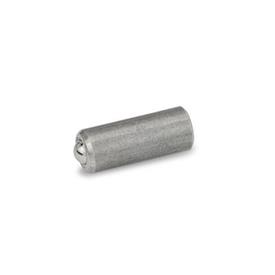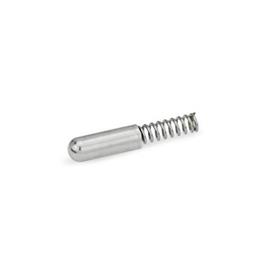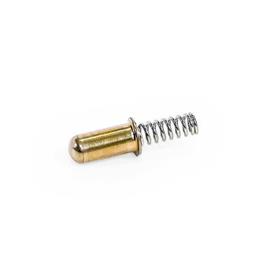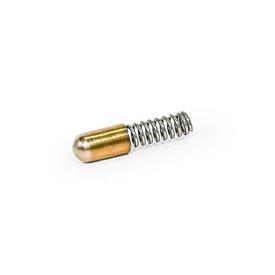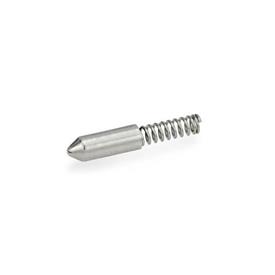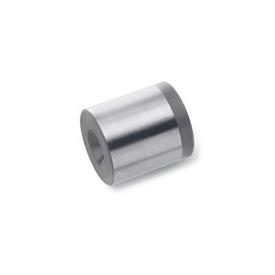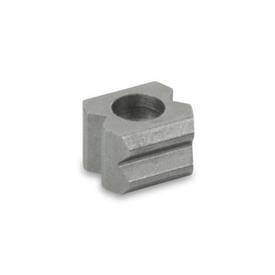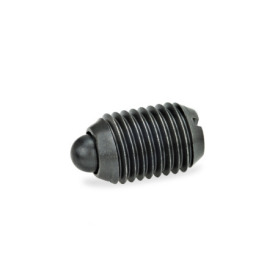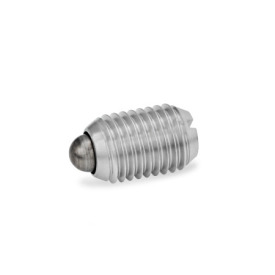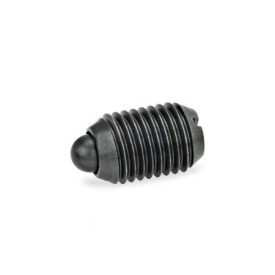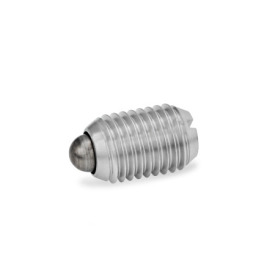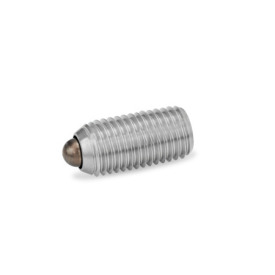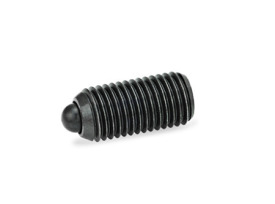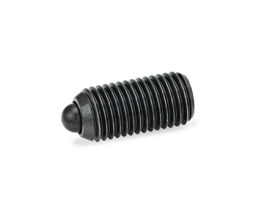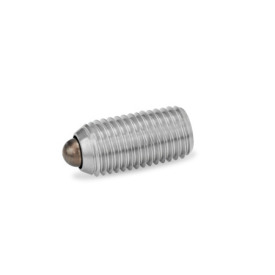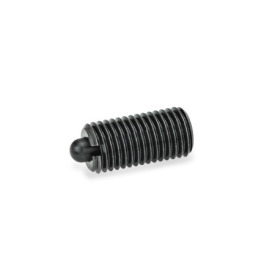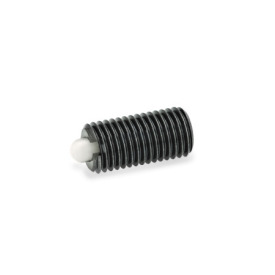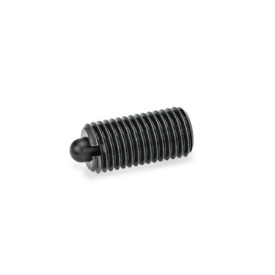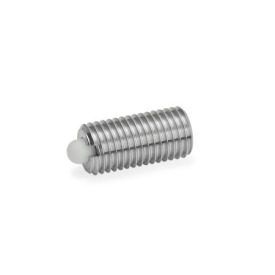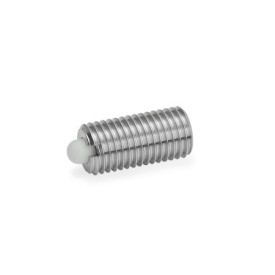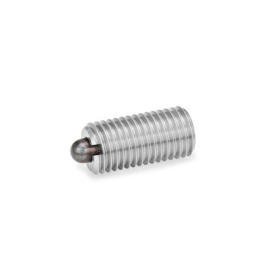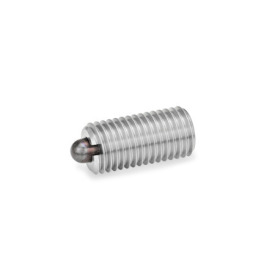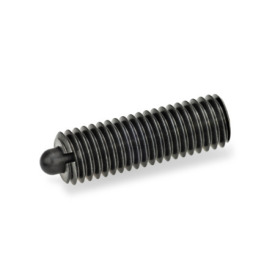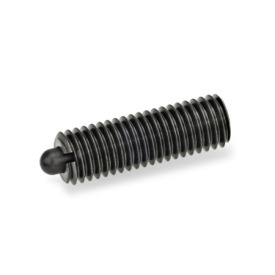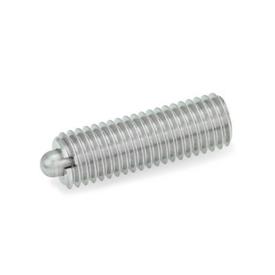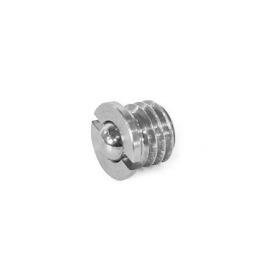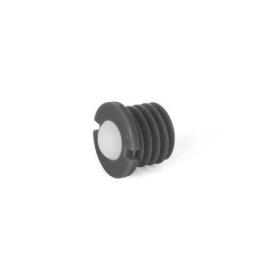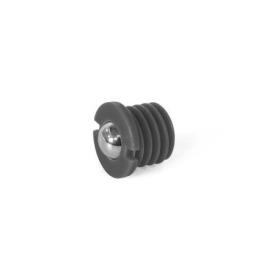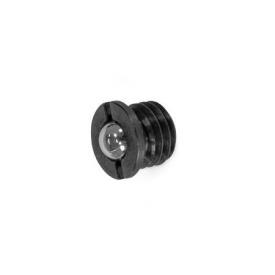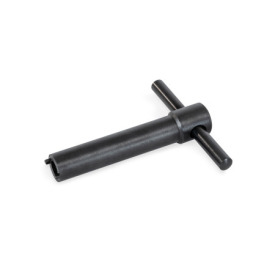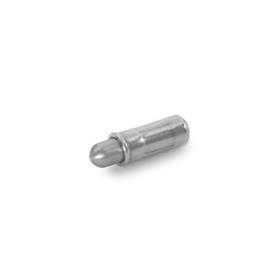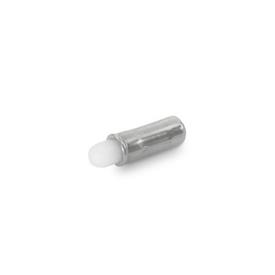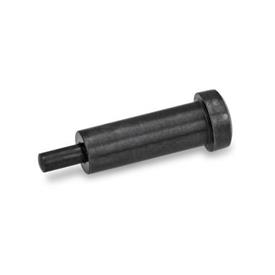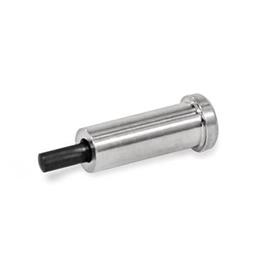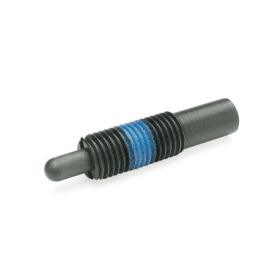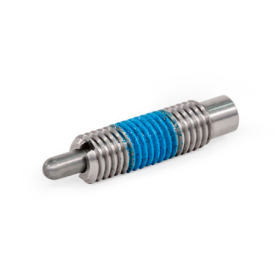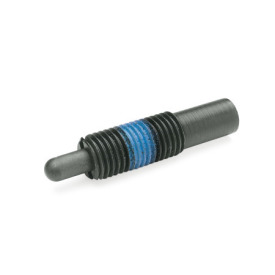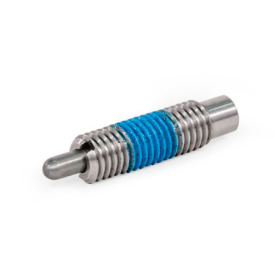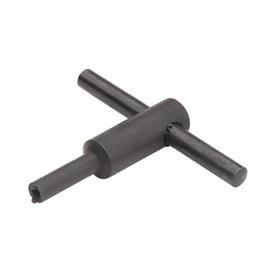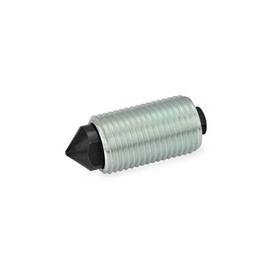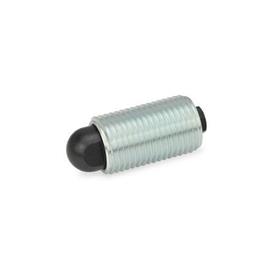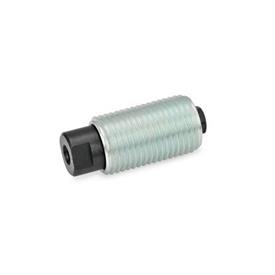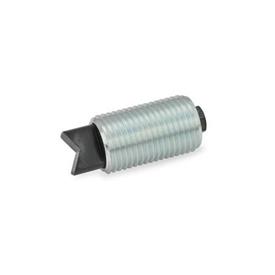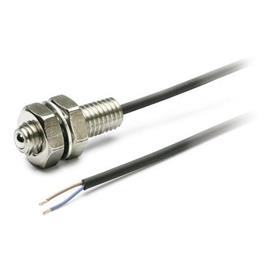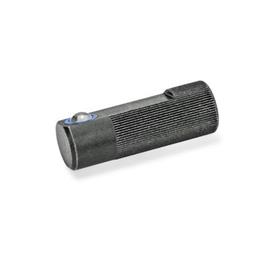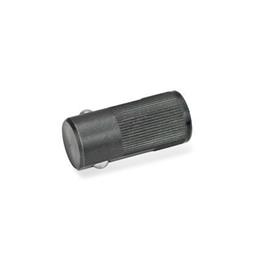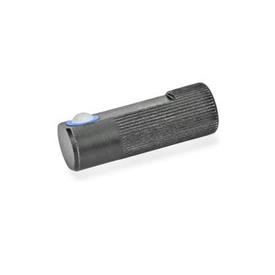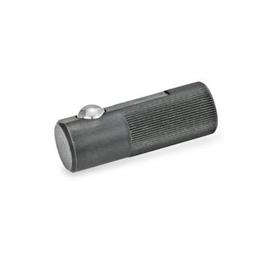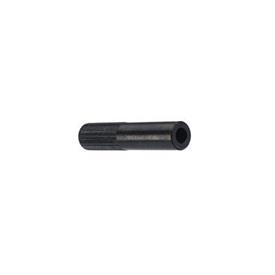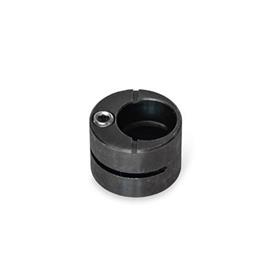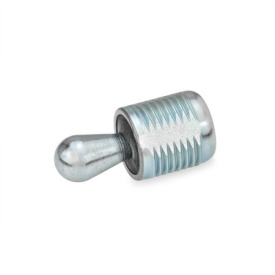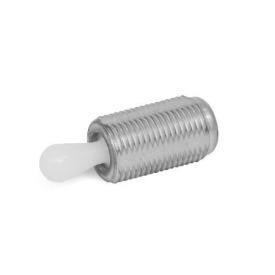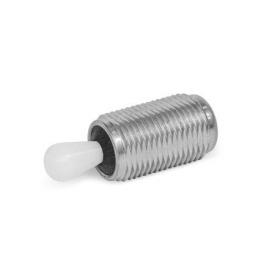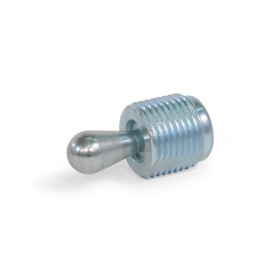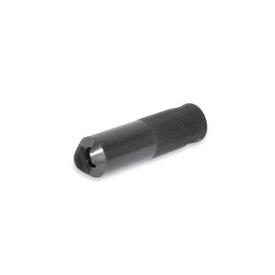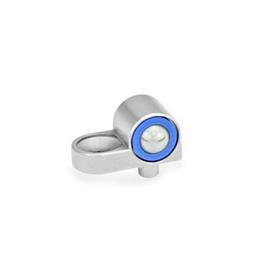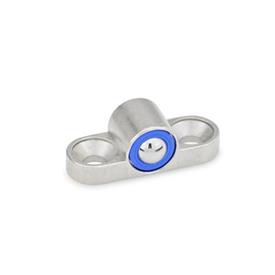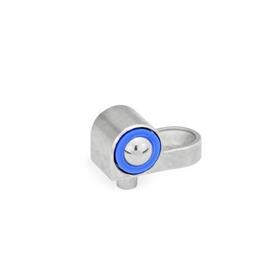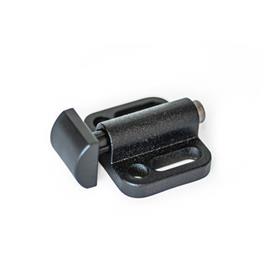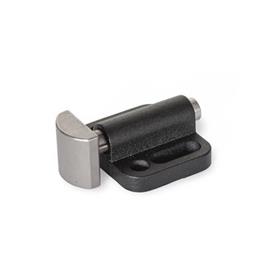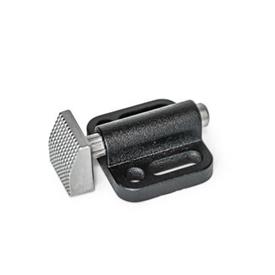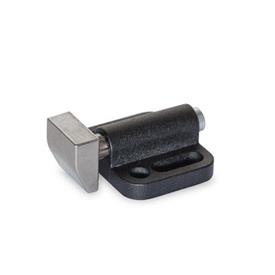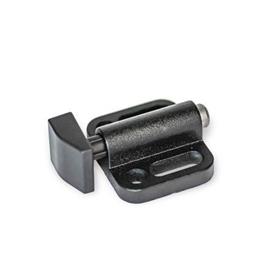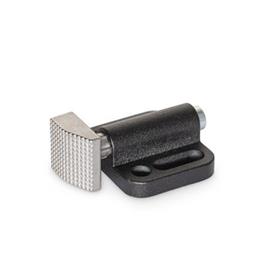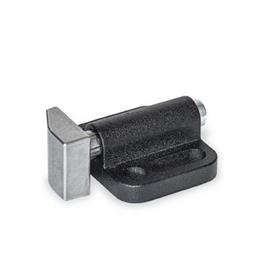
Un poussoir à ressort ou un poussoir à bille est une pièce standard qui est installée de façon permanente comme élément de serrage. Il se compose d'une vis creuse ou d'un manchon de pression avec un ressort intégré et une bille ou une goupille.
Un filetage ou un trou correspondant est nécessaire pour loger le piston. Vissé comme une vis normale ou enfoncé, le poussoir reste en permanence dans sa position. Les poussoirs à ressort peuvent être utilisés pour fixer différentes pièces dans des positions spécifiques les unes par rapport aux autres. L'une des parties maintient généralement le poussoir, tandis que la partie opposée présente une rainure ou un trou dans lequel s'engage l'élément de verrouillage. Les poussoirs à ressort sont utiles pour fixer des éléments coulissants tels qu'une broche de centrage. Pour ce faire, des rainures correspondantes sont fraisées dans la broche. Après l'enclenchement, les poussoirs à bille maintiennent les pièces concernées de façon suffisamment ferme pour que leur position relative ne change pas sous l'effet des vibrations. Lorsque les pièces sont activement déplacées hors de la position enclenchée, la bille du poussoir à ressort est poussée dans le manchon, libérant le loquet à came. Les utilisations typiques des poussoirs à ressort comprennent :
Il existe un vaste choix en une multitude de combinaisons de matériaux parmi lesquels choisir pour les poussoirs à ressort. Les manchons sont disponibles avec ou sans filetage et sont fabriqués en acier, en inox ou en plastique ; les billes sont également disponibles en céramique. Presque tous les poussoirs peuvent être équipés d'un ressort normal ou renforcé. Les conceptions comprennent des roulements à billes mobiles afin de réduire l'usure, des roulements en plastique pour l'isolation électrique ou le verrouillage des filetages intégrés. Avec cette large gamme de matériaux, de types et de tailles, Ganter peut fournir le bon poussoir à ressort pour quasiment chaque application. Les demandes spécifiques des clients, comme par ex. des matériaux ou des dimensions sur mesure, ne posent aucun problème.
Spring plungers are especially well suited for use as locking devices to securely lock, position, and secure movable components. Typical applications include securing adjustment elements, positioning workpieces in machining fixtures, and securely holding assemblies in defined positions – even under vibration. This allows the positions of mechanical components to be clearly defined and flexibly adjusted, significantly reducing the effort required for setup and operation.
By using spring plungers – such as those in the GN 615, GN 615.3, or GN 615.8 series – you can achieve repeatable securing of parts without the need for complex adjustment mechanisms. This improves usability and enhances process reliability during changeovers, setup, or positioning.
What this means in practice is that by using spring plungers, you can achieve a modular design and thus respond flexibly to changing requirements. This will significantly improve both the production reliability and operational safety of your system.
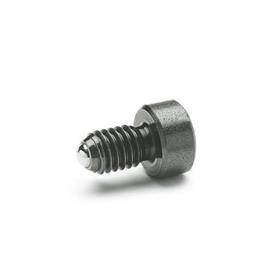
Spring plungers secure components using an integrated spring that pushes a ball or pin out of a sleeve or hollow screw. When the spring-loaded ball or pin is pressed against an opposing part, the spring yields. The ball or pin then locks into a bore, groove, or recess in the workpiece. Once the components are in the desired position, the spring force holds the element securely in place. This ensures that the situation remains stable even in case of vibrations or frequent changes.
Spring plungers enable the reliable positioning of adjustment elements, workpiece holders, or fixture components, and can be quickly released or moved as needed. This allows you to respond flexibly to changing production requirements and ensure a stable, defined stop position.
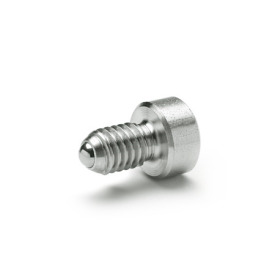
Spring plungers, such as those in the GN 615 series, are typically used to hold swivel arms, stops, or workpiece holders in the desired position. The simple operation saves time and improves operational reliability, as there are no loose parts and the locking device always engages automatically.
Spring plungers enable the secure and precise positioning of moving components. These usually consist of a sleeve or a hollow screw with an integrated spring and a ball or pin. Compared to other locking solutions, they stand out thanks to their easy installation in threads or bores, their compact design, and their high operational reliability, even under vibration or during repeated adjustments.
By using spring plungers such as GN 615, GN 815 or GN 616, you can securely and conveniently fasten adjustment elements, fixtures, or workpieces with repeatable accuracy. Installation is quick and easy, and adjustments can be made later with ease. Spring plungers offer practical advantages over knurled screws, hand levers, or positive connection pins, especially at high cycle rates or when settings need to be changed frequently.
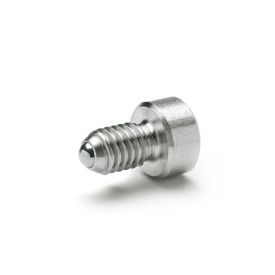
This allows you to ensure consistently precise and low-maintenance locking even under demanding conditions. The result is enhanced safety, user-friendliness, and efficiency for your applications.
Spring plungers are specifically designed to serve as compact, long-lasting locking devices that enable precise and secure positioning or locking of components. They consist of a sleeve with an integrated spring and a ball or a pin at the tip. The component is held in place at a single point either by the ball end or the pin, with the spring force acting constantly.
Spring plungers allow you to effectively tackle tasks that require quick automatic engagement, precise locking without manual operation, and a compact design. For simple locking that is intentionally released, however, indexing plungers or clamping indexing plungers are the appropriate choice.
Spring plungers are available in a wide variety of materials, allowing for flexible adaptation to different operating conditions. They are available in steel, stainless steel, or plastic versions. Additional components such as ceramic or plastic balls or pins, as well as special friction bearings, are used depending on type.
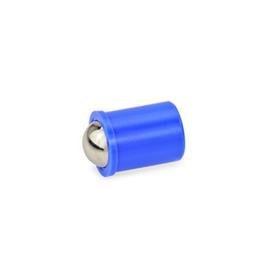
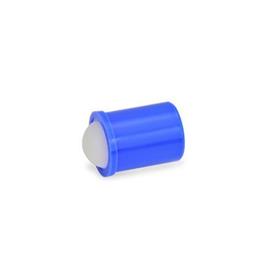
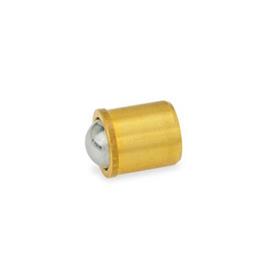
When selecting the appropriate spring rate for spring plungers, it is crucial that the contact pressure is precisely matched to your application. The spring rate determines how much force the locking mechanism exerts and how securely the component remains in position or locked – even in the presence of vibrations or frequent movements.
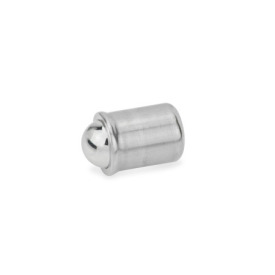
This allows you to adjust the amount of force required for operation directly to meet ergonomic or process-related requirements.
This allows you to tailor spring plungers precisely to ensure safety, ease of use, and component protection. You will benefit from improved ease of use and an extended service life of machines, fixtures, or adjustable assemblies.
If necessary, switch to a version with adjusted spring force, such as those available for the GN 615 (with ball), GN 615.8 (ball with friction bearing), or GN 615.3 (with thread locking). Always refer to the respective product data sheet for the exact spring force. Ganter Service can assist you in selecting an individual spring rate for demanding applications or special cases.
When it comes to spring plungers, a basic distinction is made between ball and pin designs. Both variants consist of a sleeve with an integrated spring, but they differ in the design of the moving part: In the ball version, this is a hardened ball; in the pin version, it is a cylindrical pin.
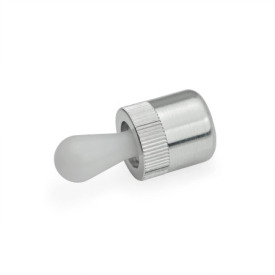
The choice between ball and pin designs for spring plungers determines whether the focus is on precise, point-to-point engagement and flexibility (ball) or on a positive connection for linear locking devices (pin). This way, you can be sure to always choose the best solution for your specific installation situation from both technical and cost perspectives.
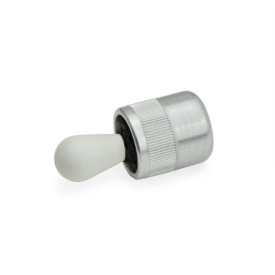
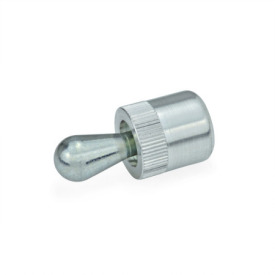
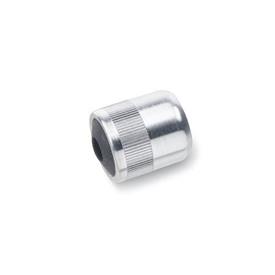
Spring plungers even ensure secure locking when subjected to vibrations. Spring plungers, such as the GN 615, GN 616 or GN 815 product series, consist of a sleeve or hollow screw with an integrated pressure spring and a ball or pin. This design ensures that the ball or pin always returns to the designated locking surface, even when the system is subjected to external vibrations.
You can therefore use spring plungers specifically in applications involving vibration and achieve maximum operational reliability. This makes it easy to operate, position, and latch components – even under demanding operating conditions.
Spring plungers made of stainless steel and those made with special ball materials are especially well suited for use at high temperatures or in corrosive environments. This means you can latch, position and lock components securely even in tough conditions, without compromising on performance or service life.
With spring plungers made of stainless steel or featuring ceramic balls, you can securely lock adjustment elements, workpieces, and fixtures in place – even when exposed to the elements or in contact with corrosive substances. This reduces maintenance requirements and prevents downtime. Ideal for use in mechanical engineering, the food industry, the chemical industry, and plant engineering, as well as for outdoor applications.
Spring plungers can generally be custom-made or modified to meet specific customer requirements. In addition to standard models featuring various sleeve, spring, and ball materials as well as different designs, Ganter offers customized product variants tailored to customer requirements. This allows you to have custom dimensions, alternative materials, or specific spring rates manufactured. Variants with specific features, such as electrical insulation, additional safeguards against loosening, or special surface coatings, are also available.
Individual customization ensures that the spring plunger is adapted precisely to your application. The available installation space can be optimally utilized, and specific requirements regarding corrosion resistance, electrical properties, or wear protection can be met. This enhances both the precision and reliability of your overall system – ideal for applications where standard parts do not cover all the technical criteria.
This allows you to respond flexibly and confidently to project-specific challenges. Direct contact with Ganter allows for technical coordination and provides you with planning certainty in finding the right custom spring plunger solutions