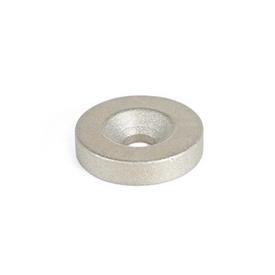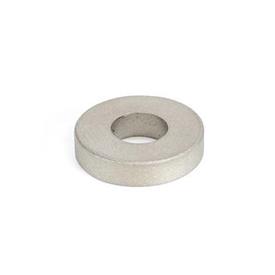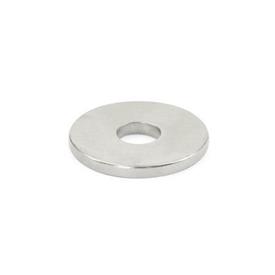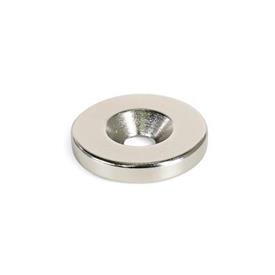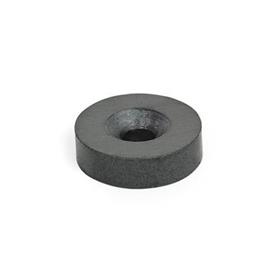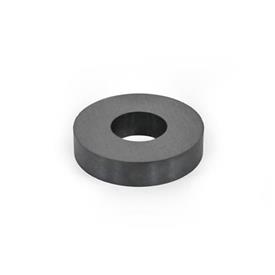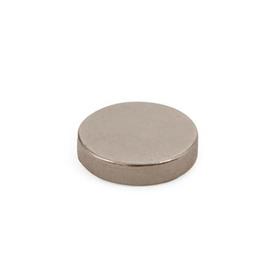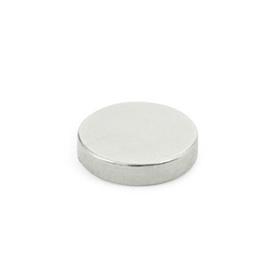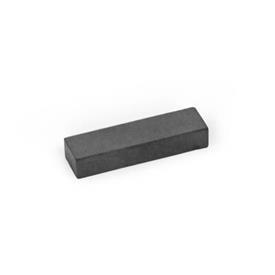
Imanes en bruto

Los imanes en bruto son adecuados para crear sistemas magnéticos específicos cuando no pueden usarse sistemas magnéticos estándar. Se recomienda el uso de un soporte adecuado que desvíe, agrupe y refuerce el flujo magnético.

FAQ - Preguntas frecuentes

Filtrar productos
Material magnético
Fuerzas adhesivas en N (de - a) Fuerzas adhesivas en N
Temperatura de trabajo (de - a) Temperatura de trabajo

¿No encontró lo que buscaba? Solicitudes especiales

FAQ - Preguntas frecuentes

What are raw magnets and which applications are they especially well suited for?

Raw magnets are untreated permanent magnets that are used especially for the construction of individual magnet systems. They are used wherever standard magnetic solutions do not fit structurally or where special integration requirements apply.

Ganter’s raw magnets – for example, as GN 55.1 (disk-shaped, with or without bore/countersink, depending on the material), GN 55.2 (disk-shaped), GN 55.3 (rod-shaped) and GN 55.4 (block-shaped) – are available in various materials: samarium-cobalt, neodymium-iron-boron, hard ferrite and aluminum-nickel-cobalt.

Concrete application examples for raw magnets

  • Format adjustment in packaging machines: GN 55.1 neodymium disc magnets can be used to design adjustable sensor holders that can be flexibly integrated into guide rails or support profiles. This allows position sensors to operate reliably, even with changing formats.
  • Quick change systems for assembly setups: Use GN 55.4 block magnets made of samarium-cobalt when high temperature stability and fast, tool-free fixing to steel plates are required. This saves time when retooling and increases process reliability.
  • End position damping or querying in linear axes: GN 55.3 bar magnets are especially suitable when there is little space in slim aluminum profiles – such as for activating reed switches or as passive damping elements.
  • Filtration and separation systems in conveyor technology: GN 55.2 hard ferrite disc magnets can be used to build individually designed magnetic grids or grates that reliably remove metallic foreign parts from bulk materials. The corrosion resistance of hard ferrite is an advantage here.

Advantages and benefits of raw magnets

  • High flexibility as you can place the magnet exactly according to design requirements or install it in a housing
  • Selection of suitable magnetic materials for special requirements: such as corrosion resistance (hard ferrite), high magnetic force (neodymium-iron-boron), high temperature stability (samarium-cobalt)
  • With integration into a dedicated design, the magnetic flux can be specifically controlled – so you can achieve the desired holding or acting forces even in difficult installation situations
  • Ideal for replacing standard solutions that do not offer an optimal mechanical or functional fit

What advantages do raw magnets offer over standardized magnet systems in construction?

Raw magnets offer an important advantage in design: They can be adapted exactly to the specific requirements of your project. In contrast to standardized magnet systems, raw magnets can be integrated into individual receiving structures to ensure exactly the right shape, magnetic flux, and holding force. This allows you to realize a powerful and reliable solution even if standard products do not fit the existing installation situation or the offer required properties.

Advantages of raw magnets in the construction environment

  • Flexible integration: Raw magnets such as GN 55.1, GN 55.2, GN 55.3, and GN 55.4 are available in various shapes (disk, block, rod) and magnetic materials. This allows you to select the right material and the optimal design – such as high remanence for neodymium-iron-boron or temperature stability for samarium-cobalt.
  • Customization: With raw magnets, you decide for yourself how the magnet is embedded in your components. Magnetic flux and holding force can be controlled with precision by design measures such as shielding, deflection, or reinforcement.
  • Better use of space: You integrate the magnet directly into your construction. This saves installation space and enables compact, functional assemblies.
  • Maximum design freedom: Whether hard-to-reach locations, complex geometries, or special installation positions – raw magnets adapt to your specifications, not the other way around.

What does this mean in practice?

Raw magnets such as the neodymium-iron-boron GN 55.1, for example, allow you to arrange magnetic holding points in mechanical devices in a space-saving manner, exactly where they are technically required. For applications with increased temperature requirements, you benefit from raw samarium-cobalt magnets (GN 55.2, GN 55.4) or aluminum-nickel-cobalt (GN 55.3), as they function reliably even at high operating temperatures. This allows you to easily and economically implement even highly specialized applications.

Raw magnets are ideal when maximum flexibility, technical precision, and individual implementation are required. This allows you to react quickly and effectively to design challenges.

What materials and shapes are available for raw magnets?

Various materials and geometries are available within the raw magnet product family. You can flexibly choose the right combination for customer-specific magnet systems. This allows you to optimally match raw magnets to your design and functional requirements.

Raw magnet materials

  • Samarium-cobalt (SmCo): Highly resistant to demagnetization, corrosion-resistant, and ideal for high operating temperatures.
  • Neodymium-iron-boron (NdFeB): Very high magnetic performance, compact design, frequently used in mechanical and plant engineering.
  • Hard ferrite: Affordable, resistant to many chemical influences, well suited for harsh environments.
  • Aluminum-nickel-cobalt (AlNiCo): Durable, high temperature resistance, preferred for rod-shaped magnet systems.

This makes it possible to find a technically suitable solution for any application – for example, when the focus is on extreme magnetic forces, temperature resistance, or corrosion resistance.

Shapes of raw magnets

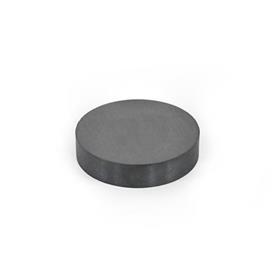
  • Disk-shaped: Available in samarium-cobalt, neodymium-iron-boron and hard ferrite as well as with or without bore/countersink (GN 55.1, GN 55.2).
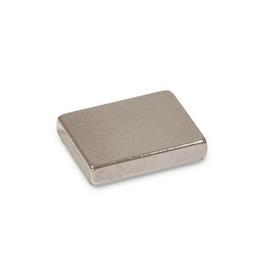
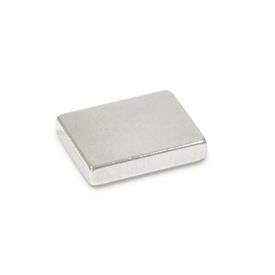
  • Block-shaped: Available in samarium-cobalt, neodymium-iron-boron and hard ferrite (GN 55.4).
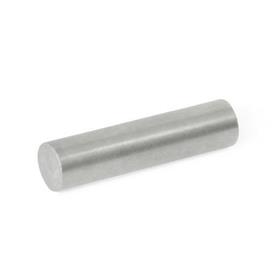
  • Rod-shaped: Made of aluminum-nickel-cobalt for elongated setups (GN 55.3).

This allows you to use raw magnets in circular, rectangular or rod-shaped geometries and integrate them flexibly into your design – for such purposes as sensor holders, measuring systems, or special devices.

Overview: Suitable Ganter standards for raw magnets

  • **GN 55.1: Disk-shaped, with bore/countersink ** – samarium-cobalt, neodymium-iron-boron, hard ferrite
  • **GN 55.2: Disk-shaped ** – samarium-cobalt, neodymium-iron-boron, hard ferrite
  • GN 55.3: Rod-shaped – aluminum-nickel-cobalt
  • GN 55.4: Block-shaped – samarium-cobalt, neodymium-iron-boron, hard ferrite

This means that standardized raw magnets in a wide variety of designs are available for your design solution. You can assemble the optimal combination of materials and shapes for almost any technical requirement.

What factors should be considered when designing a magnet system with raw magnets?

When designing a magnet system with raw magnets, it is crucial to pay attention to the type of magnet, the design, and the integration of the magnet into the application. Raw magnets such as types GN 55.1, GN 55.2, GN 55.3, and GN 55.4 offer various materials (e.g. neodymium-iron-boron, samarium-cobalt, hard ferrite, aluminum-nickel-cobalt) as well as various geometries (disk-shaped, block-shaped, rod-shaped), so you can specifically address your design requirements.

Key factors in selecting raw magnets

  • Material characteristics: The raw magnet types differ in magnetic material:
    • Neodymium-iron-boron magnets (e.g. GN 55.1, GN 55.2, GN 55.4) offer very high magnetic forces but are more sensitive to external influences.
    • Samarium-cobalt magnets (GN 55.1, GN 55.2, GN 55.4) offer good temperature resistance and corrosion resistance.
    • Hard ferrite (GN 55.1, GN 55.2, GN 55.4) is inexpensive and robust but has a lower magnetic force.
    • Aluminum-nickel-cobalt magnets (GN 55.3) are thermally stable and resistant to deformation.
  • Design and magnetization: Geometry is crucial for the alignment of the magnetic field. Raw magnets in disk, block or rod shape can be optimally adapted to your installation situation. Different shapes allow precise control of magnetic flux and holding force.
  • Integration and deflection of the magnetic field: The raw magnet is installed in a metallic receiving structure that specifically concentrates and amplifies the magnetic field. Make sure the design allows for the desired holding forces and prevents interaction with surrounding components. This allows you to effectively tailor the performance of the magnet system to your application.
  • Mechanical integration: Variants with bore or countersink (e.g. GN 55.1 with bore/countersink) facilitate secure and accurate fastening in the system. As a result, the magnet can be mounted in a convenient and repeatable manner, which is particularly advantageous during replacement or maintenance.

Practical aspects and application instructions for raw magnets

The right selection and arrangement of raw magnets allows you to realize custom magnet systems that are not available as standard solutions. Ideal for assembly setups, sensor connections, or precision mechanics, such as where the magnetic force must be specifically matched to the workpiece. By thoughtfully integrating the magnet into your design, you can react flexibly to design specifications and space restrictions.

Thanks to the ability to freely select the magnet shape and material, you can independently define the essential parameters of your magnetic system – to achieve secure holding forces and reliable functioning even under changing environmental conditions.

What versions and size variants are available for raw magnets?

A wide range of raw magnets are available from Ganter to support the construction of individual magnet systems. You will find versions in different shapes, magnetic materials, and dimensions. This allows you to flexibly meet your requirements with significantly more freedom for integrating the magnets into your own designs than would be available with standard solutions.

Versions and designs of raw magnets

  • Disk-shaped (with and without bore or countersink)
  • Block-shaped
  • Rod-shaped

Available materials

  • Samarium-cobalt (SmCo)
  • Neodymium-iron-boron (NdFeB)
  • Hard ferrite
  • Aluminum-nickel-cobalt (AlNiCo )

Size variants at a glance

  • The raw magnets GN 55.1 (disk-shaped) are available in different diameters from 6 - 102 mm and heights from 3 - 22 mm – with optional bore or countersink. You can choose between samarium-cobalt, neodymium-iron-boron and hard ferrite.
  • GN 55.2 includes raw disc magnets without bore (samarium-cobalt, neodymium-iron-boron, hard ferrite) in various diameters of 2 - 108 mm and thicknesses of 1 - 21 mm.
  • GN 55.3 (AlNiCo, rod-shaped) offers various lengths of 10 - 80 mm and diameters of 3 - 34 mm, ideal when elongated magnet bodies are required.
  • GN 55.4 are raw magnets with a block shape (samarium-cobalt, neodymium-iron-boron, hard ferrite) that are available in various cross-sectional dimensions and heights of 1.5 - 9.8 mm.

Recommendation for your selection

  1. First determine the required shape (disk, block, rod) and any mounting options such as bore/countersink.
  2. Choose the right magnetic material depending on the desired holding force and environment.
  3. Compare the available size variants of the respective standard parts GN 55.1, GN 55.2, GN 55.3, and GN 55.4 on the product page or in the catalog to select the optimal solution.

This allows you to react flexibly to any design requirement and obtain reliable, custom-made magnet holders.

Are there any restrictions on the use of raw magnets in certain environments (e.g. high humidity, aggressive media, or high operating temperatures)?

Raw magnets, such as those offered in the GN 55.1, GN 55.2, GN 55.3, and GN 55.4 product families, are untreated permanent magnets. Caution is advised when using the product in environments with high humidity, corrosive substances, or high temperatures, as the product behavior can vary significantly depending on the type of material. Choose the model that best suits your specific application to avoid subsequent damage or loss of functionality.

Limitations on the use of raw magnets

  • Neodymium-iron-boron: These magnets have a very high magnetic power but are sensitive to corrosion. Even normal humidity can lead to oxidation, which impairs the magnetic force and function in the long run. In a humid or aggressive atmosphere, use is only advisable with additional protection (e.g. enclosure, waterproofing).
  • Samarium cobalt: Samarium-cobalt magnets are relatively corrosion resistant, making them better suited for harsh environments. Nevertheless, it is advisable to resort to a suitable protective construction for aggressive media in order to prolong the service life.
  • Hard ferrite: These magnets are especially resistant to moisture and many chemical substances. This makes them the safest choice if the environment is very corrosive. However, the magnetic force remains moderate.
  • Aluminium-nickel-cobalt: These raw magnets are resistant to moisture, but aggressive, alkaline substances can corrode the material. Protection should be provided for applications in such conditions.

Recommendation for choosing raw magnets

  • Choose hard ferrite or samarium-cobalt raw magnets if corrosion resistance is a top priority.
  • Always employ protective measures against moisture and aggressive media for raw neodymium magnets.
  • Select aluminum-nickel-cobalt magnets for use at high temperatures
  • Plan additional measures such as seals, coatings, or special receptacles when the environment is aggressive.

Careful selection of the right magnet material allows you to reliably ensure already at the design stage that your system will function continuously even under difficult conditions.

How can raw magnets be integrated into customer-specific receiving structures?

Raw magnets provide a flexible basis for implementing individual magnet systems. They can be precisely integrated into customer-specific mounting assemblies by mechanically mounting and securing the magnet itself, while the structure of the design provides additional protection. This allows you to direct and concentrate the magnetic flux in a targeted manner and to adapt the holding force exactly to the specific application. The resulting magnet assemblies can be optimally matched to your specific geometry and functional requirements.

Typical approach for integrating raw magnets

  • Choose the suitable type of raw magnet (e.g. disk-shaped GN 55.1 or GN 55.2, rod-shaped GN 55.3, or block-shaped GN 55.4) that is optimally suited to your design environment due to dimensions and magnetic material.
  • Place the raw magnet in a mount or housing made of a suitable material (e.g. steel or a non-magnetic material) to secure it mechanically, glue it in place if necessary, and effectively protect it from environmental influences.
  • Use specific designs such as magnets with bores or countersinks (e.g. GN 55.1) to allow direct screwing or fastening in the construction.
  • Use additional attachments, yoke plates or panels to guide the magnetic flux in a targeted manner to establish the desired holding force and zone of action.

Advantages of integrating raw magnets

  • Maximum design freedom by freely selecting the size, shape, and positioning of the magnet in the system.
  • Efficient use of magnets by focusing the magnetic flux on the specifically required effective area to minimize losses.
  • Ensuring protection against damage as the sensitive raw magnet can be mechanically embedded and protected from impacts or corrosion.
  • Individual functional adjustment, ideal for applications where standard magnetic systems do not fit structurally or where there are special requirements.

With raw magnets, individual magnet systems can be set up simply and reliably. For example, you can respond specifically to the need for flexible or special design solutions in automation technology, device construction, or sensor applications.

What information is needed for a customer-specific design of raw magnets?

For the customer-specific design of raw magnets, it is particularly important to provide information on the planned application, the desired magnetic properties, and the installation conditions. This allows you to ensure that the selected raw magnet fits optimally into your magnet system and that the required holding or acting forces are reliably achieved.

Important information for the design of raw magnets

  • Desired shape and dimensions (disk-shaped, block-shaped, rod-shaped; diameter, length, width, height; bore/countersink)
  • Choice of materials: Neodymium-iron-boron, samarium-cobalt, hard ferrite, or AlNiCo – depending on the requirements for holding force, resistance to external influences, and temperature stability
  • Required holding force or required magnetic field at the intended site of use
  • Assembly integration: Type of installation (e.g. bore, countersink, press-fit) and connection to metallic or non-metallic components
  • Magnetization direction (axial, diametric, longitudinal, transverse, etc.) so that the magnet optimally brings its effective surface to bear
  • Environmental conditions, such as mechanical stress, humidity, contact with chemicals or special media

What does this mean in practice?

The precise specification of these parameters makes it possible to select the right magnet from the range of raw magnets – for example GN 55.1 (disk-shaped in various magnet materials), GN 55.2 (disk-shaped without bore), GN 55.3 (rod-shaped, AlNiCo) or GN 55.4 (block-shaped) – or to develop an individual solution.

This allows you to design your magnet to fit optimally into your system and direct the magnetic force to the desired area. In this way, you can reliably and economically ensure the functioning of your overall system – even if standard solutions do not fit into your design. Ideal for complex assemblies where installation space, magnetic force, and integration must be precisely coordinated.

If you have any technical questions about products, applications, or designs, our technical sales team will be happy to assist you at +49 7723 6507-259

What nominal magnetic forces can raw magnets from Ganter provide?

The nominal magnetic force of a raw magnet indicates the maximum force with which the magnet adheres to a thick, flat, and clean steel plate under ideal conditions. With Ganter raw magnets, the nominal magnetic force varies depending on:

  • Magnetic material (neodymium, SmCo, ferrite)
  • Size (diameter and height)
  • Magnetization
  • Installation situation

Ganter offers raw magnets with a maximum nominal magnetic force of up to 240 N (≈ 24 kg).

Newton to kilogram conversion

Newton (N) is a force, kilogram (kg) is a mass. For the conversion, the acceleration due to gravity g = 9.81 m/s2 is used.

Formula: kg = N / 9.81

or vice versa N = kg × 9.81

Why buy raw magnets from Ganter?

Ganter raw magnets stand for the highest quality, technical expertise, and reliable availability. As a manufacturer with over 125 years of experience in the development and production of standard parts, Ganter offers solutions that are used worldwide in a wide variety of applications and industries.

Your advantages at a glance:

  • High delivery availability: Around 98% of the product range is available directly from stock to ensure short delivery times.
  • Internationally established: With partners in more than 80 countries, Ganter ensures worldwide support and reliable supply chains.
  • Made in Germany: Development and production take place in accordance with the highest quality standards in Germany.
  • Sustainability and durability: For over 125 years, Ganter has stood for long-term thinking, responsible action, and continuous innovation.
  • Convenient procurement: All raw magnets can be ordered easily and conveniently via the Ganter webshop.
  • CAD data in reliable quality, available free of charge and as a direct download without registration.
  • Personal consultation on site: Our field service team is available to provide competent assistance if you need any help with the selection or implementation of your project. Further information and contact persons can be found on our Contact page.
  • Technical support: For technical questions regarding products, applications, or designs, our technical sales team will be happy to assist you at the phone number +49 7723 6507-259.

When you choose Ganter, you’re choosing durable and precise solutions, as well as an experienced partner who will support you from the planning stage through to the completion of your project.

Su persona de contacto

¿Busca un socio de Ganter próximo a su localidad? Seleccione su país.

Servicio de Ganter

Nuestro equipo de servicio está disponible de lunes a viernes, entre las 7:30 AM – 5:00 PM

Solicite que le devuelvan la llamada