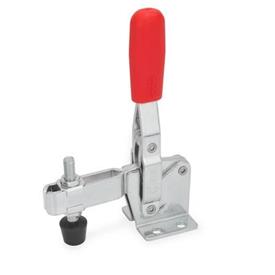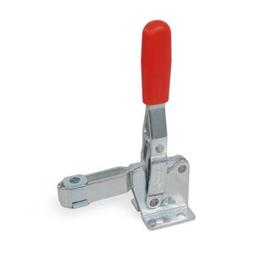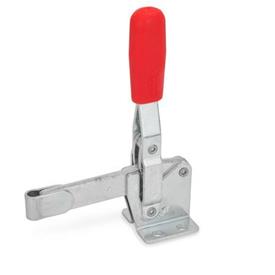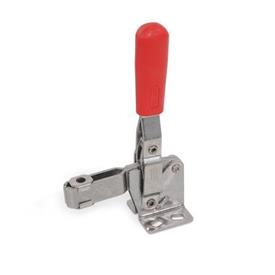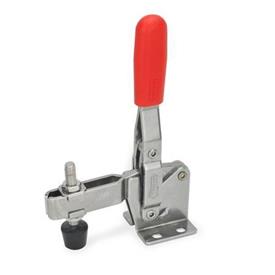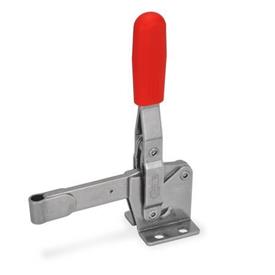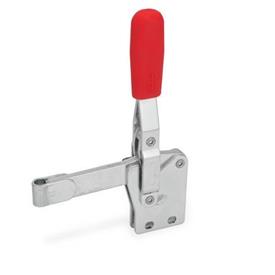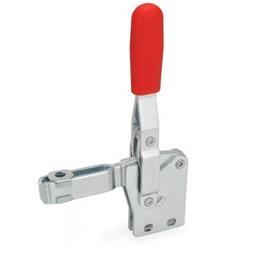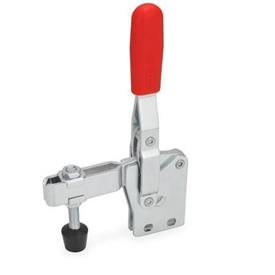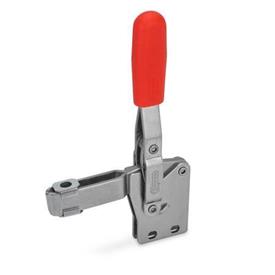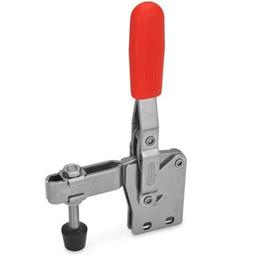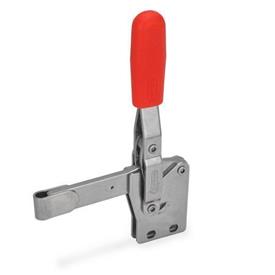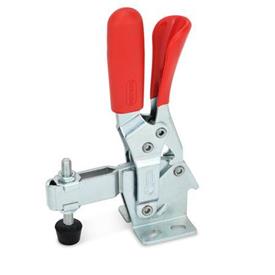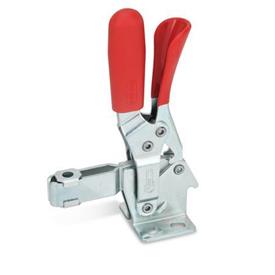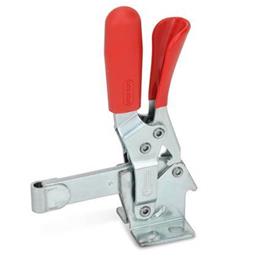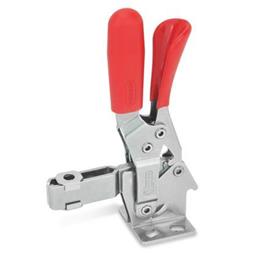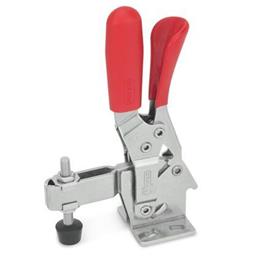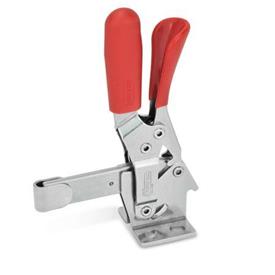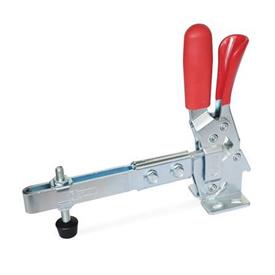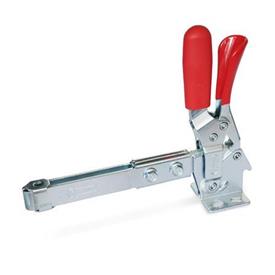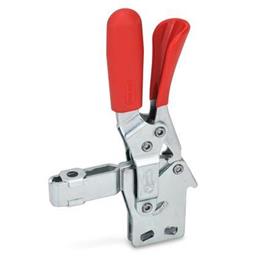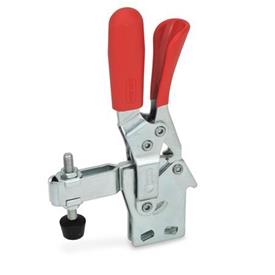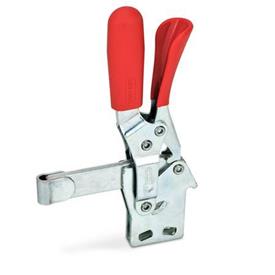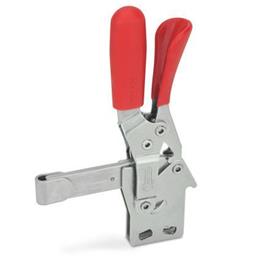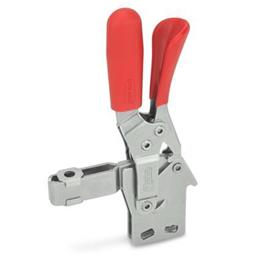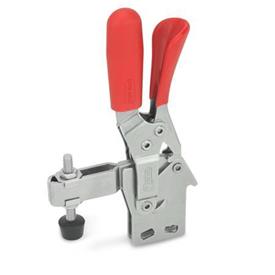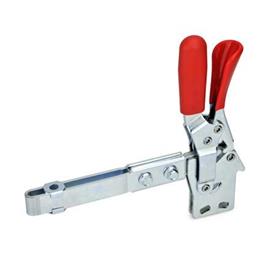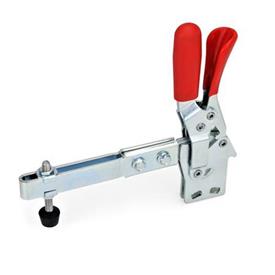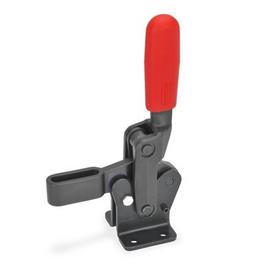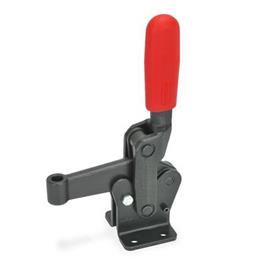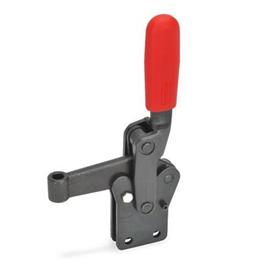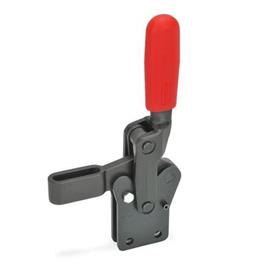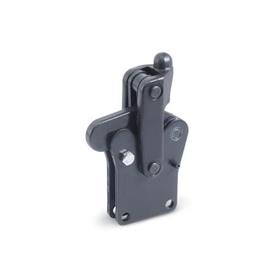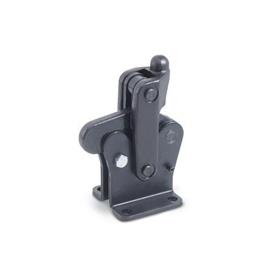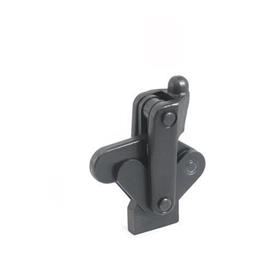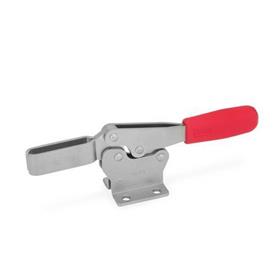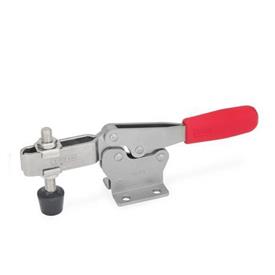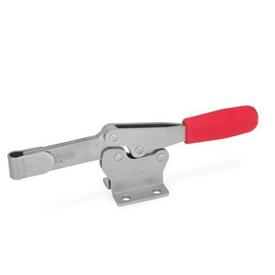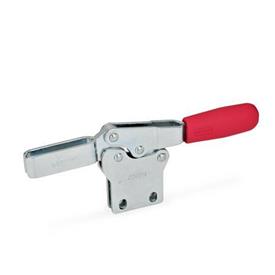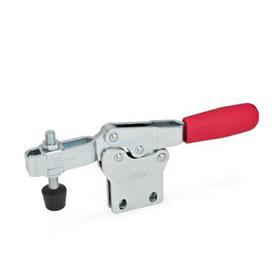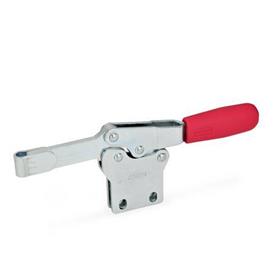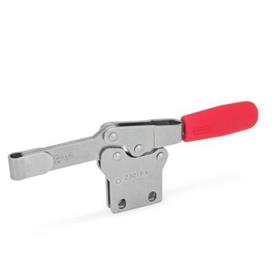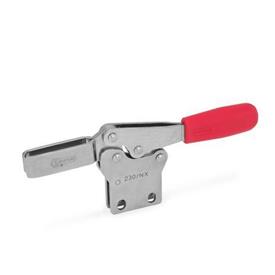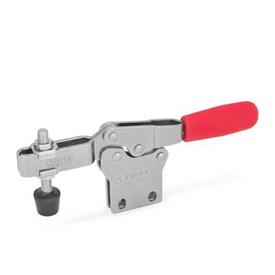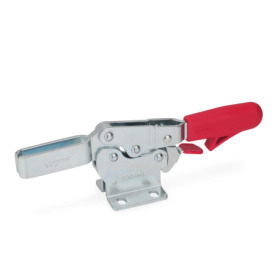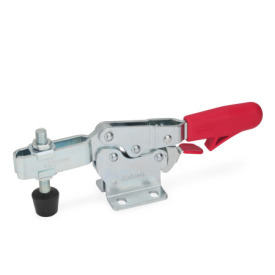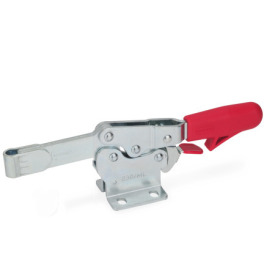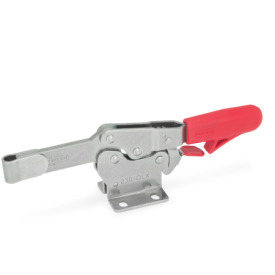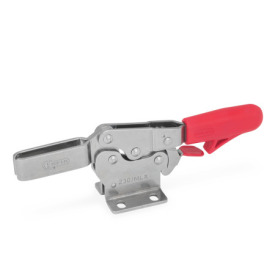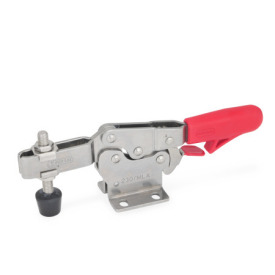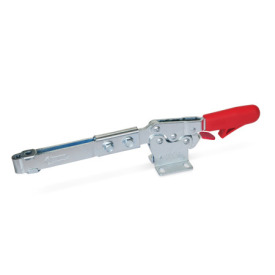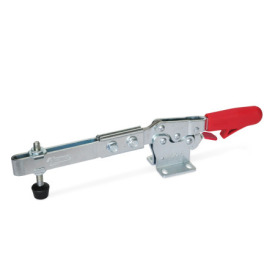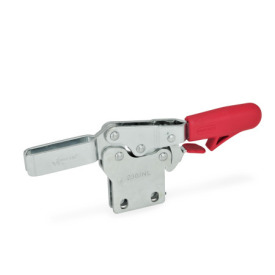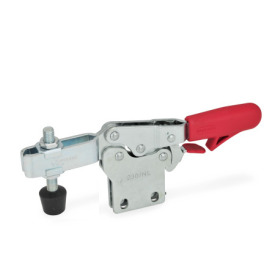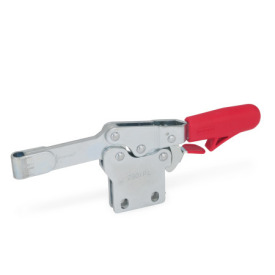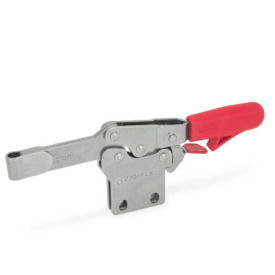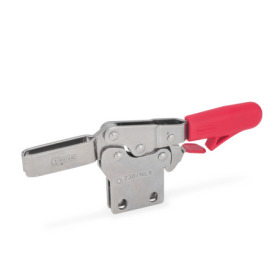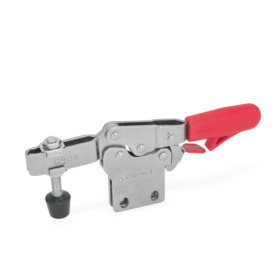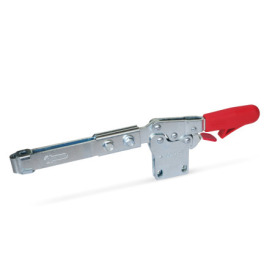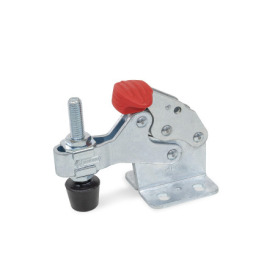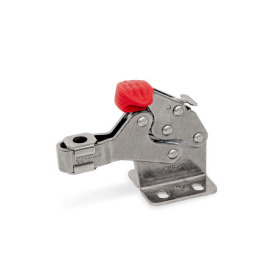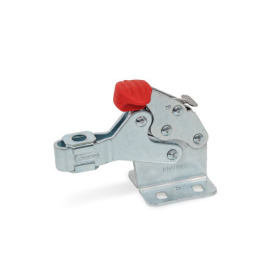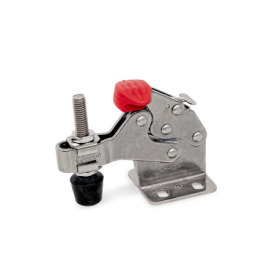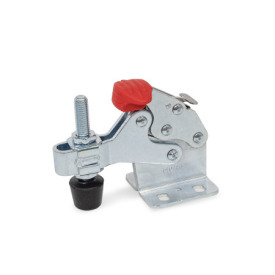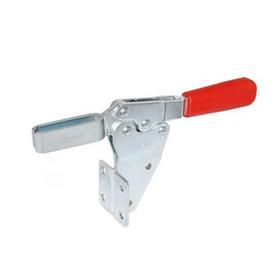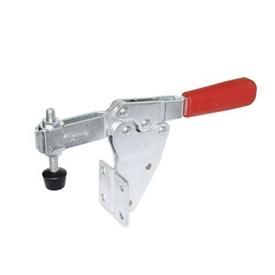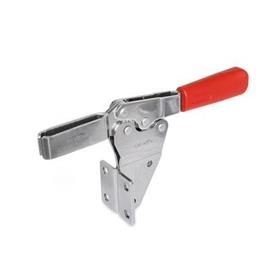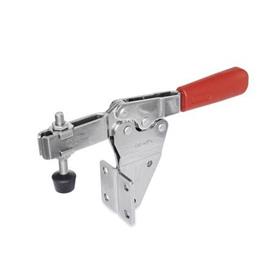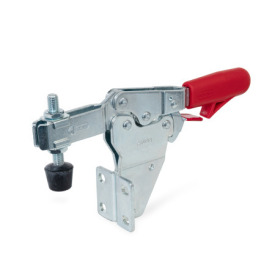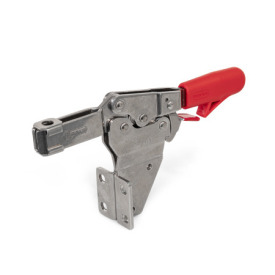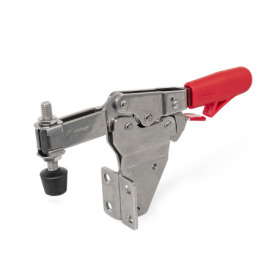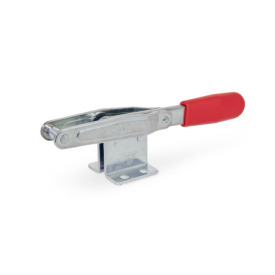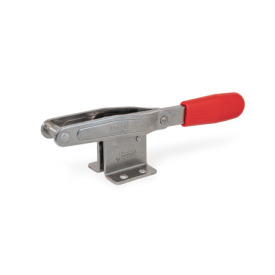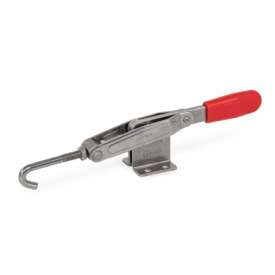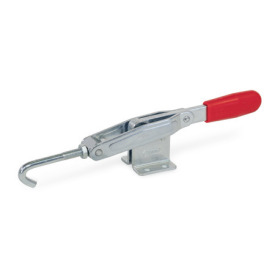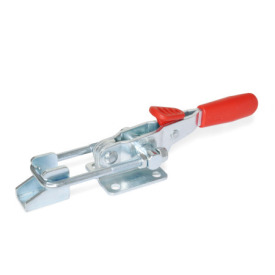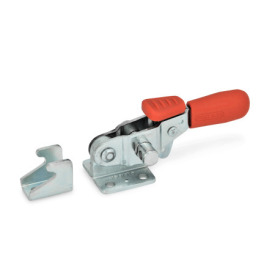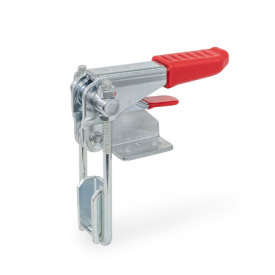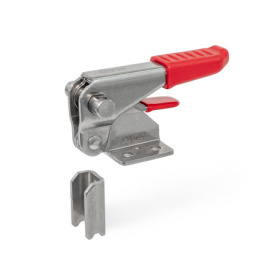
Toggle clamps for secure fastening and closing

Toggle clamps are used in machine construction and in industry for securely fastening or closing movable parts.

These standard parts are manually operated clamping systems that typically function according to the toggle lever principle and are also known as toggle lever clamps.

Functioning of toggle clamps

Toggle clamps consist of a lever that operates a clamping arm by means of a toggle lever mechanism. When operated, the large motion of the operating lever is translated into a small motion of the clamping arm. This movement overcomes the lever dead center, causing the clamp to lock securely into place. The workpiece is then held fast to its position with great force. The holding force is a characteristic value of every toggle clamp. It depends on the size of the clamp and the position of the clamping bolt on the clamping arm.
Applications of toggle clamps

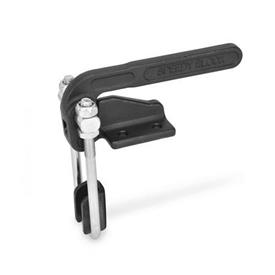
Toggle clamps are typically used on manual welding tables, for example, to hold individual workpieces. They are also found in countless industrial applications. One typical use of latch-type toggle clamps is the fastening of container lids and similar covers.

Toggle clamp types

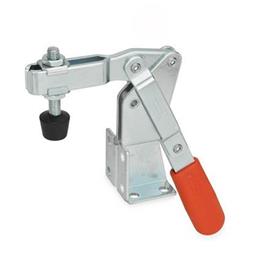
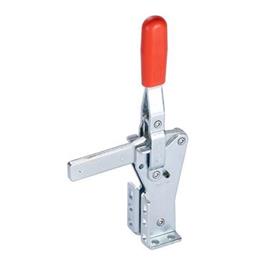
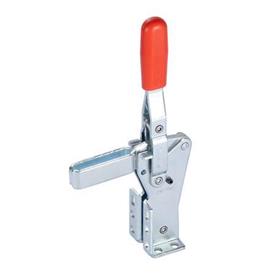
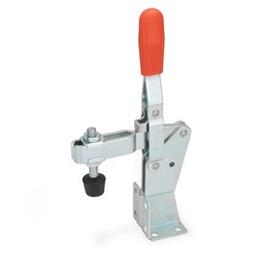
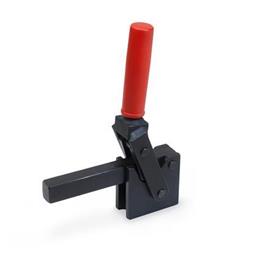
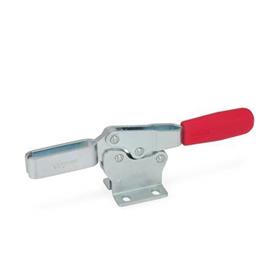
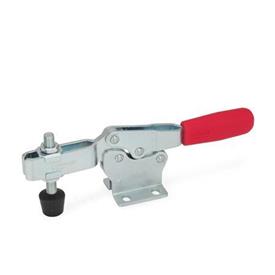
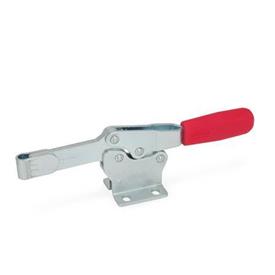
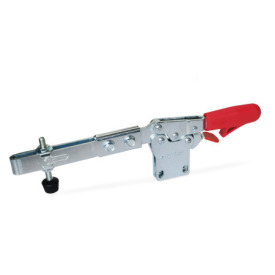
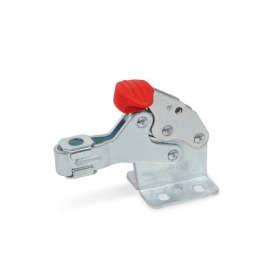
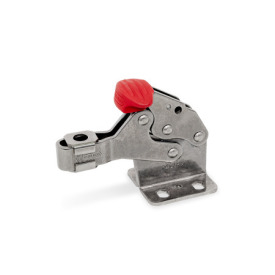
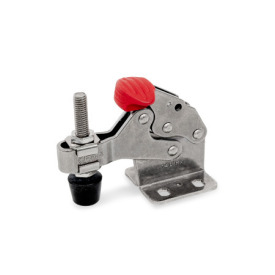
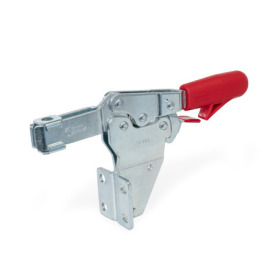
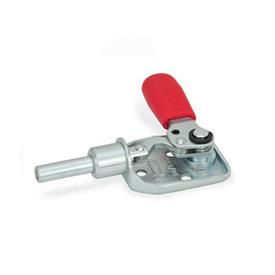
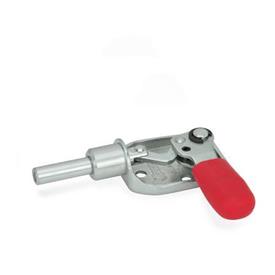
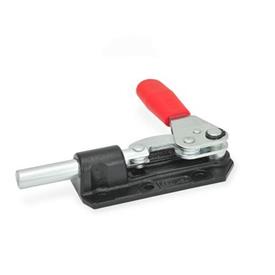
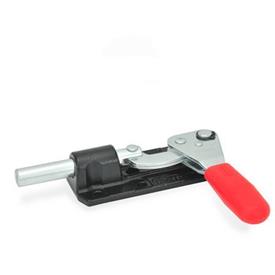
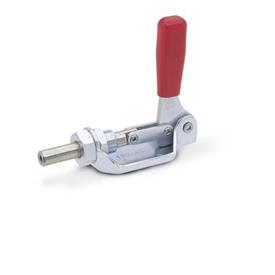
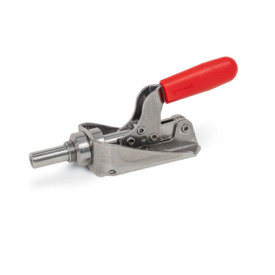
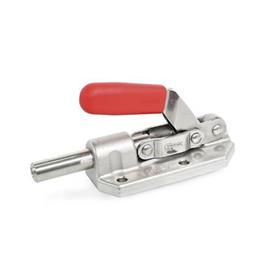
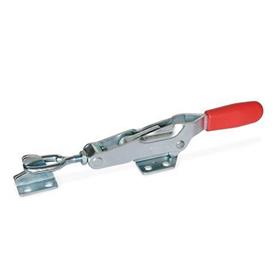
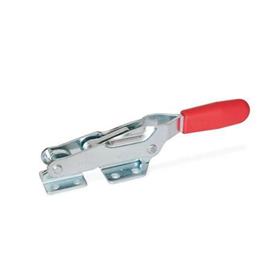
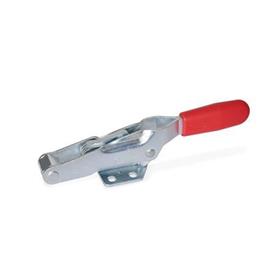
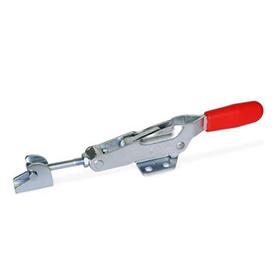
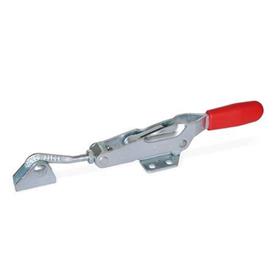
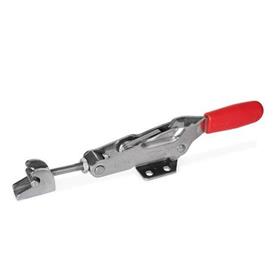
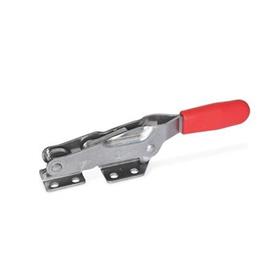
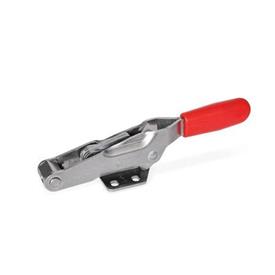
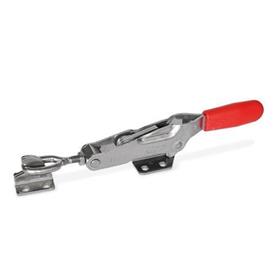
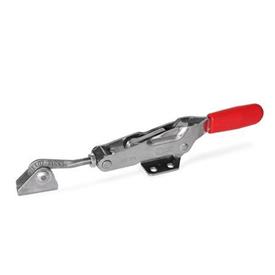
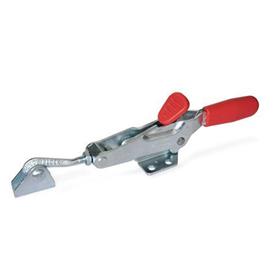
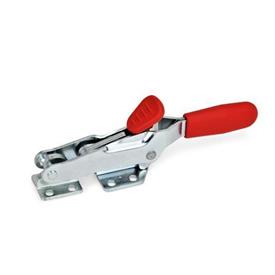
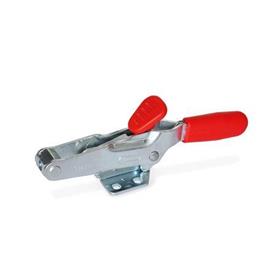
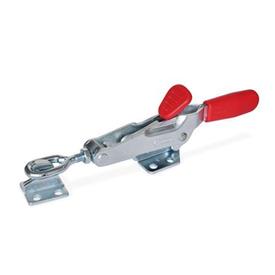
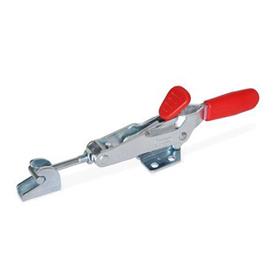
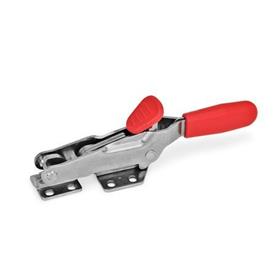
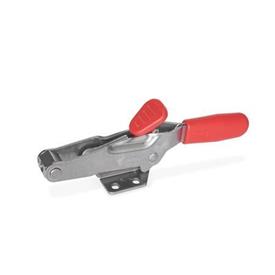
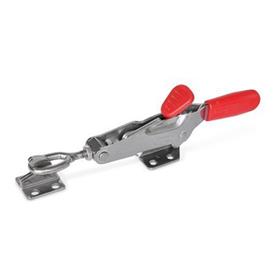
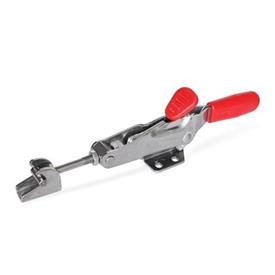
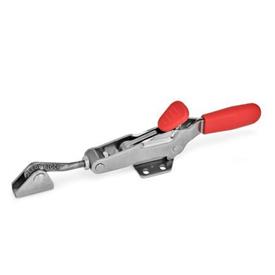
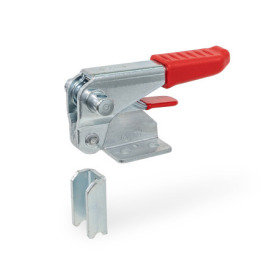
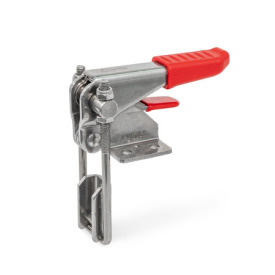
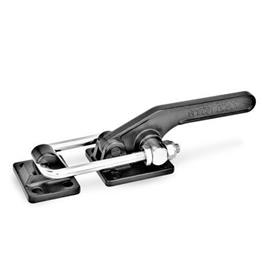
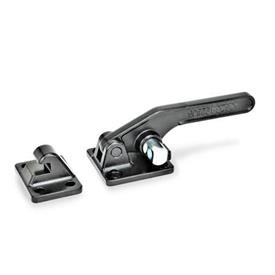
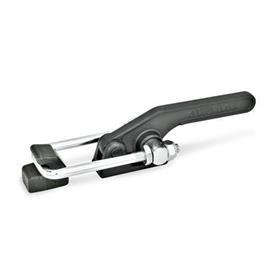
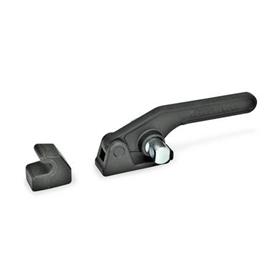
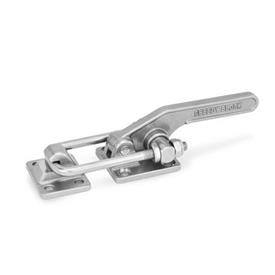
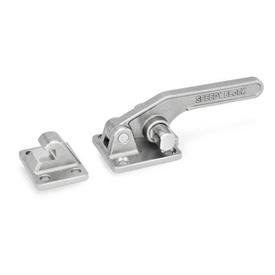
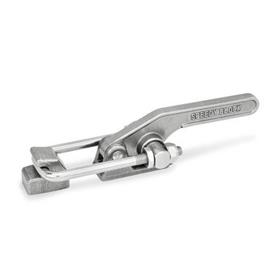
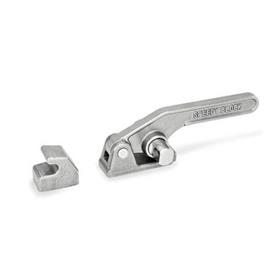
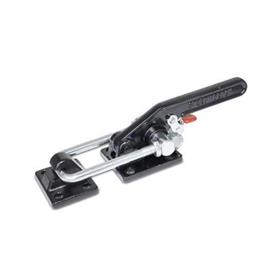
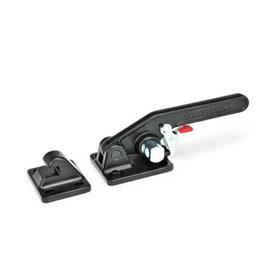
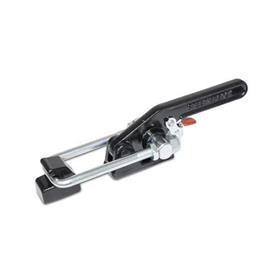
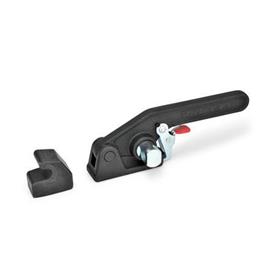
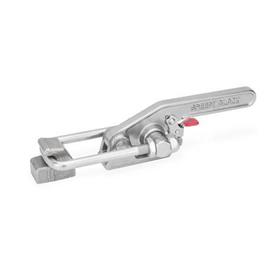
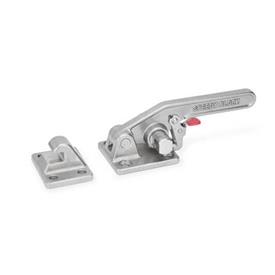
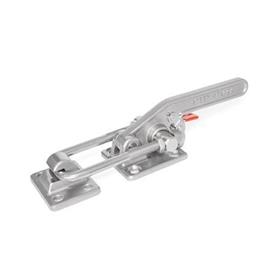
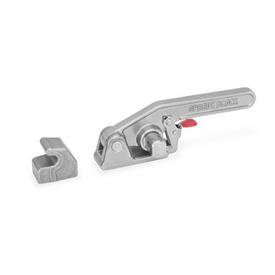
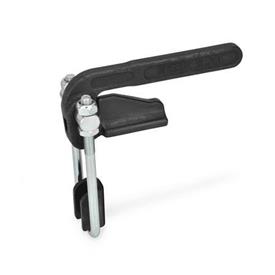
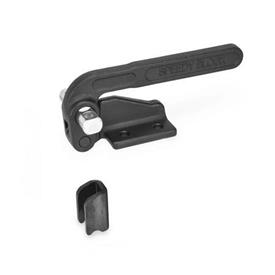
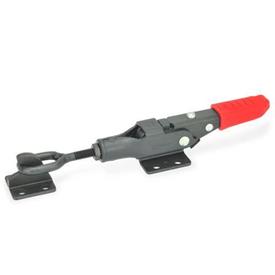
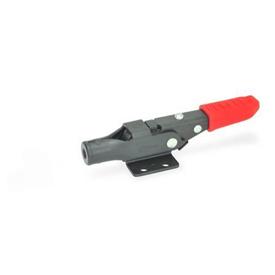
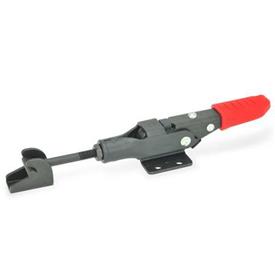
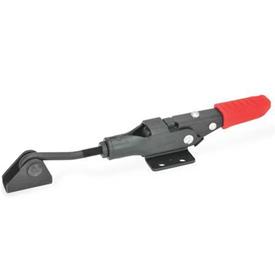
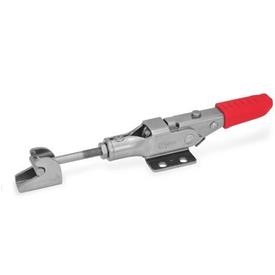
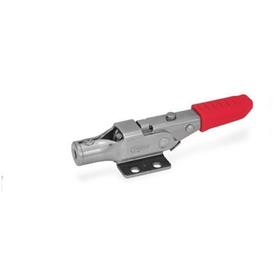
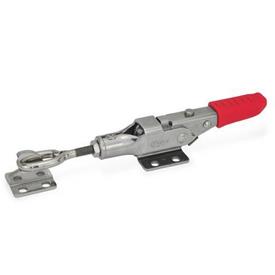
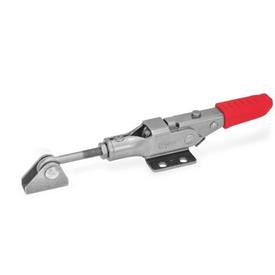
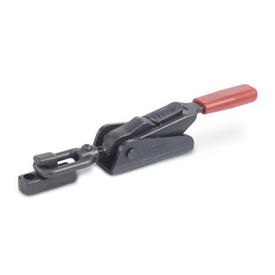
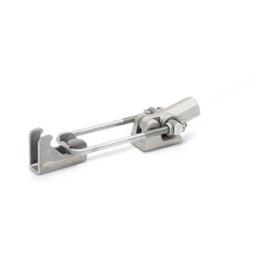
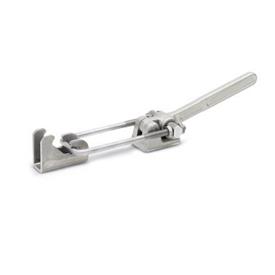
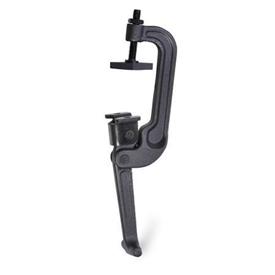
Ganter offers versions of this standard part that fall into four main groups:

Buy toggle clamps for industrial use from Ganter online

Ganter offers a large selection of these standard parts. The right clamp is available for practically every application. In addition to various design shapes, Ganter also offers especially robust “long-life” versions These are particularly suited for frequent clamping cycles, such as in mass production.
FAQ - Frequently Asked Questions

Filter products
New Products
Material
Fixing method
Version
Lock mechanism
Clamping position

Nothing found? Special requests

FAQ - Frequently Asked Questions

What applications are toggle clamps especially well suited to?
Toggle clamps are particularly suitable for applications where workpiece-specific or recurring fixing and clamping operations must be carried out quickly, safely, and with minimal effort. Typical areas of application are in mechanical engineering, plant construction, and automation technology, where workpieces, lids, or covers need to be positioned or closed reliably and reproducibly.

Overview of applications for toggle clamps

  • Secure clamping and tensioning of workpieces during welding, assembly, or machining processes
  • Quick closing or opening of machine covers, inspection or maintenance hatches
  • Fixing devices in place, such as in production lines or testing areas
  • Holding and positioning movable components, such as in mold or jig construction
  • Tightening and loosening transport or packaging equipment that needs to be changed frequently

Typical product selection for various applications

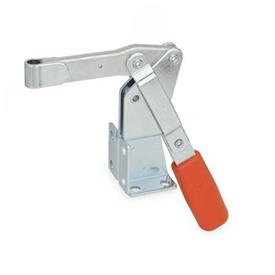
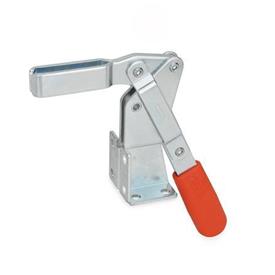
  • Vertical toggle clamps such as GN 810 (steel or stainless steel) and GN 810.1 (vertical operating lever with vertical base) are suitable for classic clamping of workpieces on fixtures.
  • If horizontal clamping is required, models such as the GN 820 (steel or stainless steel, horizontal operating lever, with horizontal base) or GN 820.1 (with vertical base) are used.
  • For applications involving tensile forces (closing lids, covers, or containers), latch type toggle clamps such as GN 850 or are GN 851 ideal.
  • If latching is required for increased safety, following variants is ideal.

Advantages of toggle clamps in practice

  • The knee lever mechanism allows high clamping forces to be generated quickly and comfortably without requiring a high operating force.
  • Toggle clamps shorten cycle times and ensure reproducible quality in manufacturing processes.
  • The wide variety of options (such as different lever designs, materials, sizes) allows you to respond directly to your installation situation and the clamping force required.

How does the knee lever principle work in toggle clamps?

The knee lever principle in toggle clamps is based on a special lever mechanism: An operating lever moves the component to be clamped by way of a joint system and a clamping arm. As soon as the operating lever slightly exceeds the dead point, a positive connection with high clamping force is created. In this state, the geometry of the levers prevents the clamping arm from opening unintentionally. This keeps the workpiece or component securely fastened until the user releases the toggle clamp again. The release is achieved by tilting the operating lever back beyond dead point, which can be done with minimal effort.

Practical benefits of the knee lever principle

This principle ensures that high levels of sustained force are not required during clamping. After passing the dead point, the toggle clamp maintains the clamping force on its own – without any re-tightening. This allows you to fix, loosen, or repeatedly clamp workpieces, lids, or covers in a time-saving and reliable manner, without any fatigue or uncertainty in the process.

Examples of toggle clamps that use the knee lever principle

  • GN 810: Ideal when the clamping arm needs to be oriented vertically, such as on welding or assembly fixtures.
  • GN 820: The operating lever moves parallel to the mounting surface – practical when there is little installation space above the component.
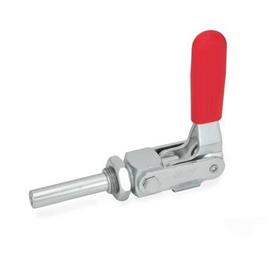
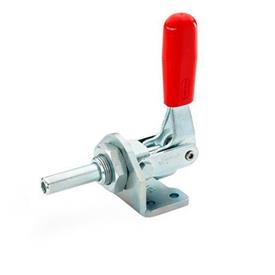
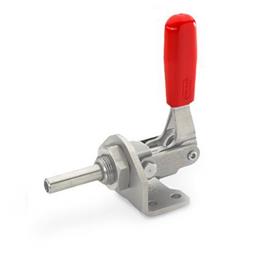
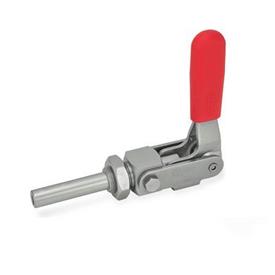
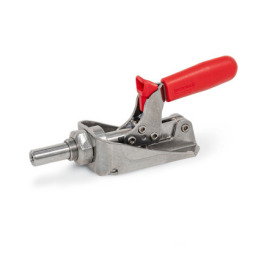
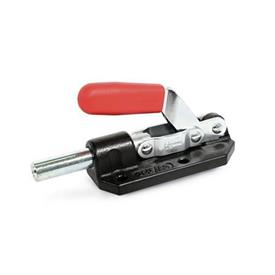
  • GN 840 / GN 844: Push-pull type toggle clamp that applies axial tension and easily transfers tensile and compressive forces.
    *GN 850, etc.: Latch type toggle clamps, specially designed for securely closing covers, lids, or tool holders.

Summary of the advantages in application

  • Very fast operation: A single lever stroke is sufficient for secure clamping or release.
  • High operational safety: The latching by positive connection prevents independent opening.
  • Flexibly adaptable: Various designs enable optimal configuration for your installation situation

What sizes and designs does Ganter offer for toggle clamps?

Ganter offers toggle clamps in a very wide range of sizes and designs. This allows you to choose a suitable solution for almost any installation situation in machine or plant construction, or in automation technology. Different designs enable targeted use in terms of space requirements, operating direction, and mechanical requirements.

Toggle clamp designs

  • Vertical clamp: With toggle clamps such as GN 810 or GN 810.3, the clamping arm points upwards when clamped. They are ideal for applications where the operating lever should protrude into the working space as little as possible. Versions with horizontal or vertical feet, angled feet, and variants with or without additional latching are available.
  • Horizontal clamp: Designs such as GN 820 or GN 820.3 feature a horizontal operating lever. The clamping arm remains flat on the mounting surface after clamping. This is helpful if you want to clamp components sideways or achieve very low installation heights.
  • Push-pull type toggle clamps: Models such as GN 840, GN 844, GN 842, and GN 843.1 transfer the clamping force via a sliding push rod. This is suitable for compressive or tensile loads. This design is appropriate if the clamping arm is to be moved in the axial direction.
  • Latch type toggle clamps: Toggle clamps such as GN 850 or GN 851 are designed as latch type toggle clamps for tensile loads. They are used wherever lids, covers, or enclosures need to be closed securely and quickly.
  • C-clamps: Products such as GN 855 also offer special designs in which the clamping arm is used as a bracket for fastening workpieces at the rear.
  • Knee lever modules and accessories: Application-specific quick-clamping solutions can be individually configured using knee lever modules (such as GN 810.12, GN 810.13) and matching accessories.

Sizes and range of variants

  • Almost all designs are available in several sizes – from compact miniature clamps for confined spaces to heavy-duty series (“Longlife” such as GN 810.10, GN 810.11, GN 813, or GN 852), which are designed for the most demanding applications.
  • You can choose between steel or stainless steel versions, allowing for greater flexibility in industrial and hygienic environments.
  • Additional models with extended clamping arm, locking device, different foot shapes (horizontal, vertical, angle), and accessories allow precise adaptation to the installation situation.
  • Various handle options, modularity, and accessory components allow toggle clamps to be expanded or replaced as needed.

What materials are used in Ganter toggle clamps?

  • Steel: Many toggle clamps and various accessories are made of zinc-plated or coated steel. This enables high clamping forces and a long service life, making them ideal for classic applications in mechanical engineering.
  • Stainless steel: Other models are available in a stainless steel version. Stainless steel is particularly suitable where corrosion resistance or demanding hygiene properties are required, such as outdoors or in the food industry.
  • Plastic: Some accessories, such as handles for knee lever modules, are made of durable plastic. Plastic components offer a pleasant feel and improve ease of use, especially when handled frequently.

Test criteria for selecting the right material for toggle clamps

  • Corrosion resistance required
  • Mechanical stress on the application
  • Hygiene conditions at the place of use

What is the difference between vertical, horizontal, and push-pull type toggle clamps?

Toggle clamps are available in three main designs: Vertical clamps, horizontal clamps, and push-pull type toggle clamps. The difference lies primarily in the movement of the tension lever and the resulting clamping process.

Vertical clamp – such as GN 810 and GN 813

  • During clamping, the lever moves upward, parallel to the base. The clamping arm presses the workpiece downwards.

Vertical clamps enable space-saving work when there is sufficient space above the part to be clamped.

Horizontal clamp – such as GN 820

  • When clamped, the operating lever is situated horizontally above the base plate.

Horizontal clamps are especially well suited to situations in which there is little space available for installation from above. This facilitates use in confined installation locations, such as machine enclosures or automated handling devices.

Push-pull type toggle clamps – such as GN 840, GN 842, GN 843.1

  • The operating lever moves a push rod axially when closing – either in the direction of tension or compression.
  • The force acts in a straight line through the push rod onto the workpiece.

Push-pull type toggle clamps are ideal when axial clamping forces are required, for applications such as precisely clamping or tightening lids, covers, or components. This allows you to flexibly secure a wide variety of geometries while always applying uniform, controlled clamping force. This increases process reliability and facilitates fluctuating assembly tasks.

How do Longlife toggle clamps differ from standard versions?

Longlife toggle clamps such as types GN 810.10 (with horizontal foot) and GN 810.11 (with vertical foot) differ from standard versions in that they are particularly robust. This applies to both the choice of materials and the design of the knee lever mechanism. The use of reinforced components and targeted design optimizations ensures a significantly longer service life and greater functional reliability in continuous use. This allows you to use Longlife toggle clamps specifically in applications where the clamping systems are operated frequently and over long periods of time – such as in production lines, assembly fixtures, or automated clamping processes.

Practical advantages of Longlife toggle clamps

  • Capable of withstanding long-term operation even under frequent operation
  • Low maintenance and wear-resistant, ideal for high-volume production environments
  • High functional reliability minimizes downtime and readjustments
  • Thanks to the heavy-duty design, the clamping forces remain constant even after prolonged operation, enabling you to achieve consistently reproducible clamping forces.

Important differences at a glance

  • Reinforced assemblies on GN 810.10 and GN 810.11 enable reliable continuous operation under demanding conditions.
  • Standard variants focus on universal use and economical unit costs – Longlife models complement this portfolio when maximum service life is required.

What is the difference between toggle clamps and latch type toggle clamps?

Toggle clamps and latch type toggle clamps are both used for quick and secure fastening or for locking movable components in machine and plant construction. The main difference lies in their respective operating principles and typical areas of application.

Differences between toggle clamps and latch type toggle clamps

Operating principle:

  • Toggle clamps usually work based on the knee lever principle. By flipping an operating lever, you engage a secure, non-positive clamping connection – ideal for repeatedly clamping and releasing workpieces or components directly on a workbench or fixture, such as with products like GN 810 or GN 820.
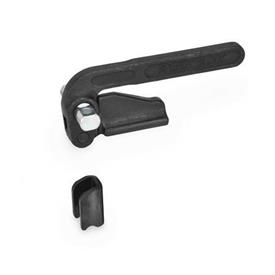
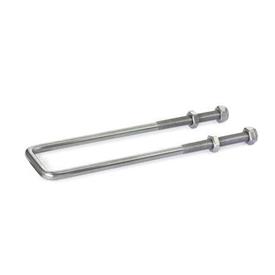
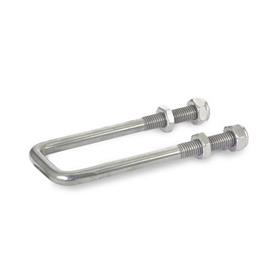
  • Latch type toggle clamps are primarily used to close and secure covers, hoods, flaps, or doors. They transfer the tension via a square U-bolt and generate a high tensile force at the latching point – for example GN 850 or GN 851. Both parts to be connected are firmly locked together once the clamp is closed.

Type:

  • Toggle clamps have a movable clamping arm (usually a vertical or horizontal clamp) that secures the workpiece.
  • Latch type toggle clamps, on the other hand, work with a square U-bolt mechanism in which tension is applied to the catch or catch bracket via a clamping movement.

What does this mean in practice?

Toggle clamps – such as ones with vertical or horizontal operating levers – allow you to secure workpieces, parts, or components quickly and conveniently for machining or manufacturing processes. This allows you to speed up workflows and increase precision when clamping, such as when inserting parts into fixtures.

Latch type toggle clamps such as GN 850 or GN 851 are always used where you need to securely close movable components such as lids or doors and lock them in the closed position. This prevents unintentional opening during operation and increases safety for users and equipment.

How can the tension of toggle clamps be adjusted?

With toggle clamps from the Ganter range, you can easily and precisely adjust the clamping force by adjusting the pressure bolt or the clamping arm. The central search term “toggle clamp” refers here to all knee lever clamps in which the contact pressure can be varied individually without special tools or major assembly work.

Practical mechanism for adjusting the clamping force on toggle clamps

Most toggle clamps – such as GN 810, GN 820, GN 840, or GN 850 – have a threaded bolt at the tip of the clamping arm (often with a pressure plate and nut included).

  • You can adjust the length of the clamping arm by screwing this pressure bolt in or out. This allows you to determine how far the clamping arm is pressed down when closing and the contact pressure with which the workpiece or component is held.
  • The lock nut on the pressure bolt allows the set position to be securely fixed. This prevents unwanted adjustment during operation.

In this way, you can continuously adjust the clamping force to different workpiece heights and strengths. For example, this makes it possible to reduce stress on sensitive parts or – with generous tolerances – to maximize the working range of a toggle clamp. In such cases, it is not necessary to replace the toggle clamp; adjustments can be made directly on the toggle clamp in just a few simple steps.

Tips for safely adjusting the toggle clamp tension

  • Roughly adjust the position of the pressure bolt to the workpiece dimensions when open.
  • Close the toggle clamp and check that the workpiece is clamped securely but not excessively tightly.
  • Adjust the setting in small increments and always secure the bolt with the lock nut to prevent accidental rotation.

In special versions such as latch type toggle clamps GN 850 or GN 853, the clamping force can usually also be adjusted using an adjustment option on the bracket or push rod.

Can Ganter toggle clamps also be customized according to customer requests?

Toggle clamps from Ganter can also be customized to meet specific customer requirements. Even the standard range offers a wide selection of different toggle clamps, such as vertical or horizontal toggle clamps, push-pull type toggle clamps, latch type toggle clamps, or special knee lever modules. This wide range to choose from allows for an application-optimized selection for a wide range of installation situations and operational requirements.

Customer-specific adaptation options for toggle clamps

Ganter engineers tailor toggle clamps specifically to customer requirements for numerous projects in machine and plant construction.

Typical adaptations:
  • Dimensions of the clamping arm or mounting feet, for example, to meet specific installation space requirements
  • Special holes, alternative fastening solutions, or modifications to clamping surfaces
  • Custom materials or surface finishes, such as special stainless steel designs for use in the food industry
  • Integration of additional functions such as special latching functions, extended operating levers, or extra securing mechanisms
  • Customized handles and accessories for ergonomic or process-specific requirements

How to proceed to obtain a customized solution

  • First, choose from among our extensive range – for example, GN 810 toggle clamps (steel or stainless steel, with horizontal or vertical feet) for conventional clamping applications or GN 820 toggle clamps for horizontal mounting applications.
  • If you require special installation dimensions, different materials, or design modifications, please contact Ganter Service – they will provide you with expert advice and review your individual specifications.
  • Small series, prototypes, and one-off pieces can be produced upon request. Ganter accompanies the process with technical precision all the way to the finished solution.

Your contact

You are looking for a Ganter partner near you?

Ganter-Service

Our service team is available from Monday to Friday between 7:30 AM and 5:00 PM:

Request Callback