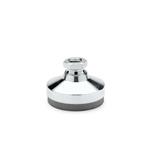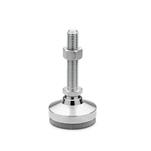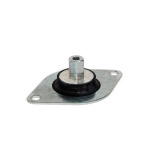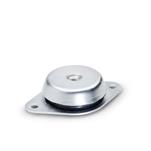
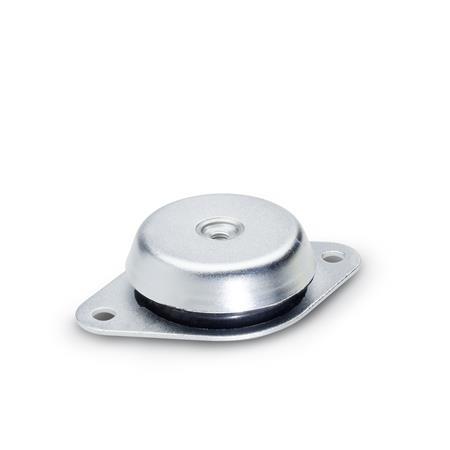
GN 148 Leveling Feet Steel, with Vibration Damping Element

Leveling Feet GN 148: Steel, with Vibration Damping Element
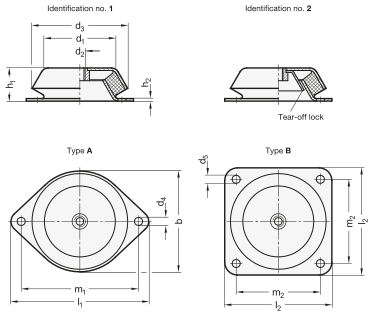
Type: A - With two-hole flange (d1 = 60 / 90 / 113)

Product description

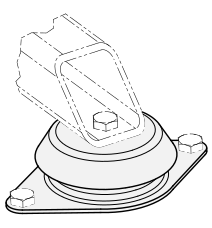
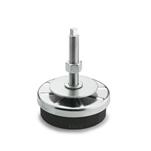
Leveling feet GN 148 are designed for setting up heavy machinery and units with insulation against vibrations.

This has a positive impact on the lifetime of machines and additionally reduces the noise pollution.

The structure is such that horizontal forces are also absorbed.

The design with tear-off lock (type 2) protects the leveling feet from destruction caused by tear-off under excessive tension loads.

The details relating to the load bearing capacity are non-binding recommended values and rule out any liability. They constitute no general warranty of quality and condition. The user must determine from case to case whether a product is suitable for the intended use.

Specification

Vibration damping element
Natural rubber (NR)

  • Vulcanized
  • Operating temperature up to 80 °C
  • Hardness Shore A ±5
    • Soft43
    • Medium57
    • Hard68

Sheet metal / Threaded insert
Steel
Zinc plated, blue passivated


RoHS
Accessory

Rubber Pads GN 148.2

Hide technical drawing
GN 148 Leveling Feet with Vibration Damping Element sketch

Article options / Table

Type

AWith two-hole flange (d1 = 60 / 90 / 113)
BWith four-hole flange (d1 = 113 / 126)

Identification no.

1Without tear-off lock
2With tear-off lock
Show / Hide columns
d1d2d3d4
Type A
d5
Type B
h1h2b
Type A
l1
Type A
l2
Type B
m1
Type A
m2
Type B
60M 10789-30278128-110-
90M 1210613-393110170-140-
113M 1615012,512,5524150216168184132
126M 20177-13634--184-150

Build & Price

Foot diameter d1
Thread d2
Type


Identification no.


Hardness


Foot diameter d1
Thread d2
Type


Identification no.


Hardness


Load Capacity

63141269-0bdb-4cce-994c-52e33a010e71

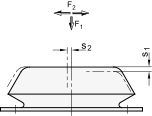
F1 = static load in vertical direction (pressure)
F2 = static load in horizontal direction (lateral thrust)
s1 = Compression in vertical direction (spring excursion) under load through F1
s2 = Compression in horizontal direction (spring excursion) under load through F2

Stiffness R: is the load which causes the dampening elements to be compressed by 1 mm (spring rate)

Equation for calculating the stiffness: R = F/S

The values listed in the table can be used to determine the degree of isolation as a function of the interference frequency, in accordance with the approach shown on page XYZ.

The information on load capacity represents non-binding guidelines and excludes any liability. They generally do not constitute a guarantee of quality. Whether a product is suitable for a particular application must be determined in each individual case by the user.

Show / Hide columns
d1Hardness 
in Shore
max. static load F1 in NStiffness R1 in  N/mmmax. compression s1 in mmmax. static load F2 in NStiffness R2 in N/mmmax. compression s2 in mm
604311003403,223007703
605717505503,2340011303
606828009303400011303
904315004303,530007504
905728008003,5500013303,75
9068450012903,5700018703,75
11343350010003,5450012903,5
11357650018603,5750021403,5
113681000028603,51100031403,5
12643750021403,5900025703,5
126571250035703,51500042903,5
126681900053403,52250064303,5

Application Example

37ecdede-bdd8-4553-96e8-3197ea4a6667

Guide to Selecting Vibration Damping Elements

For correct selection of a standard part used for vibration damping, it is first necessary to understand the terms listed below:

The disturbing frequency is the frequency emitted by the machine, e.g. the number of strokes per minute, measured in Hertz, or the main shaft rotation speed, measured in revolutions per minute.

The static load in Newtons is the load that acts on a single vibration damping element. The total weight of a machine is divided by the number of damping elements. In an optimal arrangement, each element bears the same load.

The degree of isolation, given in percent, is the measure of the absorption of the disturbing frequency, i.e. the damping.

The compression or the spring travel is the maximum change in the height of the damping element in mm.

The calculated spring rate in Newtons/millimeter is the load that causes a height change of 1 mm.

45349c40-50cb-4b57-a1e2-265684d431cd

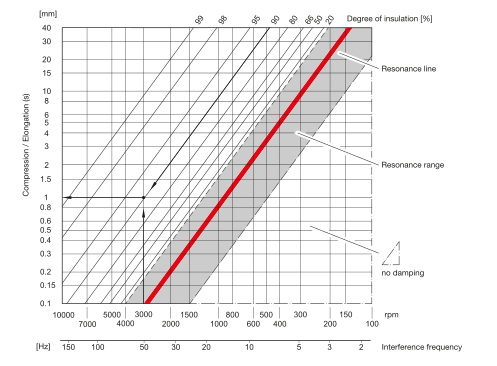
Example with the following assumptions: Disturbing frequency = 50 Hz; load = 120 N; desired degree of isolation = 90 %

The selection of a suitable vibration damping element begins with determining the required compression. This can be taken from the y-axis of the diagram at the intersection of a vertical line at 50 Hz (x-axis) and the
characteristic curve of the desired degree of isolation of 90 %. The example values yield a compression of 1 mm.
With the compression determined in this way and the given static load, it is possible to calculate the required spring rate with the following formula:

Static load F [N] per damping element / Spring travel s [mm] = Spring rate [N/mm] => 120 N / 1mm = 120 N/mm

Based on the calculated spring rate and the desired shape, the appropriate damping element can then be selected. The respective spring rates are given in a table on the corresponding standard sheets. In making the selection, it is important to ensure that the spring rate at least satisfies the calculated value.
The example arrives at a vibration damping element with article number 148.3-46-M10-A-60-S and a spring rate of 138.3 N/mm.

Selected Part (How to order)

Total (net)
26,73
plus VAT 5,08 €
gross 31,81 €
#artikelLagerbestandAnfrageUsa
Weight: 0,239 kg
If this article is new in our product range, it may happen that details concerning weight are as yet not listed.
If you do need weight details, please contact our Sales Department!
Phone +49 7723 6507 - 0
RoHS: Yes
This article is RoHS-compliant in application of Annex III., which means it complies with EU Directive 2011/65/EU, including extension (2015/863/EU), for restricting the use of certain hazardous substances in electrical and electronic devices. The Directive regulates the use of hazardous substances in devices and components. The implementation in national law is summarily described with RoHS(Restriction of (the use of certain) hazardous substances).
Customs tariff number
40169991
Please note our order discounts.
With a total value (net) per order:
from 175,00 € -> 10 % discount
from 275,00 € -> 20 % discount
from 375,00 € -> 30 % discount

Surcharge for small volume purchases:
-> 15,00 Euro
for value of goods less than 25,00 €
-> 10,00 Euro
for value of goods from 25,00 to 49,99 €
Save as favourite
Recommend a product

CAD data

Other data formats

Quick-Login

For getting CAD data please enter you Email address. But we would be pleased, if you are fully registered.

CAD Download Tutorial About CAD-Downloads

Do you find your product ?

Our service team is available from Monday to Friday between 7:30 AM and 5:00 PM: +49 7723 6507 - 0

To the customised elements | To the contact persons

GN 148-60-M10-A-1-43GN 148-60-M10-A-2-43GN 148-60-M10-A-1-57GN 148-60-M10-A-2-57GN 148-60-M10-A-1-68GN 148-60-M10-A-2-68GN 148-90-M12-A-1-43GN 148-90-M12-A-2-43GN 148-90-M12-A-1-57GN 148-90-M12-A-2-57GN 148-90-M12-A-1-68GN 148-90-M12-A-2-68GN 148-113-M16-A-1-43GN 148-113-M16-A-2-43GN 148-113-M16-B-1-43GN 148-113-M16-B-2-43GN 148-113-M16-A-1-57GN 148-113-M16-A-2-57GN 148-113-M16-B-1-57GN 148-113-M16-B-2-57GN 148-113-M16-A-1-68GN 148-113-M16-A-2-68GN 148-113-M16-B-1-68GN 148-113-M16-B-2-68GN 148-126-M20-B-1-43GN 148-126-M20-B-2-43GN 148-126-M20-B-1-57GN 148-126-M20-B-2-57GN 148-126-M20-B-1-68GN 148-126-M20-B-2-68

Your contact

You are looking for a Ganter partner near you?

Ganter-Service

Our service team is available from Monday to Friday between 7:30 AM and 5:00 PM:

Request Callback