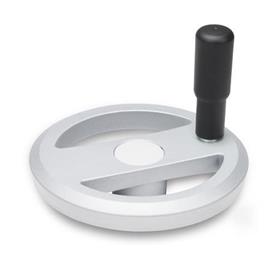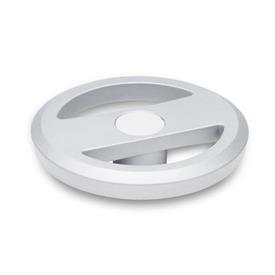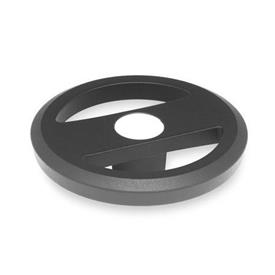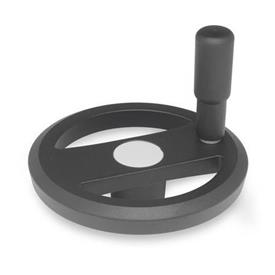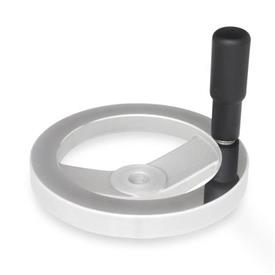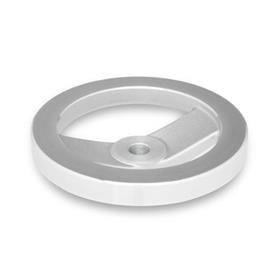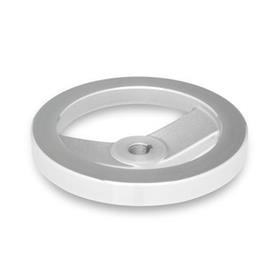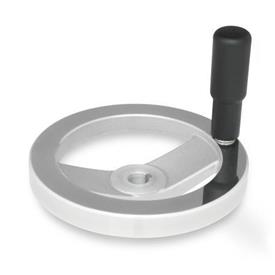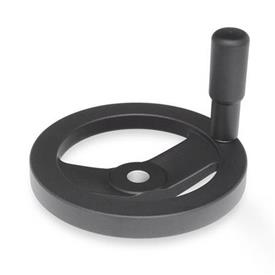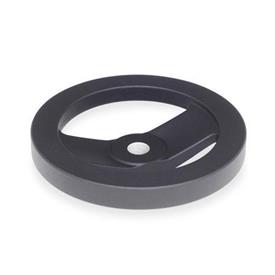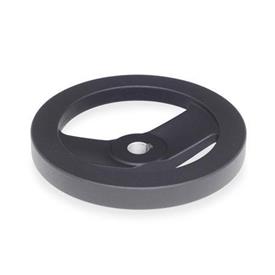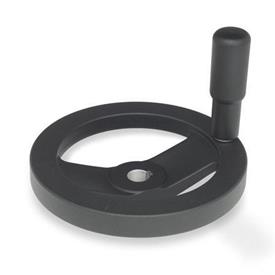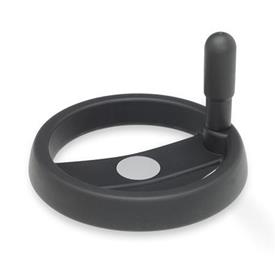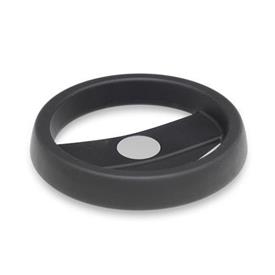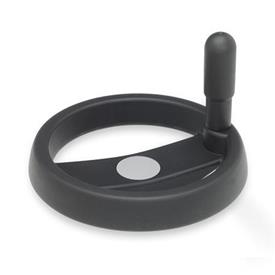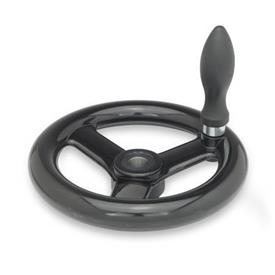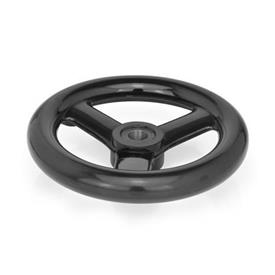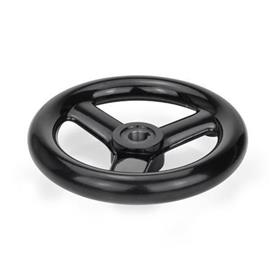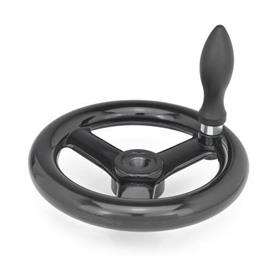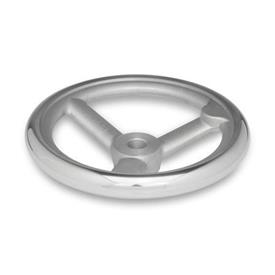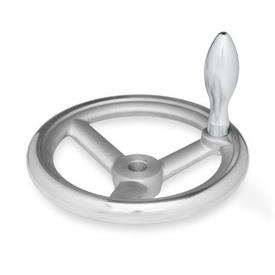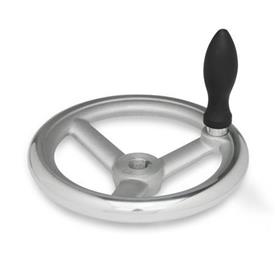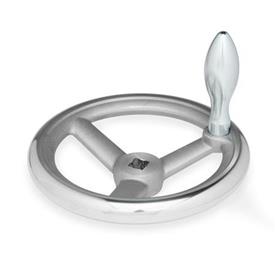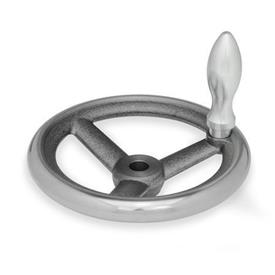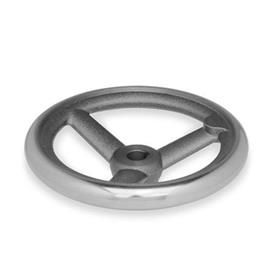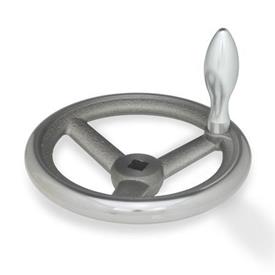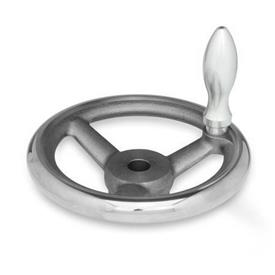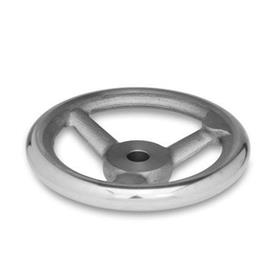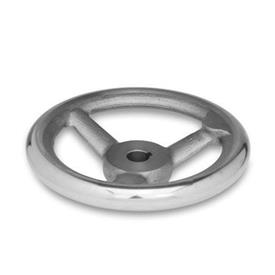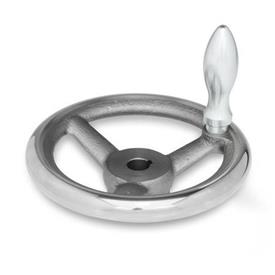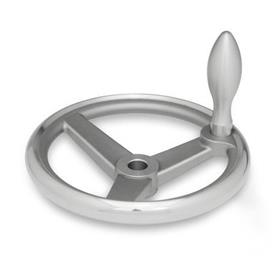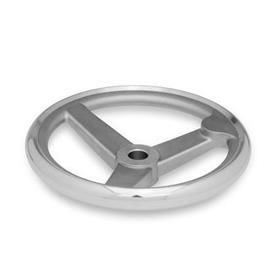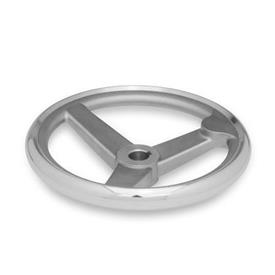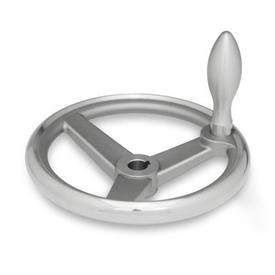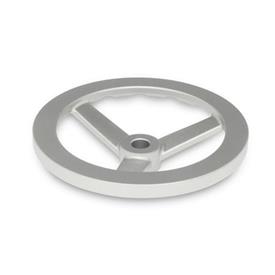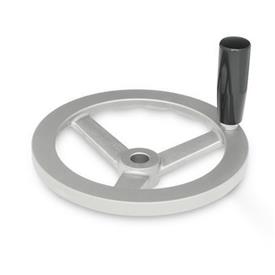
Volantini a razze

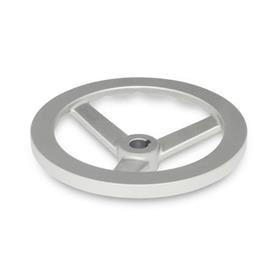
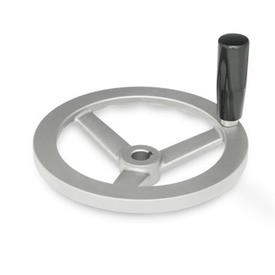
I volantini a razze trasmettono la rotazione manuale per l'azionamento e la regolazione. Il bordo aperto dei volantini a due razze consente anche l'accesso assiale.
FAQ - Domande frequenti

Filtra prodotti
Materiale
Diametro esterno (da - a) Diametro esterno
Foro alesato (da - a) Foro alesato
Famiglia di prodotti

Non hai trovato niente? Richieste speciali

FAQ - Domande frequenti

What is a spoked handwheel and how does it work?

A spoked handwheel is a control element that transmits manual rotational movements to machine axes or components. It consists of a wheel and usually two or more spokes. Through the spokes, the torque from the handwheel is transmitted to the hub and thus to the machine axis to be adjusted. The handwheel can be operated directly or via a cylindrical handle. This allows for clearly defined, reliable, and ergonomic handling, ideal for precise adjustments or repetitive movements in machine and plant engineering.

How does a spoked handwheel work?

The force transmission takes place through the spokes to the hub, which is connected to the machine shaft. Depending on the design (e.g. GN 924, GN 322, DIN 950), the wheel and spokes are made from materials such as aluminum, plastic, cast iron, or stainless steel. Open spokes, especially in 2-spoke handwheels, allow for convenient axial access to adjacent components. This allows operators to reach parallel controls or measuring devices during adjustment without removing the handwheel.

Practical benefits of spoked handwheels

  • Ergonomic, powerful adjustment of machine axes and components
  • Precise fine-tuning through direct, manual operation
  • Axial access to adjacent areas improves service and assembly
  • Numerous material and handle variants: High-quality aluminum (e.g. GN 322, GN 324), durable plastic (GN 522, GN 555), or hygienic stainless steel (GN 949, GN 950.6)
  • Ideal for applications which prioritize uncomplicated and reliable operability – such as setup changes, adjustments, or positioning of machine assemblies

Typical application examples for spoked handwheels

  • Setting the position of spindles on machine tools
  • Adjusting guides, sliders, or clamping devices
  • Operating valves and closures in plant engineering

What applications are spoked handwheels especially well suited for?

Spoked handwheels are especially well suited for applications which call for manual, precise, and reliable adjustment of machine axes or components. Typical areas of application include controls, positioning units, and adjustment mechanisms on machines where a controlled rotational movement needs to be transmitted to a shaft or spindle.

Typical application areas for spoked handwheels

  • Machine and plant construction: Ideal for setting and adjusting axes, sliders, or workpiece clamping, as spoked handwheels allow for targeted force transmission.
  • Automation technology: Frequently used in manual positioning units which require regular corrections or quick adjustments by hand.
  • Control panels: Perfectly suited for clamping, gripping, or loosening through rotary movements when automation is not intended or manual intervention is necessary.

Advantages of spoked handwheels in practice

  • Open wheel (especially 2-spoke version): Allows axial access to adjacent machine areas. This enables you to conveniently perform maintenance or adjustments without having to remove the handwheel.
  • High operator ergonomics: The spoke structure provides guidance and support for the hand. This allows you to perform precisely measured rotational movements safely and conveniently – even with high force requirements.
  • Variety of materials: Aluminum (e.g. GN 924, GN 324, GN 322), plastic (GN 522, GN 555, GN 522.5), and stainless steel (GN 949, GN 950.6) allow for adaptation to various operating conditions and design requirements.
  • Variable designs: Models are available with or without a handle, and there are also variants with a large hub (GN 950.1) for specific mounting requirements.

This ensures that you always have the optimal selection of spoked handwheels available for different operating conditions and can respond flexibly to your specific requirements. In practice, this increases operator safety, improves ergonomics, and significantly simplifies maintenance tasks.

What advantages does a spoked handwheel offer compared to other types of handwheels?

A spoked handwheel offers several practical advantages compared to other types of handwheels, such as disk handwheels. The open wheel rim ensures that spoked handwheels not only allow for ergonomic handling but also meet specific requirements for access and machine operation.

Advantages of spoked handwheels

  • The open wheel rim, especially in 2-spoke designs, allows for axial access to adjacent components or areas. This enables you to easily adjust machine axes or components without the handwheel blocking access.
  • The spoked design makes the handwheel lightweight and comfortable to operate with one or both hands. This facilitates quick and precise rotational movements in daily use.
  • The open space between the spokes provides better visibility of the machine environment. This reduces the risk of collisions and facilitates adjusting and reading display values.
  • The low weight and open design reduce the effort required for operation. This allows you to operate the spoked handwheel frequently without experiencing fatigue.
  • Spoked handwheels are usually available in various materials and versions, including aluminum (GN 924, GN 322, GN 324), plastic (GN 522, GN 522.5, GN 555), cast iron (DIN 950, GN 950.1), and stainless steel (GN 950.6, GN 949). This allows you to respond flexibly and choose the right model for each application.

What does this mean in practice?

With a spoked handwheel, such as GN 924 made of aluminum or GN 522 made of plastic, you can comfortably and safely adjust your machine axes. Thanks to the open design, access to adjacent components is also possible in tight spaces. This improves ergonomics and increases efficiency in daily work.

What materials are available for spoked handwheels?

Various materials are available for spoked handwheels from the Ganter range. Depending on the requirements for appearance, durability, or hygienic properties, you can choose between aluminum, plastic, cast iron, and stainless steel. This allows you to optimally adapt the spoked handwheel to your application and the desired environment.

Material options for spoked handwheels

  • Aluminum: Available in powder coated (e.g. GN 924, GN 324) and plain finish, polished versions (GN 322). Aluminum is lightweight, corrosion-resistant, and versatile.
  • Plastic: Models such as GN 522, GN 522.5, and GN 555 offer low weight and a pleasant feel. Especially well suited for use in damp or hygienically sensitive areas.
  • Cast iron: Robust and classic in appearance. Available in standard DIN 950 as well as in GN 950.1. Ideal for high stress or traditional machine design.
  • Stainless steel: Handwheels like GN 950.6 and GN 949 offer high corrosion resistance and are optimally suited for demanding hygienic or aggressive environments.

Advantages of diverse materials for spoked handwheels

  • Flexible use in various environments
  • Optimal coordination of design, feel, and application area
  • Improved user-friendliness and safety thanks to material-appropriate selection

How do I determine the right spoked handwheel for my individual application?

Choose the appropriate spoked handwheel by systematically matching the requirements of your application with the features of the available spoked handwheels. Material, coating, and handle type are crucial, and each option offers different advantages. This way, you will quickly find a solution that optimally combines operating comfort and process reliability.

Important selection criteria for spoked handwheels

  • Material: Aluminum (e.g. GN 924, GN 322, GN 324), plastic (GN 522, GN 522.5, GN 555), or cast iron/stainless steel (DIN 950, GN 950.1, GN 950.6, GN 949). Aluminum is lightweight and corrosion-resistant, plastic reduces weight and is ergonomic, while cast iron and stainless steel offer high stability and robustness.
  • Surface/coating: Plastic coating (black or colored) protects against corrosion and facilitates cleaning. Plain polished finishes like those on GN 322 are especially appealing and easy to maintain.
  • Type: The open design, such as in 2-spoke versions, allows for convenient axial access to nearby components – ideal for adding clamps or performing maintenance.
  • Installation type: Check whether the handwheel is available as a version with a hub, bore, or keyway, ensuring it fits securely on the machine shaft.
  • Handle type: Choose between rigid, revolving, and retractable handles – retractable handles prevent injury risks during free rotation.
  • Dimensions: Pay attention to the desired outer diameter, hub diameter, and bore – only then can you ensure reliable force transmission.
  • Special requirements: Stainless steel models (GN 950.6, GN 949) offer advantages when hygiene requirements must be met, such as in the food or pharmaceutical sectors.

What industries are spoked handwheels typically used in?

Spoked handwheels are typically used in many areas of mechanical engineering, plant construction, and automation technology. They are used for the manual adjustment of machine axes or components and enable precise, direct force transmission. Due to the open design, especially in 2-spoke versions, users can work safely and conveniently, even in tight spaces.

Typical areas of application for spoked handwheels

  • Mechanical engineering – Used on machine tools, adjustment and positioning units as well as special machines. They allow operators to control the movements of guides, units, or axes with great precision.
  • Plant construction – Used in industrial production systems, test stands, or assembly systems. Operators can thus respond flexibly to different production situations.
  • Automation technology – Used for manual override of automated processes and for setting up machines. Ideal for commissioning, maintenance, or setup operations when mechanical precision is required.
  • Food and packaging industry – Manual adjustment of format changes or machine settings. Practical example: A packaging line can be adjusted quickly, safely, and efficiently.
  • Medical and laboratory technology – Fine-tuning of devices where safe and hygienic handling is required, e.g. with stainless steel handwheels like GN 949 or GN 950.6.
  • Process engineering and chemical plants – Control or fine-tuning of valves and covers, often with products like GN 950.6 made of stainless steel for high corrosion resistance.

Can spoked handwheels be retrofitted to existing machines?

Spoked handwheels can usually be retrofitted into existing machines without any issues. The “Spoked Handwheels” product family offers various designs, standard sizes, and connection options, allowing for flexible adaptation to existing machine shafts or components. When making your selection, always be sure to check the shaft diameter, fastening type (e.g. with or without keyway), and installation space.

Procedure for retrofitting spoked handwheels

  1. Determine the required shaft diameter and connection geometry of your machine.
  2. Select a precisely fitting spoked handwheel from options such as aluminum (GN 924, GN 322, GN 324), plastic (GN 522, GN 522.5, GN 555), or cast iron/stainless steel (DIN 950, GN 950.1, GN 950.6, GN 949).
  3. Pay attention to the compatibility of hub bores, keyways, and securing elements with the existing shaft.
  4. Consider the necessary operating comfort and possible additional options such as folding or safety handles.

Due to the wide variety of options, including GN 924 (aluminum, powder coated) or GN 522 (plastic, steel bushing), you can respond flexibly to the requirements of your existing systems. This means that replacement or retrofitting is usually possible without extensive modifications.

What accessories are available for spoked handwheels?

Various accessories are available for spoked handwheels from the Ganter range, specifically enhancing the functionality and adaptability of the handwheels. These include foldable or fixed revolving handles, scale rings, keyways and position indicators.

Accessories for spoked handwheels

  • Impugnature girevoli: Many spoked handwheels can be equipped with fixed or folding revolving handles. These facilitate handling, especially for frequently adjusted systems. Turning the handwheels is safe and ergonomic, even with changing requirements.
  • Scale rings: Scale rings are available as accessories for various designs. These allow positions or settings to be read accurately while turning. Adjustments can be made precisely and reliably, such as for machine axes that require recurring positioning.
  • Indicatori di posizione analogici/digitali: Many spoked handwheels can be supplemented with digital or analog position indicators. They display the current position of an axis directly on the handwheel, reducing setup times and preventing incorrect operations. Ideal wherever precise and reliable work is a priority.
  • Parallel keys: Many models optionally offer a keyway or corresponding drivers. This allows the handwheel to be fixed to the shaft with a positive connection. The result is increased reliability and comfortable transfer of the rotational movement, especially in applications which demand accurate repeatability.

Are custom-made spoked handwheels available?

Custom-made spoked handwheels from the Ganter range are generally possible. You can request handwheels with special holes, keyways, or differing surface finishes. This applies to all spoked handwheels from the Ganter standard parts range.

Practical implementation and process

If you need custom-made spoked handwheels, it is advisable to contact Ganter Service directly. This way, you can clarify details regarding dimensions, special connection sizes, or features such as handles or surfaces. Ganter checks the technical feasibility and provides you with a customized offer. This allows you to equip your machine or plant components precisely.

Advantages of custom-made Ganter spoked handwheels

  • Individual adaptation to your technical specifications
  • Flexible design – such as different diameters, handle types, or bore variants
  • Maximum reliability thanks to precise manufacturing
  • Reduced assembly times, as reworking is eliminated
  • Ideal when standard dimensions are insufficient or special functionalities are required

Questions regarding delivery times, feasibility, or minimum quantities are best clarified directly with the technical sales team. This ensures that your spoked handwheel reliably meets the requirements of your application.

Il tuo referente

Cerchi un rappresentante Ganter vicino a te? Seleziona il paese desiderato.

Telefono del centro di assistenza

Il nostro team di assistenza è disponibile dal lunedì al venerdì dalle 07:30 alle 17:00 al numero:

Richiedi contatto telefonico