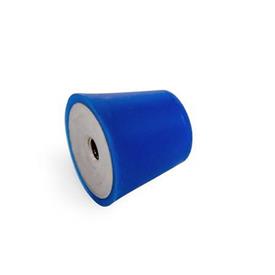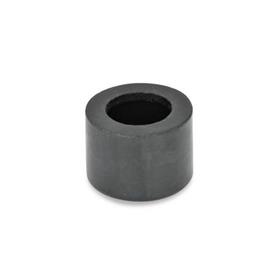
Tampons en caoutchouc pour amortir les chocs en douceur

Les tampons en caoutchouc, également appelés amortisseurs caoutchouc-métal, amortisseurs de vibrations ou amortisseurs en caoutchouc, peuvent être utilisés comme support élastique pour les éléments de machines tels que les moteurs, les compresseurs ou les pompes, mais aussi pour le montage

d'équipements. En tant qu'amortisseurs d'impacts, ils sont souvent utilisés comme butées de fin de course et absorbent la majeure partie de l'énergie cinétique générée au moment de l'impact. Dans tous les cas, ils assurent un effet d'amortissement et évitent les détériorations dues aux chocs, aux secousses ou aux fortes vibrations.

Matériaux de fabrication des tampons en caoutchouc

Les tampons en caoutchouc incluent toujours un élément élastomère. Celui-ci est fabriqué soit en caoutchouc naturel (NR), soit en caoutchouc acrylonitrile-butadiène (NBR), soit en caoutchouc en silicone, matériau résistant à la température et avantageux d'un point de vue hygiénique. L'élément élastomère peut être assemblé soit d'un seul côté, soit des deux côtés, au moyen d'une rondelle de retenue ou de douilles filetées et de boulons filetés munis d'une plaque de recouvrement. Les éléments en élastomère et les parties métalliques sont solidement assemblés par vulcanisation.

Les rondelles de retenue, les douilles filetées et les boulons filetés avec plaques de recouvrement sont en acier zingué ou en inox.

Fixation des tampons caoutchouc-métal

Les tampons caoutchouc-métal peuvent être montés à l'aide des options de fixation suivantes :

Types d'amortisseurs en caoutchouc

Ganter propose les modèles d'amortisseurs en caoutchouc et de tampons élastomère suivants :

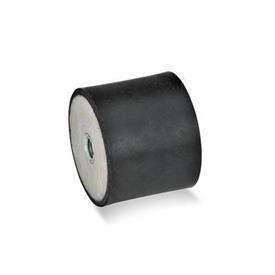
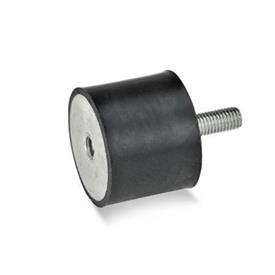
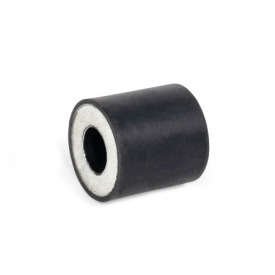
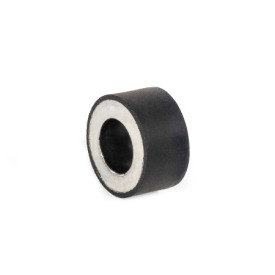
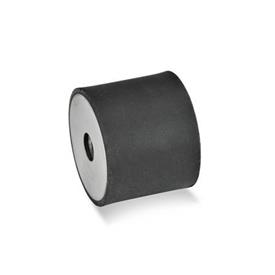
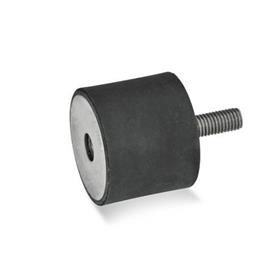
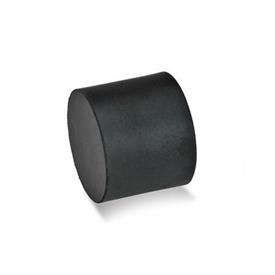
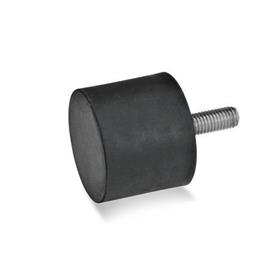
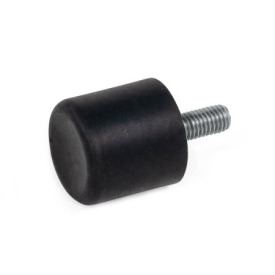
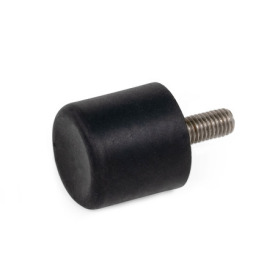
Extrêmement polyvalents et durables, les amortisseurs cylindriques en caoutchouc sont très d'usage très courant

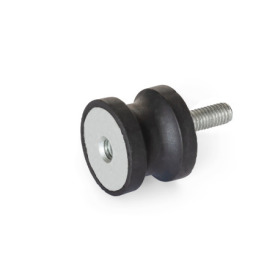
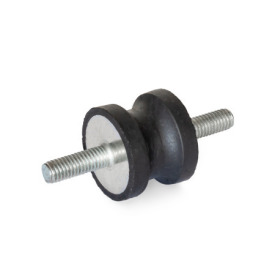
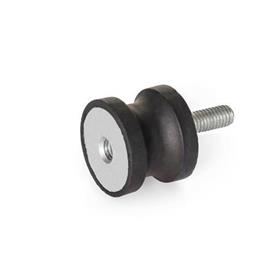
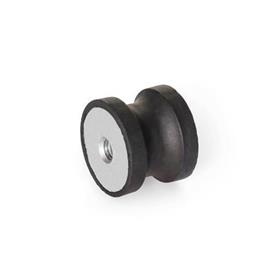
Les amortisseurs paraboliques en caoutchouc sont parfaitement adaptés à l'amortissement des chocs en raison de leur forme spéciale. Leur forme parabolique leur confère un pouvoir amortissant progressif, ce qui leur permet d'absorber les chocs tout en douceur.

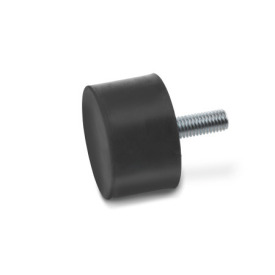
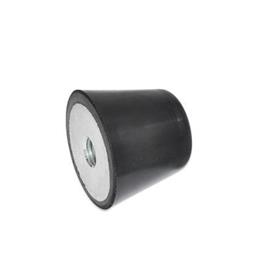
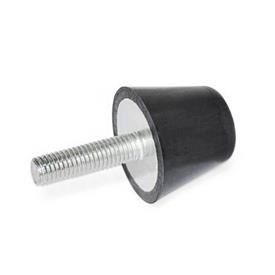
Également très polyvalents et durables, les tampons coniques en caoutchouc sont souvent utilisés en tant que pieds pour appareils.

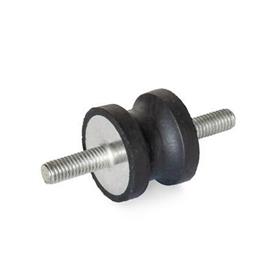
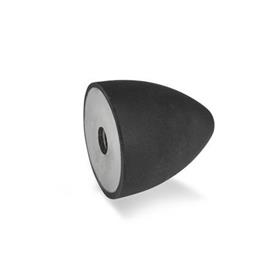
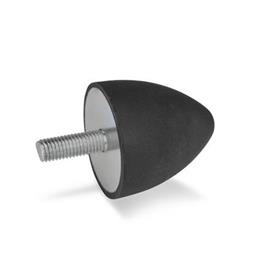
Les tampons caoutchouc-métal de forme fuselée absorbent mieux les forces latérales que les tampons cylindriques. Le caoutchouc présente en outre l'avantage de ne pas se déformer au-delà de son diamètre nominal sous l'effet des forces de compression.

Acheter des tampons caoutchouc-métal Ganter

Ganter propose une large gamme de tampons de différents types en tant que pièces standard. Ils sont disponibles en filetage mâle ou femelle de M3 à M16. Les formes les plus courantes sont disponibles en stock en 3 niveaux de dureté Shore (40, 55 et 70 Shore). En dehors des tampons en caoutchouc de couleur noire, certains modèles de sont également disponibles en gris, de série ou sur demande. Les tampons gris présentent l'avantage de ne pas se décolorer par abrasion.

FAQ - Foire aux questions

Filtrer produits
Matériau
Filetage (de - à) Filetage
Alésage (de - à) Alésage
Longueur de goujon (de - à) Longueur de goujon
Famille de produits

Rien trouvé ? Demandes spéciales

FAQ - Foire aux questions

How can rubber buffers help reduce shock and vibration in machinery?

Rubber buffers elastically absorb vibrations, shocks, and impacts generated by machinery and reduce their transmission to adjacent components or foundations. The elastic rubber-metal elements dampen shocks and absorb vibrations, effectively protecting machine components and equipment from damage caused by vibrations. This allows you to significantly reduce failures caused by material fatigue, unwanted operating noise, and damage to machines or components – a key factor in ensuring the safety and longevity of your equipment.

How rubber buffers work in damping vibrations

Rubber buffers, such as GN 351 or GN 451, consist of an elastic elastomer component (such as NR, NBR, or silicone) and sturdy metal parts made of zinc-plated steel or stainless steel. The rubber element absorbs vibrations and converts the resulting kinetic energy into heat. This allows you to significantly reduce the direct transmission of vibrations and shocks to adjacent machine components using rubber buffers. This helps reduce noise levels and minimize disruptive vibrations – making it ideal for applications where sensitive equipment or measuring systems need to be protected.

Practical applications in mechanical engineering

The targeted use of rubber buffers makes it possible to “dampen” disruptive vibrations directly at the source, even in highly dynamic processes. This makes assembly machines, conveyor systems, and pumps run much more quietly. It also protects the screw connections and joints at the same time. With flexible geometries – such as cylindrical (e.g. GN 351, GN 451), conical, or waist-shaped – and various Shore hardness ratings, vibration damping can be precisely tailored to the specific load directions and frequencies at hand.

Quick installation and adjustment

  • Rubber buffers such as GN 351 (steel, with internal/external threads) or GN 451 (stainless steel, with internal/external threads) can easily be mounted between the machine and the foundation or directly to mounting surfaces.
  • Special versions with a through hole or cover plate (e.g., GN 351 Through holes, GN 451 with a cover plate on one side, also allow for secure installation on existing systems.

Stop buffers for end-of-travel protection

  • Buffers (such as GN 352, GN 452) absorb the impact of hard jolts during acceleration and braking. This ensures that bearing housings, housing covers, and moving machine components are reliably cushioned and protected from damage.
  • For hygienic applications, silicone buffers - such as GN 256 with stainless steel threads - provide reliable, long-lasting cushioning even at high temperatures or during cleaning.

What applications are Ganter Norm rubber buffers suitable for?

Rubber buffers from Ganter Norm are used wherever machines, equipment, or systems need to be reliably protected from impacts, vibrations, and shocks. Thanks to their elastic properties, they effectively reduce the transmission of stress, thereby preventing damage to sensitive components.

Applications for rubber buffers

  • Mechanical engineering: Mounting of motors, compressors, and pumps to dampen vibrations transmitted to the frame and protect components over the long term.
  • Plant and equipment engineering: Stops and damping elements for doors, flaps, guides, and conveyor systems. This significantly reduces noise and material wear.
  • Automation technology: Elastic mounts for moving components or sensitive sensors ensure optimal operational reliability even under shock-type loads.
  • Transportation and logistics applications: Prevent shifting, sliding, or damage to shipping containers and cargo by absorbing hard impacts.

What this means in practical terms: Rubber buffers from Ganter Norm are used wherever unwanted vibrations need to be reduced, components need to be protected, or end positions need to be gently cushioned. Applications include foot buffers on assembly racks, stops in linear guides, or vibration dampers on machines.

The benefits of rubber buffers from Ganter Norm

  • Reliable shock and vibration damping – protects components and extends the machine's service life.
  • Wide range of variants: A variety of shapes (such as cylindrical, conical, and waist-shaped), Shore hardness ratings, thread types, and colors allow for precise adaptation to any installation situation.
  • Flexible mounting options: Available with an internal thread, external thread, or through hole – ensuring that the specific rubber buffer model perfectly suits your installation requirements.
  • Choice of materials for any application: Depending on the requirements, parts are available in zinc-plated steel, stainless steel, or with silicone, making them suitable for reliably covering even the most demanding areas of application, such as corrosive environments or contact with food.
  • Extremely quick and easy installation

This allows you to control vibrations and shocks at the design stage, thereby enhancing your system’s safety and ease of use. It is also ideal for retrofitting projects in which existing systems need to be quickly upgraded with custom rubber buffers.

What types of mounting options are available for rubber buffers, and what are the differences between them?

There are various mounting options available for rubber buffers, differing primarily in the design of the connecting elements and the possibilities of their applications. Choosing the right mounting method makes it easier to integrate the product into various applications and ensures secure and easy installation.

Overview of mounting options for rubber buffers

  • With internal thread: Rubber buffers such as GN 351 (steel) or GN 451 (stainless steel) have an internal thread and can be easily secured from the outside using a screw or threaded rod. This allows you to easily install rubber buffers even in hard-to-reach areas or quickly replace them if needed.
  • With external thread (threaded bolt): Many models of rubber buffers (such as GN 351 GN 451, ) feature a single-sided or double-sided threaded bolt. Simply screw the buffer directly into an existing thread. This allows for quick installation without the need for additional fasteners – ideal for mass-production applications or as a stop.
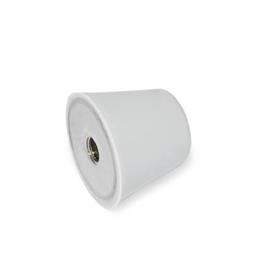
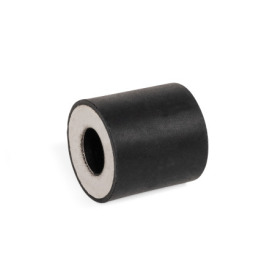
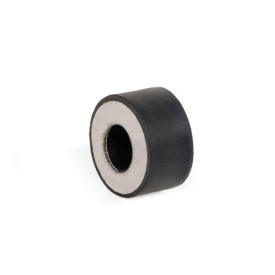
  • With through hole: The product range also includes items such as GN 351 andGN 451 with through holes, with or without a cover plate on one or both sides. Fastening can be carried out flexibly, e.g. with standard screws. This allows you to take advantage of flexible installation wherever there are threads in the component or a detachable connection is required.
  • With retaining washer: Stop buffer models like GN 454 feature an integrated stainless steel retaining washer. These rubber buffers are used for applications such as end-stop buffers, like in conveyor trolleys. They can be fixed on the damping side by elements like socket cap screws DIN 912.

What does this mean in practice?

A variety of mounting options allows you to tailor rubber buffers precisely to your specific installation conditions and load requirements. This simplifies integration, enhances security, and minimizes the risk of installation errors. In applications that call for quick maintenance and replacement, or where a wide variety of installation orientations are required, selecting the right thread or bore variant can significantly reduce installation time and downtime costs.

What thread sizes and mounting options are available for rubber buffers?

Ganter offers a wide selection of rubber buffers in various thread sizes and mounting options. This allows you to customize the installation to suit your application and adapt flexibly to the structural conditions.

Thread sizes for rubber buffers

  • Internal thread: Many models, such as GN 351, GN 451, GN 356, GN 456, GN 253,GN 254, and GN 256, are available with metric internal threads (M3, M4, M5, M6, M8, M10, M12, M14, and M16).
  • **External thread: ** GN 351Many models are also available with metric external threads (e.g., GN 451, GN 356, GN 456, GN 253, GN 254, and GN 256). Typical sizes range from M3 to M16, so there is a suitable size available for virtually any installation situation.
  • Through holes: GN 351Certain models, such as the new one, as well as their variants, feature cylindrical through holes with diameters ranging from 4.3 to 30 mm for direct screw or bolt mounting

What operating temperatures are Ganter rubber buffers suitable for?

The operating temperature depends on the elastomer used:

  • Natural rubber (NR): -40 °C to +80 °C
  • Acrylonitrile-butadiene rubber (NBR): -30 °C to +80 °C
  • Silicone rubber (MVQ): -30 °C to 200 °C

Are Ganter Norm rubber buffers suitable for use in fields with sensitive hygiene requirements, such as the food or pharmaceutical industries?

Ganter Norm rubber buffers are available in special versions that are especially well suited for use in fields with sensitive hygiene requirements, such as the food and pharmaceutical industries. The stainless steel and silicone versions are most commonly used here, as they offer high resistance to cleaning agents and disinfectants and prevent corrosion. Products such as GN 451 (stainless steel, with various mounting options), GN 456 (rubber buffers, stainless steel), or the stop buffers GN 452,GN 453 and GN 254 (all in stainless steel) meet the heightened hygiene standards required in practice.

Stainless steel rubber buffers for applications with sensitive hygiene requirements

  • Products such as GN 451, GN 452, GN 453, GN 454, GN 254 and GN 456 are made of stainless steel, making them suitable for environments in which cleanliness and corrosion resistance are paramount.
  • Stainless steel cover plate options (such as GN 451, with a cover plate vulcanized onto one or both sides) prevent dirt particles or liquids from getting under the metal parts, simplifying cleaning.
  • Stainless steel parts are resistant to moisture and common cleaning chemicals. This ensures that the function remains intact even after intensive cleaning

Silicone buffers for the strictest hygiene standards

  • The GN 256 silicone stop buffers (with internal thread or screw, stainless steel) feature a flexible damping element made of food-grade, age-resistant silicone in addition to the stainless steel housing.
  • Silicone is extremely easy to clean and often meets the requirements of the FDA or other food safety regulations.

This allows you to respond flexibly in areas where there is direct contact with food or where hygiene requirements are especially stringent, without sacrificing the benefits of shock and vibration damping.

What to look for when choosing rubber buffers for sanitary areas

  • Use nothing but stainless steel parts or silicone buffers when it comes to preventing corrosion and contamination.
  • Mounting options with closed or covered surfaces (cover plate) simplify cleaning.
  • Contact Ganter Service regarding additional industry-specific certifications or tests, if required for your application.

With the right rubber buffers from Ganter Norm, you can improve the operational safety and ease of maintenance of your equipment in hygiene-sensitive environments. If you have any questions, we recommend consulting directly with Ganter so that you can choose the product that best meets your needs.

What are the standard sizes available for rubber buffers, and can custom sizes be made?

Rubber buffers are available in a wide range of standard sizes. For types GN 351 (steel, with internal/external threads), GN 451 (stainless steel, with internal/external threads), as well as variants with through holes and/or cover plates, there are numerous combinations of outer diameter, height, and thread size/mounting option to choose from. The same applies to variants such as GN 352, GN 452, as well as the special types GN 357/GN 457 with a concave contact surface and the GN 256 silicone buffers.

Standard sizes for rubber buffers

  • The diameter ranges of standard rubber buffers vary from approximately 6 mm to 125 mm, depending on the product.
  • The heights of the rubber components typically range from 7 mm to 75 mm.
  • Thread sizes available from M3 to M16
  • Various elastomer hardness ratings (e.g. Shore 40, 55, 70) and colors for specific applications.
  • Shapes such as cylindrical, conical, parabolic, waist-shaped, or with a concave contact surface.

This allows you to select the right size for almost any standard damping or mounting application directly from the standard product range. This simplifies design planning, shortens development time, and makes it easy to reorder quickly.

Custom-made options

In addition to standard sizes, Ganter offers custom-made products. For example, you can request custom dimensions.

For a special design, please contact Ganter Service directly at +49 (0) 7723 6507-259. This allows you to tailor components to your specific technical requirements, even if the standard specifications are insufficient.

How do I find the right rubber buffer in terms of geometry and dimensions for my application?

To select the right rubber buffer for your application, start by considering the required geometry and dimensions. Ganter rubber buffers are available in a variety of designs, including cylindrical, parabolic, conical, waist-shaped, or with a special concave stop surface. This allows you to precisely tailor the damping characteristics to the mechanical requirements of your system or machine components. The greatest benefit comes from the effective reduction of vibrations, shocks, and jolts, as well as the targeted protection of your components.
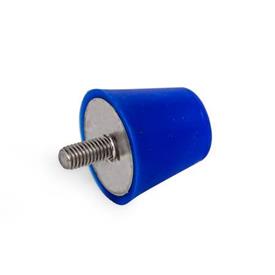
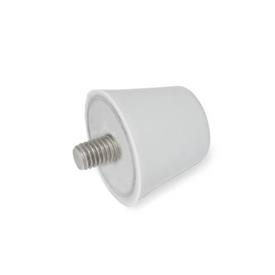
Steps for choosing rubber buffers based on geometry and dimensions

  1. GN 352GN 351First, determine whether you need a standard rubber buffer (e.g., GN 451, GN 356, GN 456, ) or a limit buffer (e.g., GN 452, GN 806). This depends on whether the focus is on elastic mounting or on limiting travel or vibration.
  2. Select the design based on the installation situation and take the spring characteristics into account.
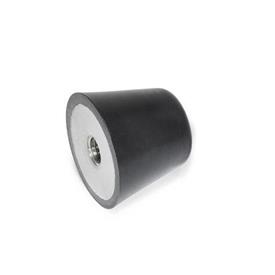
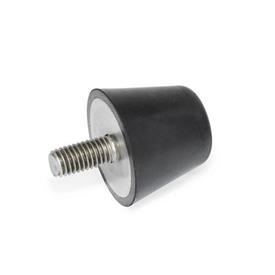
  3. Cylindrical designs (such as GN 351 and GN 451) are highly versatile and provide uniform damping under both axial and radial loads.
  4. Concave stop buffers (GN 357, GN 457) are suitable for precise damping in specific load situations.
  5. Special designs (such as GN 806, with no metal or GN 256, made of silicone) can offer advantages when in contact with sensitive surfaces or in areas where hygiene is critical.
  6. Take the available installation space into account: Use sketches or the available space to determine the maximum permitted height and diameter.
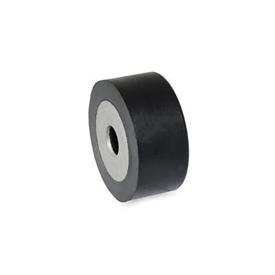
  7. Compare the available dimensions in the Ganter online catalog – many rubber buffers can be customized in diameter, height, and thread size to fit the installation location.
  8. Use the filter options provided to select by thread type (internal or external thread, screw, through hole), material (steel, stainless steel, silicone), and Shore hardness rating.

Benefits of carefully choosing the geometry and dimensions of rubber buffers

  • You can tailor the energy absorption and spring action to the specific direction of the load.
  • Optimized sizing ensures a long service life and reduces installation effort.
  • Thanks to the precise fit, your application remains reliable over the long term – unnecessary overloads or resonance can be avoided.

Rubber buffers: Geometry and dimensions as a decisive factor

The selection based on geometry, Shore hardness, and dimensions plays a key role in determining the damping effect and the accuracy of the fit during installation. With our wide range of cylindrical, tapered, and custom shapes – combined with various mounting options such as internal threads, external threads, or through holes – we can reliably meet virtually any requirement for vibration and shock protection. This saves you time during development and assembly and provides long-term protection for your components.

What information is required to order rubber buffers?

When ordering rubber buffers, please provide the following information to ensure a perfect fit and prompt delivery:

Information for ordering rubber buffers

  • Product type or standard number
  • Dimensions (e.g. diameter, height/length; depending on the design, also thread length)
  • Thread type or mounting method (internal thread, external thread, through hole, mounting washer, threaded bolt)
  • Material of the metal parts (zinc-plated steel or stainless steel)
  • Elastomer type (natural rubber NR as standard; NBR or silicone are also available for certain types)
  • Shore hardness rating (usually specified as 40, 55, or 70 Shore, depending on the damping required)
  • Geometry (e.g., cylindrical, conical, parabolic, waist-shaped; special: concave contact surface)
  • Color, if different from standard (relevant for silicone buffers, for example)

What does this mean in practice?

This way, you can ensure that the elasticity, fastening, and durability are exactly tailored to your needs. You can always find the exact model number and technical specifications in the respective product description.

Practical tips for selecting rubber buffers

  • First, determine which load direction (compression, shear, or impact) is relevant – the geometry varies depending on the application.
  • Use the selection filters on the Ganter website to specify the dimensions, material, and thread type.
  • A variety of Shore hardness ratings and elastomer types are available – ideal for applications where vibrations need to be dampened or components need to be protected.
  • For hygienic or humid environments, we recommend using stainless steel variants such as GN 451, GN 456, or the GN 256 silicone series.

This allows you to select rubber buffers that are perfectly suited to your specific needs and ensures a fast, error-free procurement process.

What standards do rubber buffers from Ganter Norm meet?

Rubber buffers from Ganter Norm comply with internal quality standards as well as the applicable material and manufacturing standards relevant to mechanical engineering and industrial applications. There is no binding, universal DIN or EN standard specifically for rubber buffers as complete assemblies. In lieu of such standards, Ganter defines unique dimensions, tolerances, materials, and options for each product series, which are documented in clear product specifications. This provides you with clearly defined geometries (cylindrical, conical, etc.), standardized dimensional tables, and specified properties for elastomer and metal parts in every series.

Mandatory standards for rubber buffers

  • Production in accordance with Ganter drawing standards: Each model is based on specifications that have been precisely defined internally at Ganter.
  • Materials that comply with international standards: For example, steel components are available in zinc-plated or stainless steel (usually 1.4301/1.4401), while elastomers such as NR (natural rubber), NBR, or silicone meet the standard requirements of the mechanical engineering industry.
  • Shore hardness rating and dimensions according to the Ganter standard: For each series, there are clearly identified variants based on hardness (Shore A), outer diameter, height, and connections.

What does this mean in practice?

Since there is currently no DIN, EN, or ISO standard applicable across Europe or globally for the complete rubber buffer assembly, standard parts from Ganter offer reliability in planning and procurement thanks to their engineered and documented design. This means that for every product variant, you can be confident that dimensional accuracy, material quality, and connection options are precisely defined and consistently available. This makes it easy to select rubber buffers in a transparent manner and integrate them seamlessly into a wide variety of machine or plant designs.

Guidelines for selecting and using rubber buffers

  • Refer to the detailed product labeling – it ensures clear technical identification and makes it easier to source replacement parts.
  • Check whether the material-specific specifications (zinc-plated steel, stainless steel, NR/NBR/silicone) and the Shore hardness rating meet your requirements for elasticity and durability.
  • Select the appropriate geometry, connection type (internal thread, external thread, screw, through hole, cover plate), and size based on your installation requirements. This allows you to respond flexibly to the direction of the load and the energy absorption.

Ganter rubber buffers are ideal for applications where impacts, vibrations, or shocks need to be reliably absorbed – such as for vibration-damping machine mounts or as durable, easy-to-install stop buffers.

What maintenance and care instructions apply to rubber buffers?

Rubber buffers require very little maintenance. A regular visual inspection for mechanical damage, signs of aging, and separation between the rubber and metal is sufficient. The elastic properties are maintained over the long term under normal use, so little maintenance is required. Avoiding the use of oils, greases, and harsh cleaning agents ensures that the material does not age prematurely or develop cracks. All rubber buffers from Ganter Norm can easily be replaced if necessary.

Practical tips for the maintenance and care of rubber buffers

  • Check the rubber buffers at regular intervals for visible damage, deformation, and trouble with adhesion to the metal part.
  • Clean the surface with a damp cloth. Use only mild, alcohol-free cleaning products for this purpose.
  • Avoid contact with oils, solvents, or acids, as these can damage the elastomer.
  • Make sure that the fasteners (e.g. screws or washers) are tight to prevent them from slipping or coming loose.
  • Rubber buffers which have been replaced can easily be substituted with Ganter standard components of the same design – compatibility will be maintained.

Votre contact

Vous recherchez un partenaire Ganter à proximité ? Veuillez sélectionner le pays.

Service Ganter

Notre équipe de service est disponible du lundi au vendredi de 07:30 à 17:00

Demande de prise de contact téléphonique