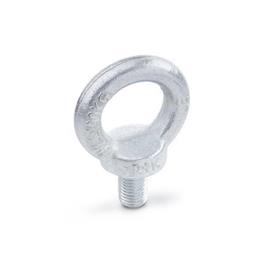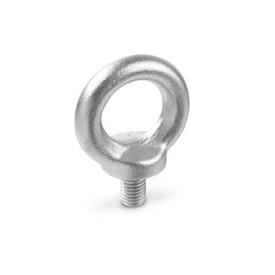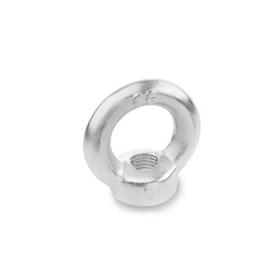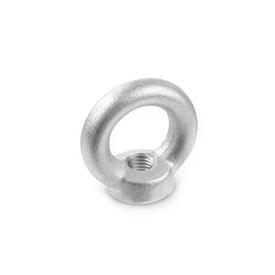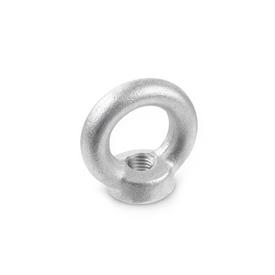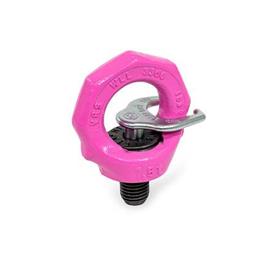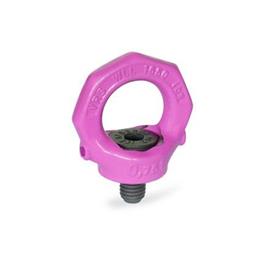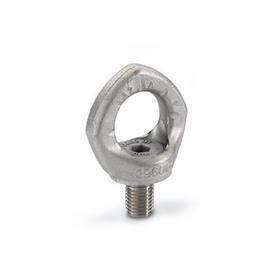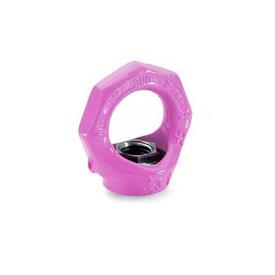
Golfari di sollevamento, terminali a occhiello

I bulloni e i dadi ad occhiello sono elementi di fissaggio indispensabili per garantire la sicurezza nelle operazioni di sollevamento, trasporto e fissaggio nel settore dell'ingegneria meccanica e impiantistica.

Da Ganter troverete bulloni e dadi ad occhiello di alta qualità in acciaio o acciaio inossidabile che si distinguono per l'elevata capacità di carico, la sicurezza certificata e la qualità duratura. Che si tratti di bulloni ad occhiello girevoli, dadi ad anello conformi alle norme DIN o moderni punti di sollevamento con tecnologia RFID, questi prodotti sono ideali per applicazioni professionali nell'industria, nell'ingegneria pesante e nell'edilizia. Scoprite soluzioni affidabili per il sollevamento, il fissaggio e il posizionamento in sicurezza di carichi impegnativi.

FAQ - Domande frequenti

Filtra prodotti
Materiale
Filettatura (da - a) Filettatura
Lunghezza perno (da - a) Lunghezza perno
Famiglia di prodotti

Non hai trovato niente? Richieste speciali

FAQ - Domande frequenti

What versions of lifting eye bolts and lifting eye nuts are available?

Ganter offers a wide range of lifting eye bolts and lifting eye nuts. They differ in terms of material, thread type, rotatability, and additional features. This allows you to choose the right product for your specific application.

Available models: Lifting eye bolts and lifting eye nuts

  • **Lifting eye bolts DIN 580, lifting eye nuts DIN 582 ** – each available in three material options:
    • Steel: durable and versatile for standard lifting tasks in mechanical and plant engineering
    • A2 stainless steel: corrosion-resistant for use in damp environments or where higher hygiene standards are required
    • **A4 stainless steel: ** highly resistant to harsh environments, such as saltwater or chemicals
  • Rotatable models for flexible positioning:
    • GN 581: Rotatable steel lifting eye bolts – once installed, the lifting eye bolt can be freely adjusted so that chains, ropes, or shackles can be attached without twisting. This prevents excessive force from being applied and improves safety during lifting.
    • GN 581.5 Rotatable stainless steel lifting eye bolts, similar to GN 581 but made of stainless steel, ideal for applications with exceptionally high corrosion protection requirements, as well as for food and pharmaceutical applications.
    • GN 583: Rotatable steel lifting eye nuts – allow for free alignment even when the nut is installed, which is especially useful in tight spaces or when the mounting direction changes frequently.

Additional features and practical benefits

  • All models listed are available with metric thread sizes ranging from M6 to M36 and are BG-certified.
  • Rotatable versions are available with an optional built-in RFID transponder, which allows you to uniquely identify each lifting eye bolt or lifting eye nut and digitally document their inspection history. This allows your company to ensure seamless security and traceability.
  • All Ganter lifting eye bolts and lifting eye nuts comply with the RoHS Directive and the Machinery Directive. This means they can be reliably integrated into modern systems and machines.

What should you consider when choosing the right size for lifting eye bolts and lifting eye nuts?

When selecting the correct size for lifting eye bolts and lifting eye nuts, it is crucial that the connecting element is optimally suited to the intended load, threaded connection, and lifting situation. The most important selection criteria include thread size, required load-bearing capacity, material, and the application and operating environment. This is the only way to ensure a secure connection that complies with standards. This ensures maximum operational reliability in mechanical and plant engineering, even when handling heavy loads or frequently changing lifting heights.

Selection criteria for lifting eye bolts and lifting eye nuts

  • Thread size (e.g., M6 to M36): Adjust the thread dimensions to match the existing hole or screw hole exactly to ensure a secure fit. This option is available for all models, including DIN 580 and DIN 582, as well as for rotatable versions such GN 581 as GN 581.5 and GN 583.
  • Required load capacity: Always select the size based on the maximum lifting capacity. Be sure to take the direction of the force into account, and if in doubt, use the larger option. This will prevent overloading the lifting eye bolt or lifting eye nut.
  • Choice of materials: For standard applications, steel is recommended (DIN 580, DIN 582, GN 581, GN 583). If corrosion protection is required, choose A2 or A4 stainless steel (DIN 580, DIN 582, GN 581.5). This allows you to lift safely even outdoors or in harsh environments.
  • Rotatable or fixed design: Rotatable lifting eye bolts (GN 581, GN 581.5) and lifting eye nuts (GN 583) allow for optimal alignment in the direction of tension. This prevents unwanted lateral loads and makes handling easier. Ideal for varying load directions.
  • Compliance with standards and test certification: All models listed are BG-certified, comply with the Machinery Directive, and meet the relevant DIN or Ganter standards. This ensures you have tested, reliable lifting points.

What materials are used for lifting eye bolts and lifting eye nuts?

Ganter manufactures lifting eye bolts and lifting eye nuts from high-quality materials, using either steel or stainless steel. The steel used is high-strength, crack-tested steel that provides a reliable grip during lifting operations. Stainless steel versions are available for applications with specific corrosion resistance requirements: A2 stainless steel for general applications and A4 stainless steel for especially corrosive environments, such as those found in the chemical industry or outdoors. Rotatable models such as the GN 581 and GN 583 are available in high-strength steel. GN 581.5 is also available in stainless steel.

Overview of materials available for lifting eye bolts and lifting eye nuts

Advantages of different materials

  • Steel: High strength, ideal for heavy loads in indoor applications and wherever there is no increased risk of corrosion. This allows you to work safely and cost-effectively in traditional industrial sectors.
  • A2 stainless steel: Corrosion-resistant, suitable for humid environments, food processing, and outdoor use where there is no significant exposure to harsh chemicals. This allows you to respond flexibly to different environmental conditions.
  • A4 stainless steel: Extremely high corrosion resistance, ideal for corrosive environments, demanding hygiene areas, or marine applications. This ensures long-term reliability even under extreme conditions.

What thread sizes are available for lifting eye bolts and lifting eye nuts?

Ganter offers standard metric thread sizes from M6 to M36 for lifting eye bolts and lifting eye nuts. These dimensions are available for both the classic, rigid models (in accordance with DIN 580 and DIN 582, made of steel and stainless steel, respectively) and the rotatable models (GN 581, GN 581.5, GN 583).

Available thread sizes for lifting eye bolts and lifting eye nuts

  • Standard thread sizes: M6, M8, M10, M12, M16, M20, M24, M30, M36
  • All sizes listed are available for the following product types:
    • Lifting eye bolts DIN 580 (steel, A2 stainless steel, A4 stainless steel)
    • Lifting eye nuts DIN 582 (steel, A2 stainless steel, A4 stainless steel)
    • Rotating lifting eye bolts GN 581 (steel) and GN 581.5 (stainless steel)
    • Rotating lifting eye nuts GN 583 (steel)

What does this mean in practice?

You can select the exact thread size needed for virtually any lifting or slinging application in mechanical and plant engineering. This allows the stop element to be precisely adjusted to the specified connection dimensions of your design. At the same time you can choose between sturdy steel and corrosion-resistant stainless steel for all product types of lifting eye bolts and lifting eye nuts. This allows you to flexibly put together the best solution for your application and environment.

What precautions should be taken when using lifting eye bolts and lifting eye nuts as lifting gear?

When using lifting eye bolts and lifting eye nuts as lifting devices, special attention must be paid to selecting products that comply with standards, ensuring proper installation, and monitoring the load. Certified products lifting eye bolts DIN 580 or lifting eye nuts DIN 582, as well as rotating versions GN 581, GN 581.5 and GN 583 made of steel or stainless steel are suitable for reliable and safe lifting operations.

Key criteria for selecting and installing lifting eye bolts and lifting eye nuts

  • Make sure the lifting eye bolt or lifting eye nut is suitable for the type of load and the required thread size (M6 to M36 available). Select the correct version (e.g., A2/A4 stainless steel for corrosive environments).
  • For safety-critical applications, choose products with BG certification and compliance with the Machinery Directive, such as those offered by Ganter. Standardized products such as DIN 580 (lifting eye bolts, steel, A2/A4 stainless steel) and DIN 582 (lifting eye nuts, steel, A2/A4 stainless steel) are manufactured and tested in accordance with strict quality standards. This makes it easy to comply with legal and company requirements.
  • Always screw lifting eye bolts and lifting eye nuts fully and tightly into the locating thread until they stop. This is the only way to ensure maximum safety.
  • Make sure the force application point (the ring) is properly aligned. For changing pull directions, rotatable models such as GN 581 or GN 583 are recommended, as they can be adjusted to align perfectly with the direction of force. This prevents unwanted twisting and ensures that the load is transferred safely.
  • Regularly inspect the lifting eye bolts and lifting eye nuts to ensure they are in good condition (e.g. check for cracks, corrosion, or deformation). This is how you prevent dangerous equipment failure during operation. Whenever possible, use RFID tags for unique identification and tracking.

Additional guidelines for selecting lifting eye bolts and lifting eye nuts

  • Lifting eye bolts and lifting eye nuts are ideal for lifting and transport applications that require defined load-bearing points.
  • The product range meets common standards as well as specific requirements for hygiene and corrosion protection (A2/A4 stainless steel).

This provides you with a reliable, long-lasting solution that can be easily adapted to meet the demands of challenging lifting applications.

Can Ganter Norm lifting eye bolts and lifting eye nuts be used with different types of lifting gear?

Yes, lifting eye bolts and lifting eye nuts from Ganter Norm can be flexibly combined with various elements of lifting gear, such as chains, ropes, round slings, or shackles. Both the standard models DIN 580 and DIN 582, as well as the rotatable models GN 581, GN 581.5 and GN 583 are designed as designated attachment points suitable for use with various types of slings. This makes it possible to easily adapt virtually any standard lifting technology used in mechanical and plant engineering in accordance with industry standards.

Possible combinations with lifting slings

  • Ganter Norm lifting eye bolts and lifting eye nuts are compatible with all standard forms of lifting gear, such as chains, wire rope slings, round slings, and shackles.
  • The selection is based on the specific thread type and load-bearing requirements.

Practical tip for selection

  • Select the appropriate product based on the desired mounting thread (M6 to M36), material (steel or stainless steel), and the desired level of flexibility (rotatable or fixed).
  • For applications requiring documentation, we recommend using the rotatable models with RFID transponders (GN 581, GN 581.5, GN 583). This enables unique identification and digital audit trail tracking during operation. This increases transparency and traceability in day-to-day operations and makes it easier to document maintenance and inspection cycles.

This allows you to respond flexibly in your application, securely attach lifting loads, and reliably fulfill your documentation requirements.

What load capacities do Ganter lifting eye bolts and lifting eye nuts offer, and how are they designated?

Ganter's lifting eye bolts and lifting eye nuts are designed as reliable load-bearing components for the machine and plant engineering industry. The load-bearing capacity of these products depends on the specific thread size and the material used. Options include steel, A2 stainless steel, or A4 stainless steel for special requirements.

Load capacities for lifting eye bolts and lifting eye nuts

The permissible load capacity varies depending on the product standard and model. The system is based on standard parts DIN 580 (lifting eye bolts) and DIN 582 (lifting eye nuts), whose load-bearing capacities are specified in graduated sizes. The product range also includes rotatable versions (GN 581, GN 581.5, GN 583), which allow for optimal force direction thanks to their special design, thereby providing greater flexibility and safety. You can find the load capacities for all the products listed directly in the technical specifications on the product page. For example, the load-bearing capacity of an M12 lifting eye bolt DIN 580 in steel version is 0.34 t.

  • Each size/variant has a specified load capacity, tailored to the thread and material.
  • These values apply only when the screw is fully tightened, fits properly, and is used as intended.
  • Rotatable models offer greater safety under varying loads thanks to their adjustable force directions.

Select the appropriate load-bearing element based on the load case to avoid risks associated with overloading. This is especially true for applications in which heavier components or assemblies must be moved reliably and in compliance with standards.

Marking and safety of connecting devices

The labeling of lifting eye bolts and lifting eye nuts complies with current standards and ensures maximum safety:

  • The standard (e.g., DIN 580 or DIN 582), the thread size (e.g., M16), and other inspection information are permanently laser-marked or stamped on each part.
  • Ganter's rotating lifting eye bolts and lifting eye nuts also feature a special identification system with an integrated RFID transponder, allowing each lifting device to be uniquely identified and the required inspection history to be conveniently documented.
  • All products are BG-certified and comply with RoHS and the Machinery Directive (2006/42/EC).

This allows you to quickly determine at any time during operation whether the lifting sling is approved for the intended load. Errors caused by mix-ups or improper use are effectively prevented.

Are replacement parts or special designs available for lifting eye bolts and lifting eye nuts?

Individual replacement parts are not available for lifting eye bolts and lifting eye nuts, as these are safety-critical, integral components. To ensure full functionality and safety, Ganter generally recommends replacing the entire component if it is worn or damaged. This ensures safe load operation and reliable compliance with all regulatory requirements.

Custom designs of lifting eye bolts and lifting eye nuts

With Ganter's custom designs, you can be sure that the lifting eye bolts or lifting eye nuts will be perfectly suited to your specific application and offer the highest level of operational safety. For custom designs, please contact Ganter Service directly at +49 (0) 7723 6507-259 – our technical support team will provide expert assistance from your initial inquiry through to delivery.

Il tuo referente

Cerchi un rappresentante Ganter vicino a te? Seleziona il paese desiderato.

Telefono del centro di assistenza

Il nostro team di assistenza è disponibile dal lunedì al venerdì dalle 07:30 alle 17:00 al numero:

Richiedi contatto telefonico