Shackles for secure load attachment secure load attachment

Ganter's high-quality shackles, made of heat-treated steel, offer maximum safety when lifting, slinging, and securing heavy loads.

The straight and curved versions impress with their high load capacity, 6-fold safety factor, and durable, hot-dip galvanized quality for industry, mechanical engineering, and material handling. Thanks to a variety of sizes and designs, Ganter shackles are ideal for ropes, chains, and wire ropes in demanding applications. Discover robust shackles with certified safety and custom-fit solutions for professional load handling.

FAQ - Frequently Asked Questions

Nothing found? Special requests

FAQ - Frequently Asked Questions

What are shackles and what are they used for?

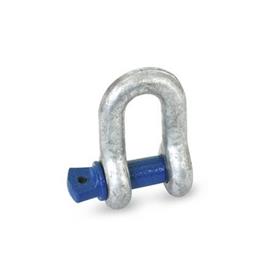
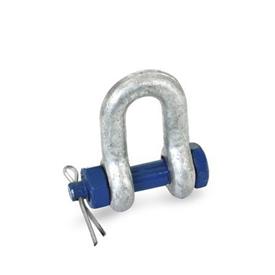
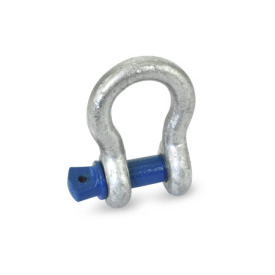
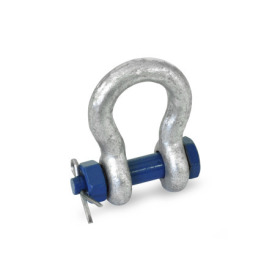
Shackles are indispensable as standardized connecting elements in industrial load stops if you want to connect ropes, chains or wire ropes safely and flexibly. Typical shackle models such as GN 584 (steel, straight version) and GN 585 (steel, cranked version) are made of robust, tempered steel, are die-forged and hot-dip galvanized. A lockable bolt makes the connection so that shackles remain reliably closed and can still be easily released.

What are shackles used for?

Shackles are mainly used for transporting, lifting and securing loads. As a result, lifting gear such as chains or wire ropes can be quickly and securely fastened to components or released again. Areas of application include mechanical and plant engineering, conveyor technology and assembly work.

Features of shackles GN 584 and GN 585

  • Different geometries: The straight version GN 584 is especially well suited for straight pulling directions, while the cranked version GN 585 offers more freedom of movement.
  • Different buckle shapes: Can be used optionally for permanent connections with cotter pins or frequent loosening with screw thread.
  • Each version is marked with nominal load capacity and nominal size. This increases safety during use and prevents incorrect applications.
  • A six-fold safety factor provides additional operational safety. So you can use shackles even for demanding lifting operations.

What does this mean in practice?

Shackles such as GN 584 and GN 585 can be used to quickly establish or detach connections and handle loads efficiently and in a controlled manner. This allows you to act flexibly and safely in the event of different requirements – such as changing between assembly locations, temporarily hitting a crossmember or permanently securing components.

In which industries or industrial sectors are shackles typically used?

Shackles are typically used in industries where secure, flexible and releasable connections are required for lifting, fastening and securing loads. These include - first and foremost - mechanical engineering, plant engineering, conveyor technology and transport. Shackles such as GN 584 (straight version) and GN 585 (cranked version) are also used in industries such as steel construction, intralogistics and maintenance and repair work.

Industries and applications for shackles

  • Mechanical engineering: For mounting, transport and flexible connection of load attachment points
  • Plant construction: For lifting gear in maintenance and connection points.
  • Conveyor and transport technology: For secure attachment of ropes or chains to loads or equipment.
  • Structural steelwork and industrial hall construction: For the temporary or permanent connection of load-bearing elements.
  • Logistics/material handling: As an aid for quick adaptation to different lifting situations.

What does this mean in practice?

With shackles of this product family you can connect or disconnect your lifting and transport equipment comfortably and safely. The robust construction and wide range of different geometries (straight or cranked) ensure that you can react flexibly to different requirements and space conditions. Ideal for applications that require maximum reliability and reusability, such as machine transport, production lines or modular plant setup.

What applications are Ganter shackles especially well suited to?

Ganter shackles are especially well suited for the safe connection and attachment of ropes, chains or wire ropes in industrial lifting applications. Thanks to their construction of die-forged and hot-dip galvanized steel, they offer reliable connections wherever loads need to be transported, lifted or fixed. This enables the safe and convenient transport of heavy machine parts, connection of conveyor chains, suspension of traverses or securing of components in plant construction.

Typical applications for Ganter shackles

  • Machine and plant construction: Attaching and lifting components, temporary or permanent connections during assembly and maintenance.
  • Transport and conveying equipment: Load impact, for example when handling goods in production lines or when securing and tensioning conveyor trains.
  • Mounting inserts: Temporary attachment points during installation, replacement or transport of machine modules.
  • Locking elements: Fixing of components by permanent or releasable sling gear.

Advantages of Ganter shackles in practice

  • Sixfold safety factor: High reliability and protection in daily use.
  • Closed bolts: Permanent or flexible connection depending on the chosen design.
  • Selection between straight (GN 584) and cranked (GN 585) design for precise solutions of a wide variety of stop situations.

What do I need to consider when choosing the right shackle?

When choosing the right shackle, it is important to pay particular attention to the design, the nominal load capacity, the nominal size and the closure technique. Shackles are available in straight (GN 584) or cranked (GN 585) shapes, each made of drop-forged hot-dip galvanized tempered steel with lockable bolt. Both types are designed for use as robust sling gear for connecting ropes, chains and wire ropes, and are especially well suited to industrial applications in transport and conveyor technology as well as in mechanical and plant engineering. This allows you to conveniently choose the right component for a wide variety of connection situations.

Central selection criteria for shackles

  • Nominal load: Each Ganter shackle is marked with the relevant working load limit. Orient yourself to the largest load occurring during operation.
  • Specification: Straight shackles (GN 584) provide a space-saving connection, especially in tight spaces, while cranked shackles (GN 585) allow more freedom of movement and are flexible for changing pulling directions.
  • Nominal size: The nominal size depends on the diameter of the chain, rope or other elements to be connected – it is clearly marked on the shackle
  • Buckle shape: Both Ganter shackles have a lockable bolt that allows for quick, secure connection and reusability. The choice of bolt shape influences how comfortable and repeatable the shackle can be opened/closed during use.
  • Safety factor and marking: A six-fold safety factor greatly increases operational reliability. Always check the clearly visible marking of nominal size and load capacity directly on the product before use to prevent incorrect applications.

What you should pay extra attention to

Regular, knowledgeable checks complement the safety factor: This minimizes the risk of operational failures and increases the service life of your lifting gear.

How do I determine the correct size of a shackle for my specific application?

To determine the correct size of a shackle, you should specifically address the requirements of your use case.

Choosing the correct shackle size – key test criteria

  • Determine the maximum load to be moved or carried. This shall be equal to or less than the nominal load capacity of the shackle.
  • Note the nominal size of the shackle, also called the bolt diameter. The connecting element (the diameter of a chain link or eye bolt, for example) can never be larger than the nominal size.
  • Choose between straight (GN 584) and cranked (GN 585) versions, depending on the installation space required and the mobility of the attached elements. Straight legs are suitable for simple, axial tensile stress. Cranked shackles offer more flexibility when attaching multiple elements.
  • The nominal load capacity clearly marked on each Ganter shackle (GN 584, GN 585) indicates the maximum permissible load. This information must be complied with in a binding manner.

How to proceed in practice

  1. First, read the maximum payload incurred in operation or calculate it, taking into account all the safety factors of your main system.
  2. Compare the required payload with the technical data on the nominal load capacity of the shackle versions GN 584 (straight) or GN 585 (cranked) on the Ganter website. This ensures that the shackle permanently holds the load securely.
  3. Check that the dimension between the chain link, rope eyelet or wire rope eyelet and the shackle frame or bolt fits securely without leaving too much play or too much clearance.
  4. Take into account the desired connection type (single or multi-strand), the space available and any movements or twists during operation and choose the appropriate shackle geometry.

What does this mean in practice?

By correctly determining the shackle size, based on load capacity, nominal size and geometry, you ensure that your lifting gear will work reliably and comfortably in daily operation. This allows you to avoid injury risks and property damage, improve occupational safety and react flexibly to new requirements in plant operation.

Regular monitoring after assembly and before any major load change is ideal. Use only shackles with clearly recognizable nominal load-bearing capacity markings such as GN 584 or GN 585 – this allows you to easily secure your selection process and uniquely identify the relevant component at all times.

What sizes and load capacities are available for Ganter shackles?

Ganter shackles are available in different sizes and load capacities, so you can flexibly choose the right version depending on the application. The main product variants are GN 584 (straight version) and GN 585 (cranked version). Both types are made of drop-forged hot-dip galvanized tempered steel and have a lockable bolt. The products are each marked according to nominal size and load capacity.

Available sizes and load capacities for shackle GN 584 and GN 585

  • For GN 584 (straight version) and GN 585 (cranked version), several nominal sizes are available (6mm to 25mm). Load capacities range from low (0.5 t) to high loads (8.5 t), depending on size, suitable for various industrial load stop applications
  • Both variants are equipped with a six-fold safety factor (minimum breaking force = 6× nominal load capacity). Each nominal size has a clearly defined payload (rated load capacity) that is marked on the product. This will allow you to safely choose the right size for your application.

Size and load capacity marking of shackles

  • The nominal size is usually based on the diameter of the bracket. It is clearly visible on each shackle.
  • The nominal load capacity indicates which load the respective shackle can safely hold. This marking can also be found directly on the product.

In which materials are Ganter Norm GN 584 and GN 585 shackles offered?

Ganter shackles are made of high-quality, drop-forged tempered steel that is additionally hot-dip galvanized. This material is used both in the straight version GN 584 and in the cranked version GN 585.

Advantages of steel material for shackles

  • Die-forged tempered steel ensures high strength and excellent toughness. So you can safely use Ganter shackles under demanding conditions – especially in industrial load stops.
  • Tempered steel is insensitive to short-term shock loads. This allows heavy loads to be reliably connected and moved, even during repeated lifting operations.
  • Hot-dip galvanizing reliably protects the steel from corrosion. Shackles remain functional in the long term when used properly, even when used in outdoor or damp areas.
  • The combination of material and surface coating ensures a sixfold safety factor (minimum breaking force = 6× nominal load capacity) and guarantees safe handling in mechanical and plant engineering.

Where can I find technical drawings and measurements of Ganter shackles?

Technical drawings and dimensional specifications for Ganter shackles can be found directly on the respective product pages. These pages each offer standardized technical drawings, detailed dimensional tables and further information on selecting suitable nominal sizes and designs. This allows you to check exactly which model is suitable for your application in advance and precisely plan the integration into your design.

There is also a CAD data download available to directly reuse the drawings in the design of your project.

Are Ganter shackles CE-conform?

The shackles GN 584 and GN 585 are CE conform and thus suitable for lifting gear. In contrast, the commercial versions GN 584.1, GN 585.1 and GN 585.2 are not CE-conform, making them unsuitable for lifting gear.

Your contact

You are looking for a Ganter partner near you?

Ganter-Service

Our service team is available from Monday to Friday between 7:30 AM and 5:00 PM:

Request Callback