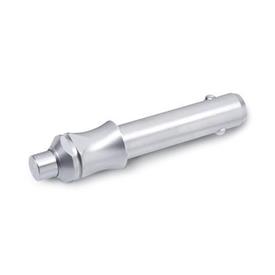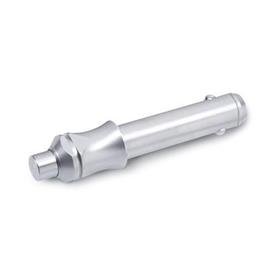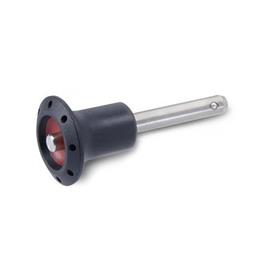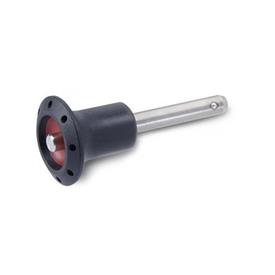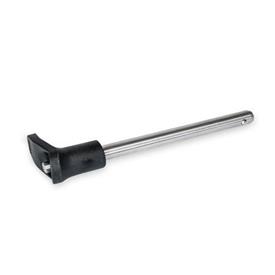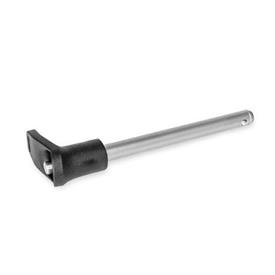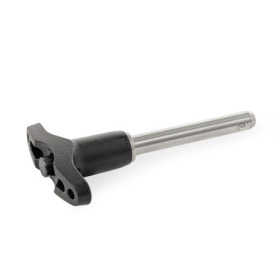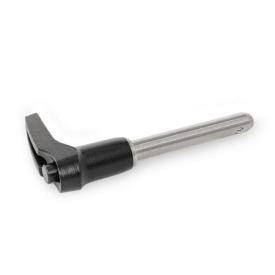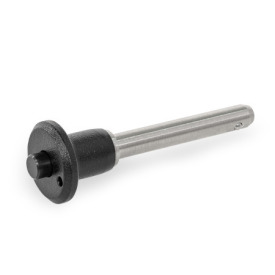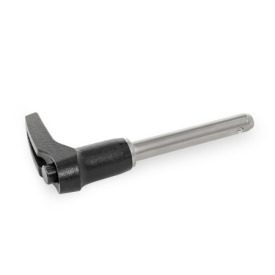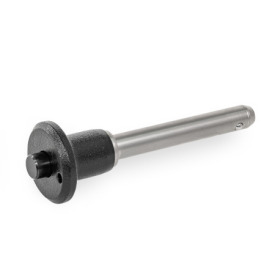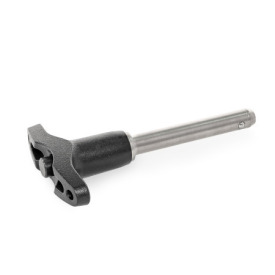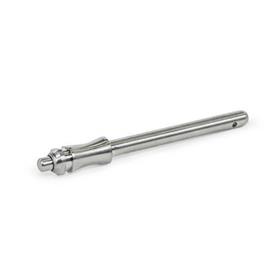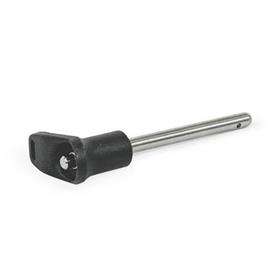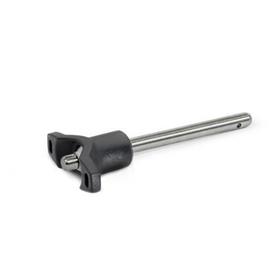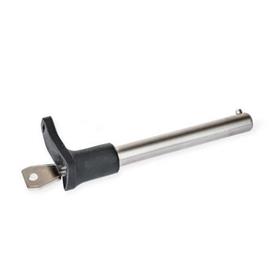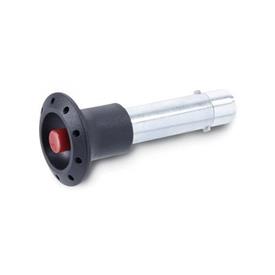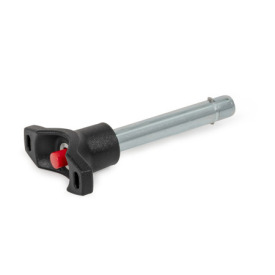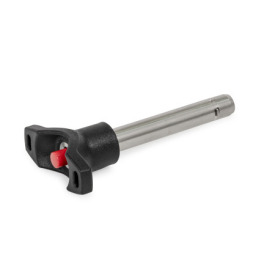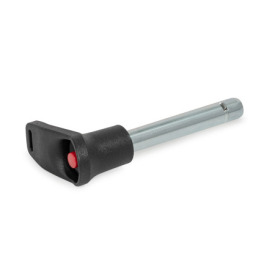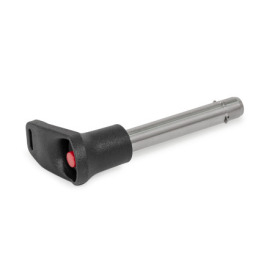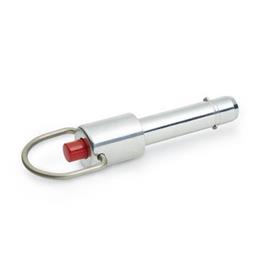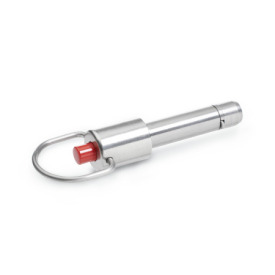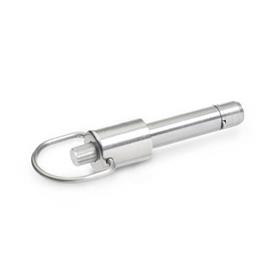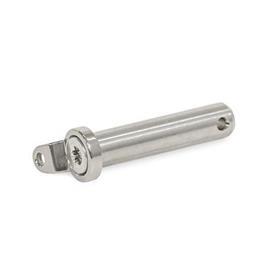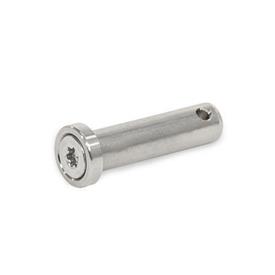
Locking pins and split pin locking pins for securely connecting loose parts

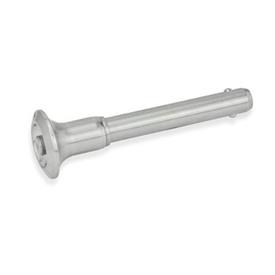
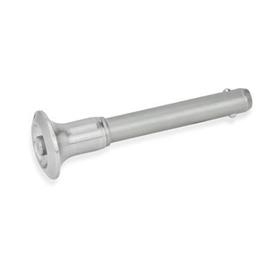
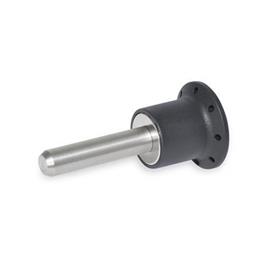
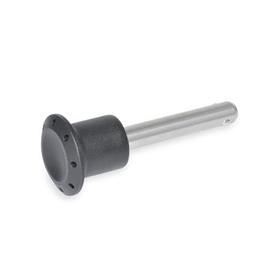
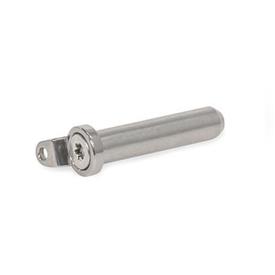
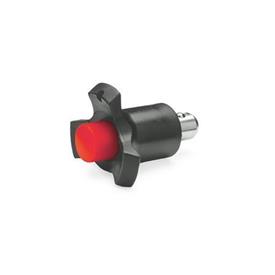
Locking pins, ball lock pins and split pin locking pins are standard parts of steel or stainless steel. They are used to connect separate components together. Simple to use, they are also very reliable. This applies in particular to locking pins with lock.

These are offered either as locking pins with ball lock or locking pins with axial lock. Typical applications for these connecting elements include stage equipment, fitness equipment or jig construction. Ball locking pins from Ganter can be fitted with a retaining cable or a ball chain. These prevent the parts from being lost and ensure that they stay where they are needed.

Locking pins with ball lock or pawl

If the connected elements must be frequently disconnected, a locking pin with ball lock or pawl is the ideal choice. When installed, the balls prevent the locking pin from sliding out of place. To release the locking pin, simply press a release button at the tip of the connector. This allows the balls to move, and the pin can be pulled out.

Locking pins with split pin or spring cotter pin

The locking pins with split pin or spring cotter pin are as simple as they are ingenious: A transverse hole at the end of the locking pin receives the axial locking element made of bent wire. This is available as an accessory in the form of a spring cotter pin or a split pin. The locking pin is prevented from sliding out of place while in use. To release the locking pin, the split pin or spring cotter pin is simply pulled out of the locking pin.

FAQ - Frequently Asked Questions

Filter products
New Products
Material
Bolt diameter (from - to) Bolt diameter
Length (from - to) Length

Nothing found? Special requests

FAQ - Frequently Asked Questions

What are locking pins with axial locks and what are they used for?

Locking pins with axial locks are standard elements made of steel or stainless steel that connect two separate components safely and dissolvable. The axial lock prevents the bolt from unintentionally loosening. Depending on the design, the lock is either via a ball lock (as with ball lock pin GN 113.4, GN 113.5, GN 113.6 and similar) or via lock handle or split locking pin, spring cotter pin or ball lock (for example with locking pins GN 114.2, GN 114.3, GN 124.2, GN 124.3). Plugs of this product family can be additionally secured against loss by optionally attached retaining cables or ball chains.

Typical areas of application of the locking pins with axial locks

They are used wherever flanges, frames, racks or modules need to be connected or disconnected frequently and quickly. These include demanding environments in mechanical engineering, in fixtures, adjustment devices, transport and exchange devices or in the securing of moving machine parts.

Functional principle of locking pins with axial locks and typical variants

  • Ball lock pins such as GN 113.10 or GN 113.20 release and secure position by pressing a button or pulling on the handle, with spring-loaded balls holding the pin in the component. This allows for easy, repeatable connection and release without tools.
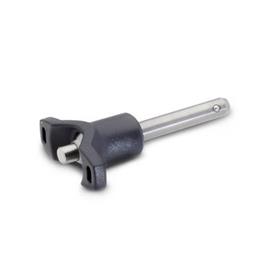
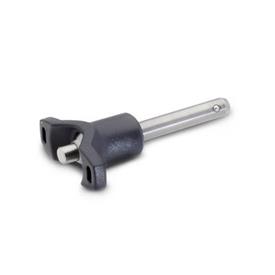
  • Plugs with locking clamp such as GN 114.7 are held in place axially by a mechanical locking device which is released via a slide or button. This way, you can protect components from accidentally falling out and remove them comfortably.
  • Plugs such as GN 124.2 and GN 124.3 provide axial locking through a ball lock-this increases the ease of use for often changing connections on devices.
  • Versions in stainless steel (e.g. GN 113.4, GN 114.3) or even titanium (GN 113.30) are available for especially stringent requirements. This enables you to react flexibly to corrosion protection requirements.
  • Ergonomically designed handles (e.g. GN 113.7 with T-handle, GN 113.11 with L-handle or GN 113.20 with aluminum handle) simplify handling even further.
Practical benefits and advantages
  • Safe, fast and tool-free assembly and disassembly saves time and reduces downtimes.
  • Axial locking provides reliable protection from unintentional loosening and increases the operational safety of mechanical systems.
  • Various securing mechanisms and material variants allow adaptation to individual applications and ambient conditions.
  • Loss protection by means of retaining cables or ball chains provides additional safety – ideal for recurrent disassembly.
Sample applications for locking pins with axial locks
  • Change of tools or modules on production lines (e.g. GN 113.3 and holding bushing GN 1140).
  • Quick securing and releasing of flaps or covers on machine housings (e.g. GN 114.3 or GN 124.1).
  • Temporary joining of mounting frames in fixtures and mounting platforms (e.g. GN 114.6 or GN 124.2).

This allows you to design your assembly processes efficiently and flexibly, especially if they call for frequent changes or retooling. The reliable axial fuse increases process reliability during ongoing operation.

What applications are locking pins with axial locks especially well suited to?

Plugs with axial locking are especially well suited to applications where separate components must be repeatedly and securely connected or detached. They allow for quick and easy assembly and disassembly without the need for additional tools. This allows devices, machine frames or interchangeable inserts to be secured or positioned comfortably and flexibly, for example.

Typical areas of application of locking pins with axial locks

  • Installation of devices for quick changes of production parts or tools
  • Connection of assemblies that need to be removed on a regular basis, i.e. during maintenance work on machines or in maintenance
  • Securing and positioning of moving machine parts that require reliable axial locking to prevent unintentional loosening
  • Fastening of guards, covers or stops to allow flexible working
  • Connection of frames, trusses or profiles in systems that are to be quickly disassembled for cleaning or conversion purposes

Practical use of locking pins with axial locks

The axial locking system (e.g. by means of a ball lock, locking pawl, spring cotter pin or splint) ensures that the pin is protected from vibration or accidentally being pulled out. This increases process reliability, especially in case of frequently changing connections under loads. Optional retaining cables or ball chains, which are available for many models, can also be used to secure the pin to prevent loss, ensuring it remains within easy reach at its place of use. This saves you time and reduces the risk of errors in day-to-day operations.

Example solutions from the product family of locking pins with axial locks

  • The ball locking bolts GN 113.3, GN 113.4, GN 113.7, GN 113.20 and GN 113.30 are ideal for machine and device construction when stainless steel or especially high corrosion resistance is required.
  • The locking pins are suitable for applications where safety is crucial and unauthorized opening must be reliably prevented.
  • Magnetic locking pins with axial locks GN 124.1 simplify repeated removal and installation with low tensile stress.
  • Holding bushings GN 1140 enable secure and repeatable fixation of the pins in frequently used interfaces.

This allows you to respond efficiently to different operating requirements in your application, reduce installation effort and increase safety.

Are locking pins with axial locks suitable as lifting gear?

A normal locking pin with axial lock does not automatically qualify as a hoist or load attachment point. Such pins are generally used for fixing, positioning or connecting components and are not primarily designed for lifting operations or lifting loads over people.

The following PDF "Load Rating Information" explains how the load capacity or the two-section shear strength is calculated for the respective standards.

What are the advantages of the axial lock over other types of lock?

Locking pins with axial locks enable extremely safe and easily controllable connections of separate components. In contrast to other types of locking, such as pure clamps or screw connections, the axial locking ensures that bolts cannot be accidentally released, even under dynamic loads or vibrations. This ensures that critical components remain securely fastened at all times without having constantly having to be watched.

Advantages of axial locking for locking pins

  • Prevents unintended pulling out or loosening of the bolt by the additional means of locking (e.g., splint, spring cotter pin, lock handle, ball lock or magnet).
  • Enables clear visual inspection: It is easy to tell when an axial lock is securely seated. This allows operators to check the condition of the connection quickly.
  • Enables quick and frequent (dis)assembly processes without tools – a major advantage when components are regularly changed or serviced.
  • Secures the bolt connection even under vibrations, movement or changing load directions. This allows you to react flexibly to changing conditions without compromising the connection quality.
  • Numerous variants, such as Ganter products GN 113.3, GN 114.2, GN 124.1 or GN 113.7 offer optimized axial locks for different applications (e.g. ball locks with button release, pawls, magnetic locks or ball retainers).

What does this mean in practice?

Axial secured pins such as ball lock pins GN 113.3 or locking pins GN 114.2 allow fast, tool-free and yet safe connection and release of components. Ideal for frequent setup or maintenance work, machine replacement parts or mobile connection points. Thanks to the axial locking, the connection remains stable even in demanding environments – even if operating errors or external influences occur. This way, you can easily increase work safety and minimize downtime.

Additional practical benefits through optional features

  • Optional retaining cables or ball chains (e.g. with GN 113.3 or GN 114.2) prevent the bolts from being lost and facilitate handling at the installation site.
  • With coordinated holding bushings (such as GN 1140), pins can always be guided safely and positioned correctly. This optimizes the functional sequence and reduces the risk of errors.

Axial locking ensures that pins can be used comfortably, safely and reliably in machine and plant construction.

What are the different variants of locking pins with axial locks?

Locking pins with axial locks are available from Ganter in a wide variety of variants, so that you can find the right solution for almost any requirement. There are versions as ball lock pins, locking pins with pawls, bolts with ball retainers, magnetic locks as well as supplementary accessories and special mounts. This allows you to react flexibly to different construction requirements and benefit from maximum safety against unintentional loosening.

Variant overview of locking pins with axial locks

  • Ball lock pins

    • GN 113.3: Pin stainless steel 1.4305, with gripping tray
    • GN 113.4: Pin stainless steel 1.4542, with gripping tray
    • GN 113.5: Pin stainless steel 1.4305, button plastic
    • GN 113.6: Pin stainless steel 1.4542, button plastic
    • GN 113.7: Pin stainless steel 1.4305, T-handle plastic
    • GN 113.8: Pin stainless steel 1.4542, T-handle plastic
    • GN 113.9: Pin stainless steel 1.4305, button stainless steel
    • GN 113.10: Pin stainless steel 1.4542, button stainless steel
    • GN 113.11: Pin stainless steel 1.4305, L-handle plastic
    • GN 113.12: Stainless steel 1.4542, L-handle plastic
    • GN 113.20: Pin stainless steel, handle aluminum
    • GN 113.30: Ball lock pins, titanium
  • Locking pin with locking pawl (release button or handle):

    • GN 114.2: Pin steel, button plastic
    • GN 114.3: Pin stainless steel, button plastic
    • GN 114.6: Pin stainless steel, button plastic
    • GN 114.7: Pin steel, T-handle plastic
    • GN 114.8: Pin stainless steel, T-handle plastic
    • GN 114.11: Steel bolt, L-handle plastic
    • GN 114.12: Pin stainless steel, L-handle plastic
    • GN 214.2: Pin stainless steel, slider plastic
    • GN 214.3: Pin stainless steel, slider plastic
    • GN 214.6: Pin stainless steel, slider stainless steel
  • Locking pins with axial locks by splint or spring cotter pin:
    GN 314: Pin stainless steel, L-handle plastic, lockable

  • Magnetic axial locking
    GN 124.1: Pin stainless steel bolts, knob plastic, with axial lock (magnetic)

  • Locking pin with ball retainer:

    • GN 124.2: Stainless steel bolt, plastic button, with axial locking (ball lock)
    • GN 124.3: Stainless steel bolts, with axial locking (ball lock)
  • Locking pin with ball retainer and clamping length compensation:
    GN 113.1: Pin stainless steel, with clamp length compensation

  • Other system elements:

    • GN 2342: Pin stainless steel
    • GN 2344: Retaining washers stainless steel
    • GN 1140: Holding bushings made of stainless steel, for ball lock pins/locking pins for retaining and guiding functions

What does this mean in practice?

Thanks to the wide range of variants at Ganter, you can adapt locking pins with axial locks specifically to your assembly requirements – for recurring assembly processes, for use in corrosive environments (stainless steel, titanium), or jobs that call for fast operation and high operating safety without tools. By choosing suitable grip variants, you can also improve ergonomics or operate the bolts comfortably even with little space. Ideal for machine and plant assembly, fixture construction and wherever fast, secure and yet flexible connections are required.

Which materials are locking pins with axial locks available in?

Ganter’s locking pins with axial locks are available in various materials, especially steel and various types of stainless steel. Selected models are also available in titanium or with special grip materials such as aluminum or plastic. The choice of materials makes it possible to respond specifically to requirements in terms of corrosion resistance, hygiene or weight. This allows you to flexibly select the right material for your application and obtain a secure and reliable connection that can be operated comfortably even with frequent assembly and disassembly.

Material variants for locking pins with axial locks

  • Steel: Products such as GN 114.2, GN 114.7 and GN 214.2 are based on robust steels, making them ideally suited for classic mechanical engineering tasks where high strength and an attractive price-performance ratio are of paramount importance.
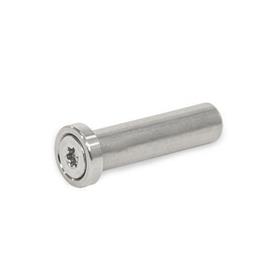
  • Stainless steel (various qualities): Many pin series come in stainless steel 1.4305 or corrosion resistant 1.4542. This makes them optimal for areas with heightened hygiene requirements, in the food industry or in corrosive environments.
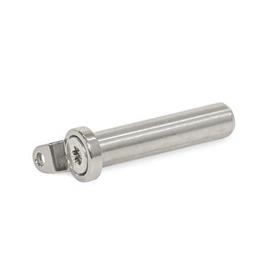
  • Titanium: The GN 113.30 ball lock pin is made of titanium. Thanks to its low weight and very good corrosion resistance, this model is ideal for use in aircraft construction or in highly demanding technical environments.
  • Handles and knobs made of aluminum or plastic: Many variants have handles and knobs made of high-quality plastic (e.g. T-handle or L-handle) or aluminum (e.g. GN 113.20). These materials ensure a pleasant feel, low weight and easy operation.

What diameters and lengths are available for locking pins with axial locks?

Diameter Standard and special sizes

  • The available diameters of the locking pins with axial locks typically range from 5 mm to 25 mm.
  • Smaller diameters such as 5, 6 or 8 mm are suitable for lightweight connections and compact assemblies.
  • Larger diameters, such as 10, 12, 16, 20 or 25 mm, are ideal when a robust and mechanically stable connection is required.

Length: Wide variety of versions - which can be flexibly combined

  • Graduated lengths are available for all locking pins with axial locks.
  • The lengths usually start from 10 mm and go in increments, i.e. 10 mm, 20 mm, 25 mm, 40 mm, 50 mm, etc., sometimes up to 150 mm, depending on the pin diameter and the product design.
  • This allows you to create both very short connections and very long, sturdy through-wires – depending on the requirements of your assembly.
How to choose the right diameter and length for locking pins with axial locks
  • Check the available grades in the respective product standard: All standard values for diameter and length are clearly shown for each model.
  • Variants with a T-handle, L-handle or different materials also offer identical or precisely fitting dimensions-which makes it easier to replace existing systems.
  • Not all lengths are available for each diameter. In the Ganter web catalog, you will find a clear mapping between diameter and length options for each product.
  • For individual requirements or special installation situations, a targeted product consultation by Ganter is recommended. We will also be happy to advise you on tailor-made special solutions.

What grip variants are available for locking pins with axial locks?

# # # Grip variants for comfortable handling

What accessories are available for locking pins with axial locks?

Ganter offers optional accessories for its locking pins with axial locks, such as retaining cables and ball chains, which allow you to secure the pins to prevent them from getting lost and determine their position. This means that the bolt always remains at hand on the application and cannot be accidentally lost. This accessory makes handling more comfortable and reduces downtimes, especially when components frequently have to be assembled and dismantled.

Accessories for locking pins with axial locks

  • Retaining cables, such as GN 111.2 and GN 111.8 or ball chains GN 111 and GN 111.5 can be attached to most ball lock pins and locking pins with axial locks.
  • The optionally available retaining cables/ball chains are typically made of stainless steel, brass or plastic.

This is how safety works in practice.

After assembly, the bolt can be securely anchored to the base body, frame or assembly with a retaining cable or ball chain. This means that no loose part will fall on or into the installation. Typical applications include quick tool changes or the temporary securing of flaps, lids and frames. In the field of machine and equipment technology, this means: You can react flexibly at any time, without the need for time-consuming spare parts procurement or search times for lost bolts.

What you should look out for

  • Select the accessories according to the respective bolt size and design (e.g. strength and length of the retaining rope).
  • It is recommended to use the original accessories offered by Ganter in order to ensure an optimal fit and reliability.
  • Information on the available accessories can be found directly in the product data of the individual models a tganternorm.com under the "Accessories".

This way, you can always use locking pins with axial locks safely and conveniently in your machines, systems or devices without them getting lost.

Is it possible to individually adapt locking pins with axial locks?

Locking pins with axial locks – in particular ball lock pins or locking pins with pawls – can be individually adapted on request. This goes for both special lengths and special designs in terms of material, shape or handle design. For example, you can get bolts that are longer or shorter.

Individual adjustments for locking pins with axial locks
  • Special lengths: Pins can be manufactured in custom lengths – ideal when space constraints or installation requirements call for it.
  • ** Special diameters** Pins in different diameters can be manufactured.
  • Adjustment of grip shape or grip color: Solutions can be implemented with different handle designs.
This is how a special production is made

Contact Ganter sales directly (+49 7723 6507 - 259) and specify your desired specifications, drawings or requirements. Ganter reviews the technical feasibility and creates a tailor-made offer. This allows you to optimally adjust your locking pins to the intended use and achieve safe, comfortable installation – ideal when standard articles are not sufficient.

Is CAD data or 3D models available for locking pins with axial locks?

For locking pins with axial locks, CAD data and 3D models are directly available for all listed Ganter products free of charge. You can find these models on the respective product detail page. There you can select the required CAD formats and download the model immediately, without registration. This allows you to plan your construction quickly and precisely and to obtain the right installation dimensions for your project.

Benefits in practice

This allows you to conveniently integrate locking pins with axial locks into your designs without error. This saves time in the design phase and reduces installation errors. This is especially helpful for projects in mechanical engineering and assembly equipment which have frequent changes or critical time pressure.

How quickly can locking pins with axial locks be delivered?

Standard versions of locking pins with axial locks are usually available in 1-2 days. Ganter keeps a wide range of these standard parts – such as ball lock pins, split pin locking pins or locking pins with different means of locking –continuously in stock at all times. So you can already expect delivery within a few days after ordering.

Coarse of action in case of increased demand or special designs

  • For special requests, large quantities or rare variants, Ganter recommends a request for the current delivery time-so you can plan your project safely.
  • The delivery times for standard designs can also be found directly in the Ganter online shop on the respective product page in real time. This allows you to react flexibly and place orders immediately.

Your contact

You are looking for a Ganter partner near you?

Ganter-Service

Our service team is available from Monday to Friday between 7:30 AM and 5:00 PM:

Request Callback