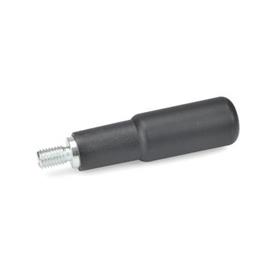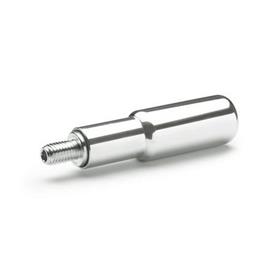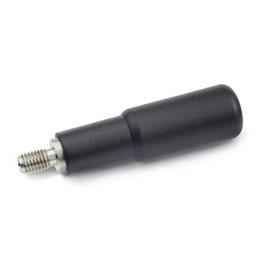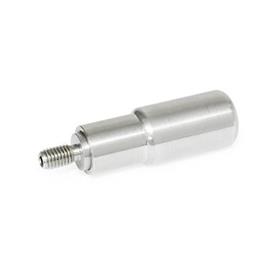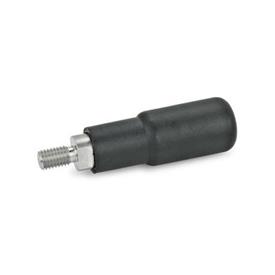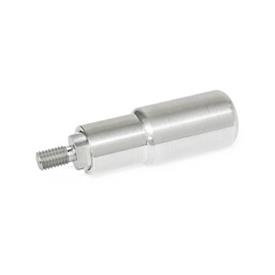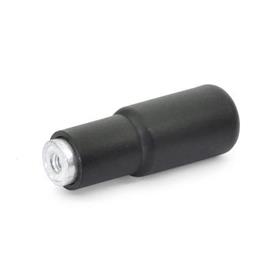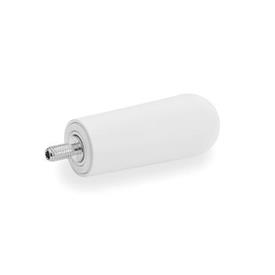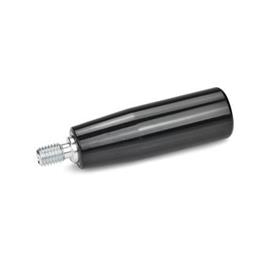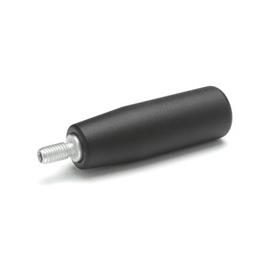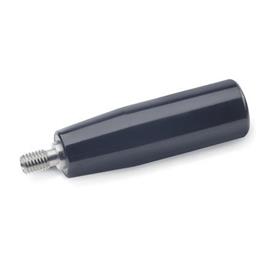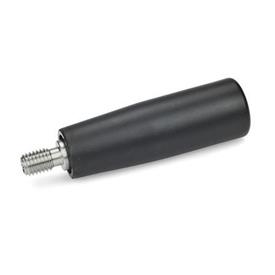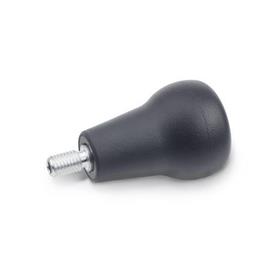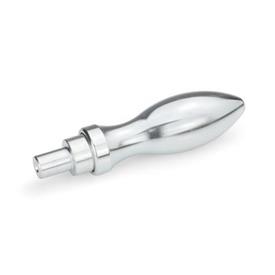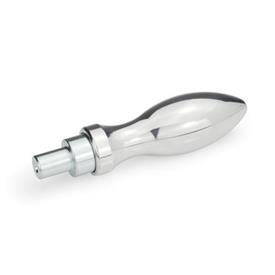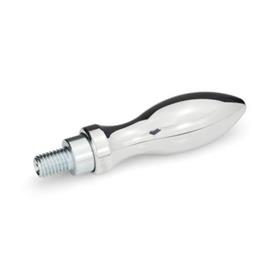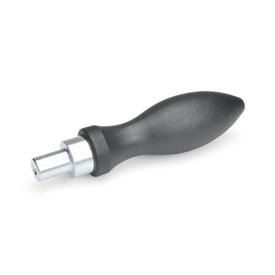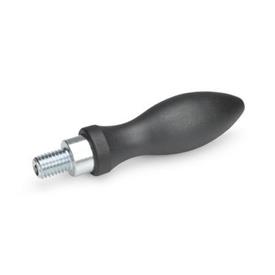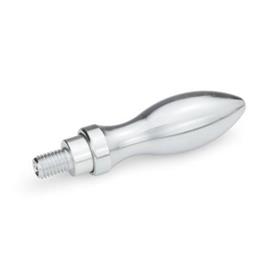
Revolving Handles

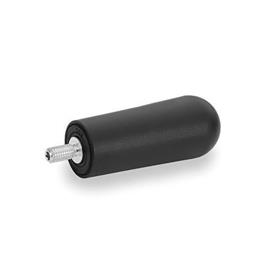
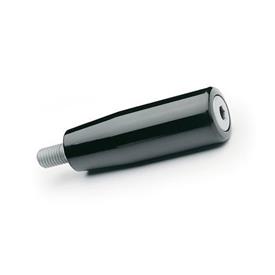
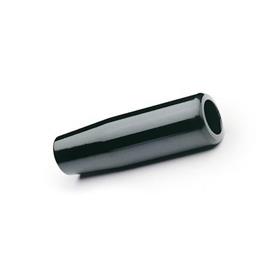
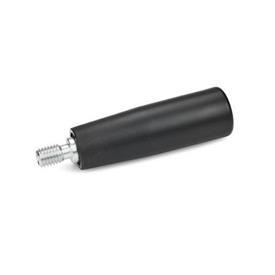
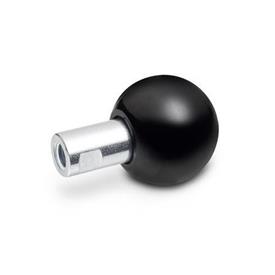
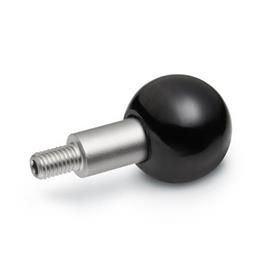
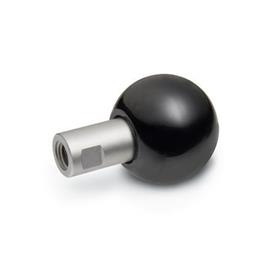
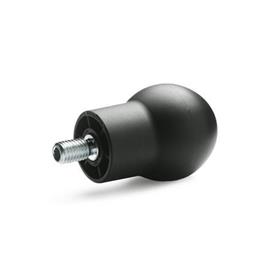
Revolving handles transfer manual force and prevent pivoting and rotary movements such as from handwheels and cranks from being transmitted to the handle element, which makes them easier to use.

FAQ - Frequently Asked Questions

Filter products
Material
Thread (from - to) Thread
Product Family

Nothing found? Special requests

FAQ - Frequently Asked Questions

Which applications are revolving handles typically used for?

Revolving handles from Ganter are primarily used in applications in which a manual rotational movement is required for configuration, adjustment or clamping of machine and plant components. Typical applications are found in machine and plant construction as well as device construction. Revolving are handles frequently used for adjusting spindles, axes or carriages, such as in setup mechanisms, guide units or workpiece mounts.

Typical application areas

  • Machine construction: For manual fine adjustment, retightening or positioning guide carriages or other moving parts.
  • Plant construction: For operating control elements, closures or clamping elements, such as on housings, covers or operating panels.
  • Automation technology: For the precise positioning of sensors, end stops, tools or transfer units for variable manufacturing tasks.
  • Laboratory and medical equipment: For measured operation or adjustment of sensitive components calling for the precise and measured application of force.
  • Packaging and food-processing systems: For frequent setup changes or adjustment of conveyor belts, format adjustment elements or guide elements, especially if the product is to be changed frequently.

Practical example

Example: On a packaging machine, the position of a guide element can be easily and reliably adjusted with a revolving handle to process different product sizes. Revolving handles from Ganter are designed for excellent ergonomics and long service life and ensure reliable performance of recurring operating actions.

What advantages do revolving handles offer compared with rigid handles?

In comparison with rigid handles, revolving handles offer a number of advantages in applications requiring frequent adjustment or clamping movements. They increase ease of use, improve ergonomics and simplify handling in a variety of situations.

Main advantages of revolving handles

  • Ergonomic operation: The handle can be moved by hand during the rotational movement. This prevents friction between the palm and the handle surface for more comfortable operation, especially during prolonged or repetitive use.
  • Reduced stress on the hand: Since the handle revolves and moves along with the hand, it puts less stress on the wrist and skin. This lowers the risk of fatigue, pressure points and blistering.
  • Better handling for frequent adjustments: A revolving handle allows for faster and more precise work than a fixed grip, especially for clamping or setup actions that must be repeated frequently.
  • Protection of the installed components: The revolving bearing optimizes the force transmission so that no unnecessary transverse forces act on the part.
  • Wide range of mounting options: Revolving handles are especially suited for applications that require rapid grip changes or flexible operating positions.

Practical example from machine construction

  • A revolving handle is frequently used on clamping mechanisms or handwheels. This allows the operator to grip the handle in the optimal way for each use and quickly bring it to the next position without changing grips.
Use of a revolving handle is recommended whenever ergonomic, effort-saving and repeated operations are required. At Ganter, you will find a variety of designs and materials to suit your individual situation.

Which designs and handle diameters are available for revolving handles?

Ganter’s range of revolving handles includes various designs that are adapted to diverse operating requirements and areas of application. The most common designs include handles with cylindrical, tapered or ergonomic shapes. Models with angled or ball-shaped handles are also available for optimal adaptation to specific installation conditions or operating concepts.

Overview of designs

  • Cylindrical revolving handles: Especially well suited for classic operating tasks such as on handwheels or cranks.
  • Ergonomically shaped revolving handles: Developed for improved handling for repeated or forceful tightening.
  • Ball-shaped or angled handles: Frequently used where space is tight or for special ergonomic requirements.
  • Models with smooth or textured surface: For adapting to the given application environment and for reliable gripping.

Handle diameters and selection criteria

Revolving handles are available in various diameters. This allows for selection of the right version based on the required force transmission, available space and ergonomic requirements. The exact selection of the handle diameter depends on the respective product type. Consult the Ganter product range to find out about the available options.

Recommendation

To find the right product, check the Ganter online shop for the desired shapes and diameters by using the filter function or directly consult the technical data sheet for the respective model. If you are unsure or have specific requirements, the Ganter service department would be happy to help you make the right choice and find a suitable design.Typical applications include use with handwheels, cranks and operating elements in machine and plant construction as well as in automation applications.

Which materials are Ganter’s revolving handles made of?

Ganter manufactures revolving handles from a variety of carefully selected materials to live up to the diverse requirements encountered in machine and plant construction and automation technology. The following material groups are typically used for revolving handles:

Typical materials for revolving handles

  • Plastics such as thermoset or thermoplastic materials, often reinforced or refined to improve surface quality and service life.
  • Metallic materials, in particular steel or stainless steel, for applications with special strength, robustness or corrosion resistance requirements.
  • In some cases, aluminum or diecast zinc are used to fulfil special requirements on weight, surface finish or feel.

Information on material selection

  • Selection of the suitable materials is based on the actual conditions of use, such as requirements for chemical resistance, hygiene, mechanical load capacity or temperature resistance.
  • Revolving handles from Ganter are available in various different versions, each of which is coordinated to the requirements of various industries and applications.
  • For specific requirements, it is recommended to check the technical data and material specifications in the respective product data sheet or to submit an inquiry via the Ganter website.

Application example:

Revolving handles of stainless steel are typically used in areas with elevated hygiene requirements, such as in food processing systems or medical technology, while revolving handles of reinforced plastic are preferred in environments that are prone to soiling and moisture.Please note that the actual suitability of a material always depends on the individual use case at hand. Ganter would be happy to assist you in selecting the right product and can provide product-specific material information on request.

Which handle can be combined with which handwheel?

Whether a revolving handle can be combined with a specific handwheel depends on the mechanical mounting features of both components. In principle, revolving handles are designed to make handwheels easier and safer to operate. Suitable combinations can be selected based on the following criteria:

Important aspects for combining handles with handwheels:

  • The handwheel must have a mount or hole intended for a revolving handle (consult the respective product description).
  • The selected revolving handle must have a mounting type (e.g. thread size, attachment with nut or screw) that corresponds to the design of the handwheel.
  • Many handwheels from Ganter, such as the series GN 322, GN 323 or DIN 950, are available with or without a revolving handle or allow can be retrofitted with one.
  • Consult the technical data and the accessories/selection section of the desired handwheel to determine whether a revolving handle is provided or recommended. The exact type designation of the matching handle is usually indicated here, e.g. GN 798, GN 798.1 or GN 599.
  • Compare the connections (e.g. M8, M10, special mounts) of both components to ensure a good fit.
  • Depending on the handwheel, a revolving handle may already be mounted or can be selected as an accessory.

Application example

  • A Ganter handwheel of the series GN 322 can – depending on the version – be equipped with a revolving handle GN 798 if the corresponding version is selected or the hole is provided. The same applies to other handwheel series with corresponding handle variants.
  • The technical drawings show which handle variants are appropriate.

Note:

Detailed information on which handle and handwheel combinations are possible can be found in the respective product data sheets. These also contain information on special aspects (e.g. with a folding handle or ball lever). In case of doubt, Ganter’s technical service can assist you in selecting the optimal combination.A compatible and ergonomic solution for your application can be guaranteed in this way.

Which mounting methods are available for revolving handles?

A variety of mounting types are available in Ganter’s selection of revolving handles. These differ depending on the design and usage requirements. Typical variants include fastening via threaded connections, through holes or molded-on studs. Certain revolving handles offer special mounting methods that allow for quick and convenient mounting. This makes it possible to flexibly handle various mounting situations or requirements in machine and plant construction.

Overview of mounting methods

  • Mounting with internal thread: Direct screwing onto the matching threaded stud or shaft end.
  • Mounting with external thread: Screwing onto an appropriately prepared hole or nut on the element in question.
  • Through hole: Mounting via a stud that is fixed with a locking nut.
  • Stud mounting: Fixed mounting to a shaft by means of a pressed-on stud or pin.
Selection recommendation:
  • Select the mounting method based on the connection geometry of your application.
  • Note the mounting environment, available space and required tightening torque.
  • For frequent mounting or if quick changes are required, a mounting method that permits easy removal is recommended.
Depending on the version, the handles are designed for various shaft diameters and mounting systems. Details on available mounting methods can be found in the respective product descriptions of the individual revolving handle types. In case of doubt, it is advisable to consult your design engineer or the Ganter service department to make the optimal choice for your application.Typical applications include operating elements on machines and equipment, switching and positioning handles or quick adjustment of fixtures.

Can revolving handles be retrofitted or replaced?

Handles from Ganter’s “Revolving Handles” product family are generally designed so that they can be retrofitted or replaced. Depending on the version, they may be fastened using threaded connections, expansion connections or similar mounting methods that enable easy removal and replacement. However, it is important to observe the mounting information and product information for the specific handle model since the design and mounting methods may differ.
  • Before the replacement, check how the current handle is mounted (e.g. thread, parallel key, plug-type connection).
  • Then remove the old handle according to the respective instructions or the standard procedure.
  • When mounting the new revolving handle, it is advisable to carefully observe the respective mounting information of the manufacturer to ensure safe and functional mounting.
  • In case of doubt, consult the technical documentation for the respective product variant or contact the Ganter service department.

Note on compatibility

The suitability for use as a replacement also depends on the compatibility with the existing mounting type and any integrated functional elements. In some applications, adaptations may be necessary, such as if the handle has a special locking mechanism or anti-rotation lock.

Practical example

Machine operators wishing to replace a worn-out revolving handle can in most cases remove the old handle and install an identical model according to the instructions. For special designs or special materials, it is advisable to consult the manufacturer in advance to ensure technical suitability and appropriate fit.

Recommendation

Before carrying out a planned retrofit or replacement, always check the mounting type of the existing handle as well as the product-specific information. Make use of Ganter’s technical service department if you are uncertain or require individual solutions.

Are there any revolving handles in non-rusting or corrosion-resistant versions?

Revolving handles from Ganter’s “Operation with Handles and Knobs” product family are available in various corrosion-resistant versions. Depending on the product type, such applications call for non-rusting stainless steels or corrosion-resistant plastics that are specially adapted to environments with an increased risk of corrosion. The material descriptions in the respective detailed product pages provide information about the material used and special features to protect against corrosion.

Recommendation for product selection

  • When making your selection, pay attention to the stainless steel icon, information on the material designation or similar descriptions in the product names or material overview.
  • For applications in damp or aggressive environments, it is recommended to search specifically for revolving handles designated as being corrosion resistant.
  • For sensitive areas, such as in food-processing or medical equipment, particularly appropriate versions are available that are designed to meet the relevant hygiene requirements.

Practical example

Revolving handles with stainless steel components are typically used in machines that must be cleaned regularly or in outdoor areas. Versions made of plastic with special additives also offer good protection against external influences.


Note: The actual corrosion resistance depends on the material, the design and the ambient conditions of the respective application. Please check whether the selected product is fully suitable for your planned use.To quickly find the right product, use the filter functions in the Ganter online catalog and select the material option stainless steel.

Can revolving handles be combined with other Ganter components?

Revolving handles from Ganter are generally designed for combination with other Ganter components. In many cases, they are used with matching threaded studs or operating levers or as part of an operating element in machines and plants. Thanks to their standardized mounting dimensions and mounting types, revolving handles can be easily combined with clamping elements, adjusting elements or machine elements from the Ganter product range.

Typical combination options

  • Use with clamping elements, such as clamping screws or threaded bushings
  • Combination with stop elements, cranks or handwheels for appropriate operating solutions
  • Integration into mechanisms or operating units by means of standardized interfaces

Recommendation for selection and integration

For an optimal connection, the interfaces (e.g. thread types and mounting diameter) of the respective components should be coordinated with each other. Before mounting, check whether the selected products are able to fulfil the technical requirements of your application – such as stability requirements, material compatibility or ergonomics. The various versions, materials and design details of the revolving handles offer suitable solutions for a wide range of uses.The actual usability and compatibility depend on the specific technical conditions of your application. In case of doubt, it is advisable to consult Ganter’s technical support or to compare the technical data sheets of the respective products.

Practical example

A revolving handle is mounted onto a clamping screw and combined with an adjusting element to create a convenient solution for quickly carrying out frequent adjustments of mechanical assemblies.Thanks to the wide range of combination options, you can realize individually customized operating solutions and improve the user-friendliness of your application.

Does Ganter offer special designs or individual customizations for revolving handles?

Ganter offers revolving handles with a wide range of options for special designs and individual customization. For example, special shapes, deviating materials, special coatings or deviating colors can be supplied on request. Adapted mounting methods or functional modifications are also possible, such as modified hole types or specific surfaces. Depending on the product family, further customer-specific adaptations can also be provided, subject to technical feasibility.

Recommendation for implementation:

  • Check in advance what requirements you have for the revolving handles – such as in relation to the installation situation, material properties or ergonomics.
  • Consult the Ganter service team ahead of time and tell them your desired specifications or alterations in as much detail as possible.
  • Ganter will assist you in selecting technical implementations and evaluating the feasibility in order to develop appropriate solutions.

Note on feasibility:

The actual implementation of a special design depends on the technical possibilities and the complexity of the desired adaptation. It is therefore advisable to discuss specific cases directly with Ganter.Typical examples in practice include the manufacturing of handles with individual company logos, special shapes for more secure gripping or special mounting solutions for machine and plant construction.For more information or to get an offer, it is best to contact Ganter’s technical sales department directly and provide the desired specifications. This way, you can find the best solution for your application.

Your contact

You are looking for a Ganter partner near you?

Ganter-Service

Our service team is available from Monday to Friday between 7:30 AM and 5:00 PM:

Request Callback