
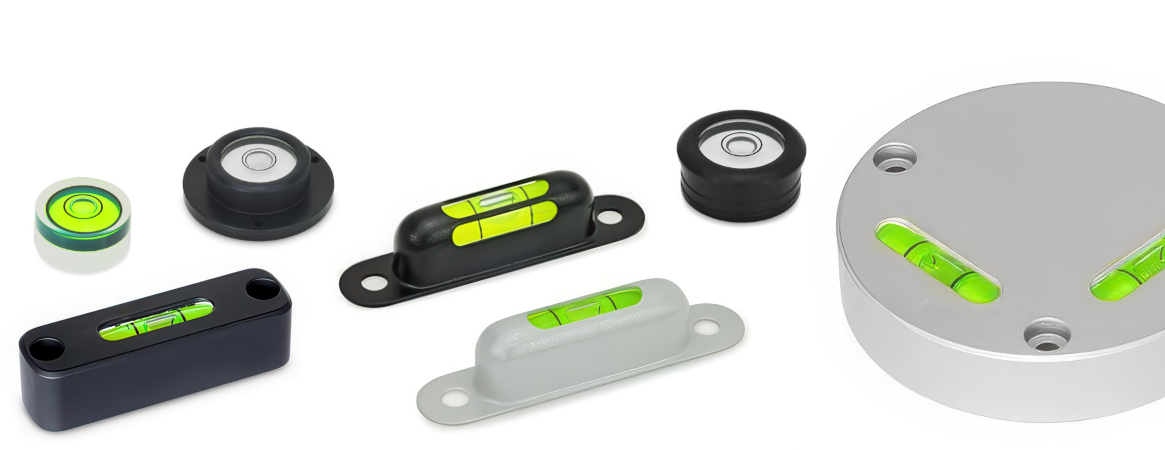
Spirit level type
Spirit levels are available as bull’s eye, linear or right-angle spirit levels.
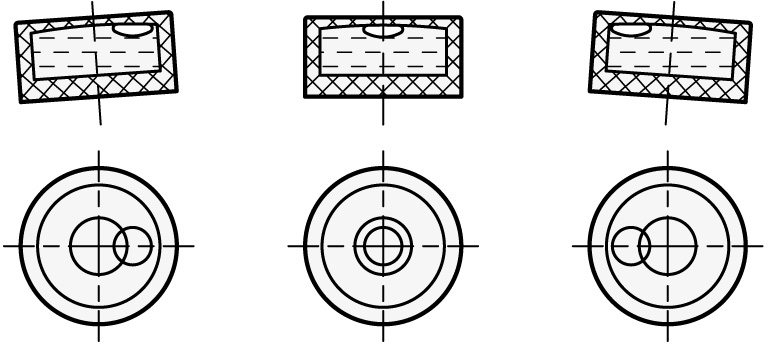
The bubble in a bull’s eye level simultaneously indicates the direction and the angle of inclination in the horizontal plane.
Linear levels only indicate the angle of inclination along the spirit level axis, with no indication of the overall inclination or its direction with respect to the horizontal plane.
Right-angle spirit levels contain two horizontal levels situated at a 90° angle to each other. This allows them to simultaneously indicate the direction and angle of inclination, with separate indication of the X and Y components.
The function
It is easy to explain how a bull’s eye level works. The hollow body containing the fluid and the gas bubble has a defined radius at its topic side, causing the gas bubble to float by its buoyancy always to the highest point.
The transparent upper section normally bears markings or a circle centered on the middle position. If the gas bubble is centered precisely inside the marking, the object to be checked (or the reference surface of the spirit level) is in the horizontal position.
Sensitivity
The sensitivity of spirit levels is given as angle of inclination, e.g. 30 angular minutes or 0.5 degrees. This is the angle of inclination by which the spirit level must be tilted to make the bubble move by 2 mm. A spirit level with a sensitivity of 6 angular minutes therefore has a higher sensitivity than a spirit level with a sensitivity of 30 angular minutes.
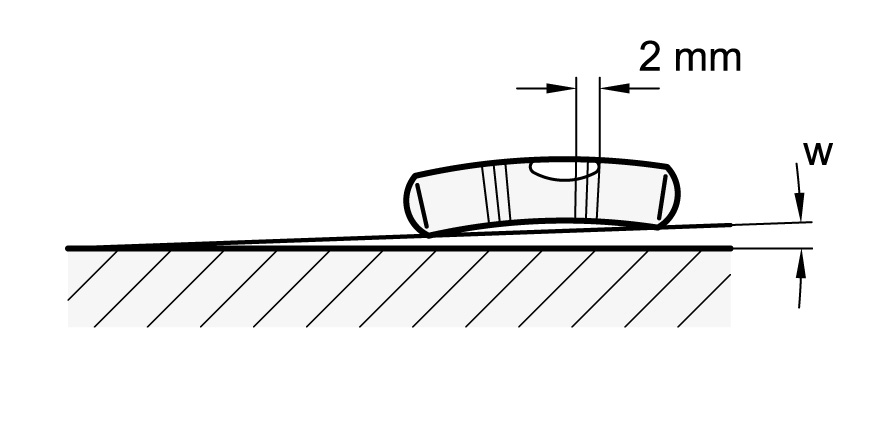
Angle of inclination and difference in altitude
Sensitivity is sometimes also given in millimeters per meter, i.e. as difference in altitude per unit of the length.
See also the reference table.
| Height difference | Angle w | Angle w |
| In millimeters per meter | In minutes | Degrees, decimal |
| 0.3 | 1 | 0.0167 |
| 0.9 | 3 | 0.0500 |
| 1.7 | 6 | 0.1000 |
| 2.9 | 10 | 0.1667 |
| 5.8 | 20 | 0.3333 |
| 8.7 | 30 | 0.5000 |
| 11.6 | 40 | 0.6667 |
| 14.5 | 50 | 0.8333 |
| 17.5 | 60 | 1.0000 |